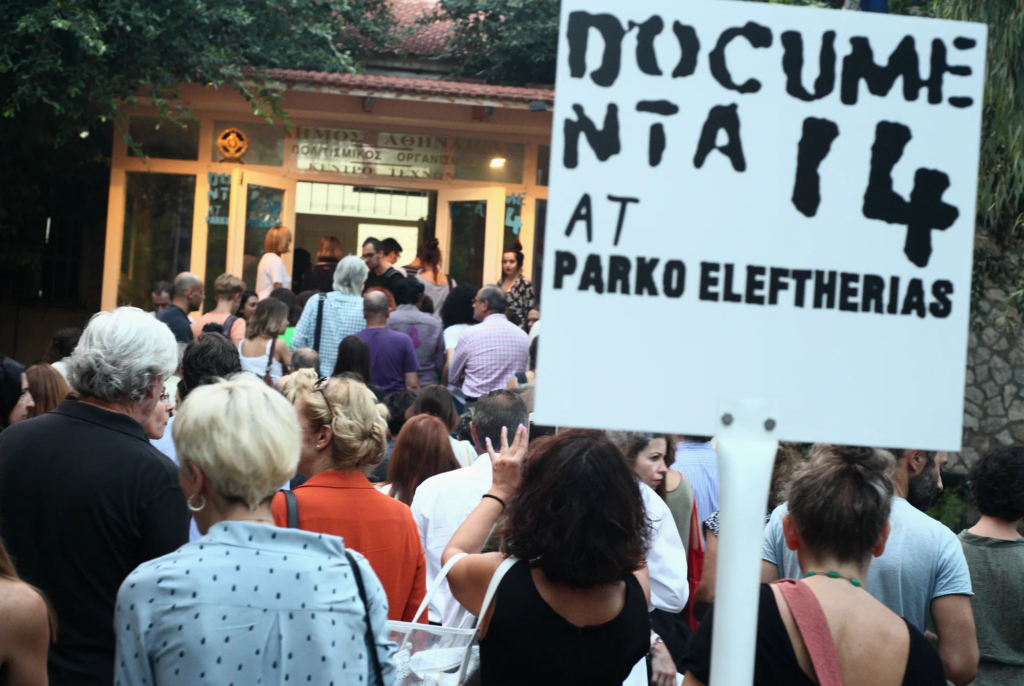
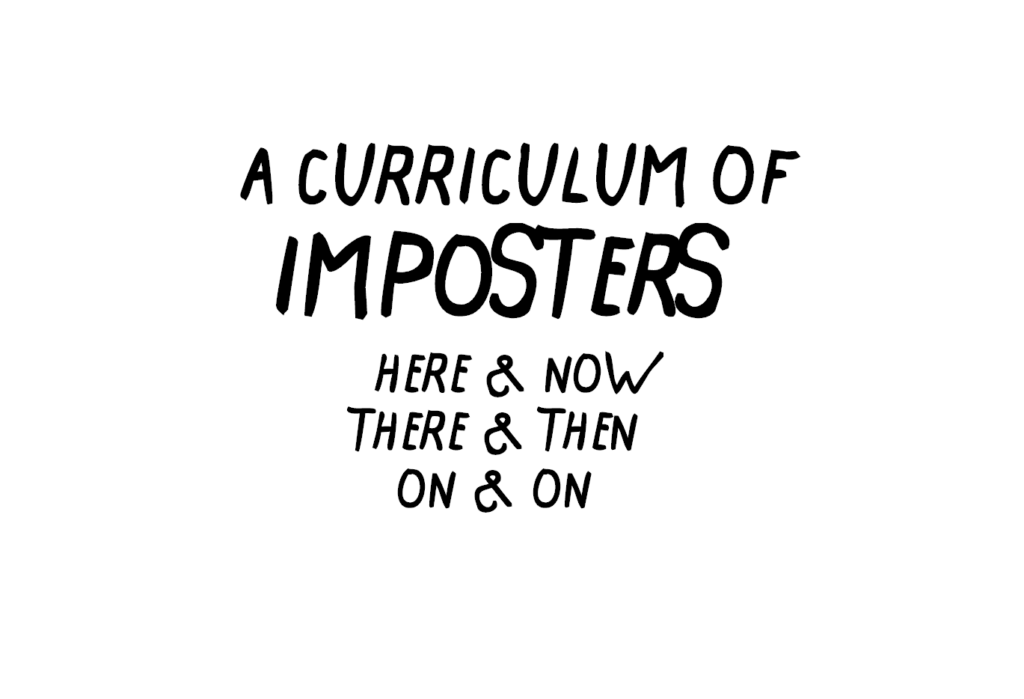
On this day 10 years ago in Parko Eleftherias (‘Freedom Park’), Athens, Greece, months before the exhibition’s opening in April 2017, the documenta 14 public program Parliament of Bodies initiated 34 Exercises of Freedom – a series of talks, conversations, artist lectures and performances. See below for the full description of the program, but I want to bring specific attention to the following part:
We have avoided conventional museological names that establish distinctions between talk and performance, theory and action, criticism and art. Instead, we invited forty-five participants to “exercise freedom” within the building, which, not long ago, served as the headquarters of the military police during the dictatorship years. We understand freedom, with Foucault, as neither an individual property nor a natural right, but rather as a practice. We drift in history. There is a space. There are some bodies. There are some voices. But what does it mean to be together, here, now? What can be done? Who and what are made visible? Whose voices can be heard and which remain silent? How can the public sphere be reorganized?
Today, 10 years later, I ask these questions afresh, from a different place and context, a different here and now, to mark the anniversary and my ongoing engagement with and expansion of documenta 14 within the fraught settler colonial context of a corporate land-grab university in central Ohio and as civil liberties and democratic processes are undermined by the lawless Trump administration.
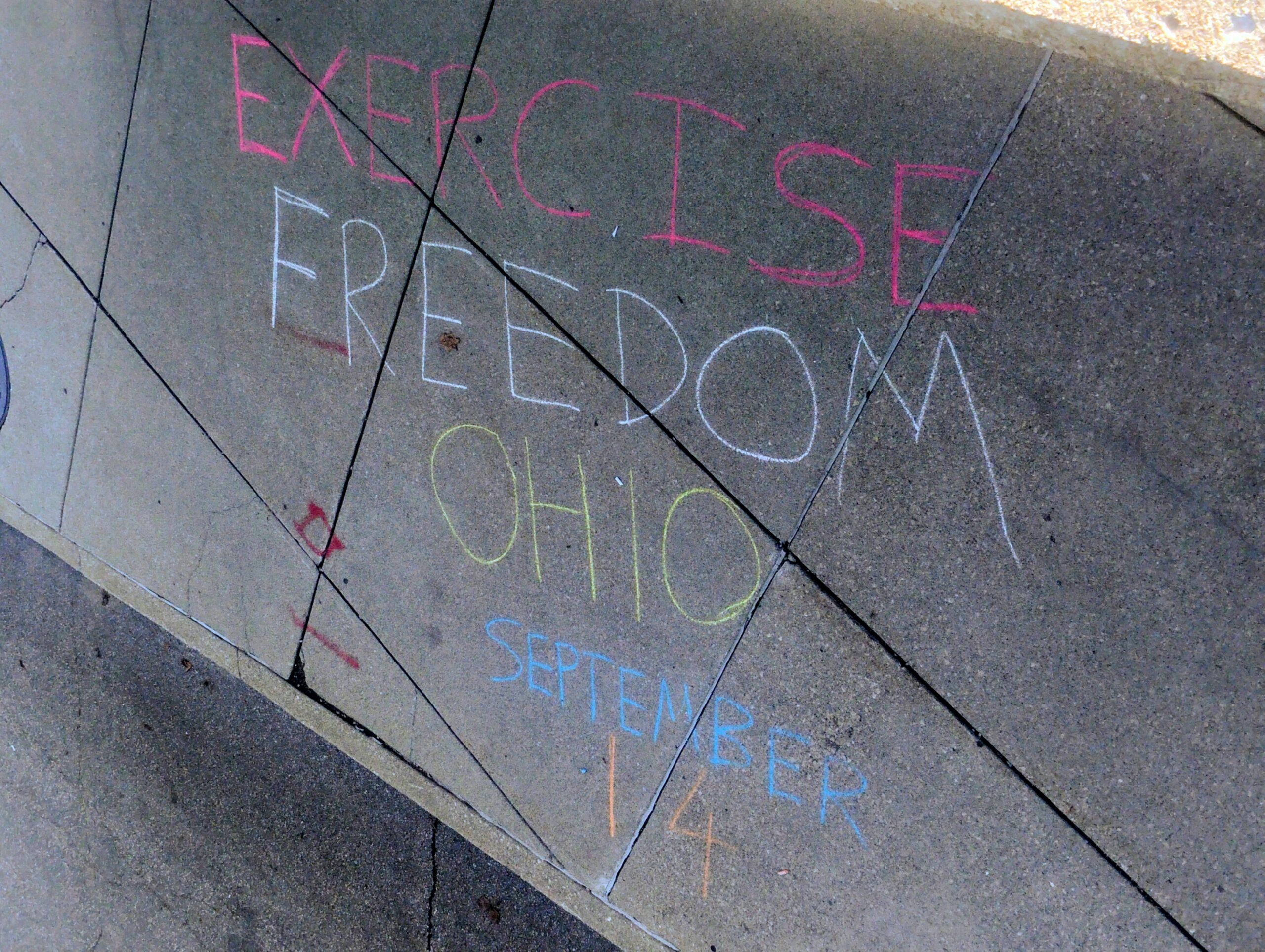

At 7:45am this morning I performed a minor ‘exercise of freedom’ on Ohio State University campus, chalking the words ‘EXERCISE FREEDOM OHIO SEPTEMBER 14’ on the sidewalk outside the Wexner Center for the Arts, facing the Oval (the green space at the heart of OSU’s campus).
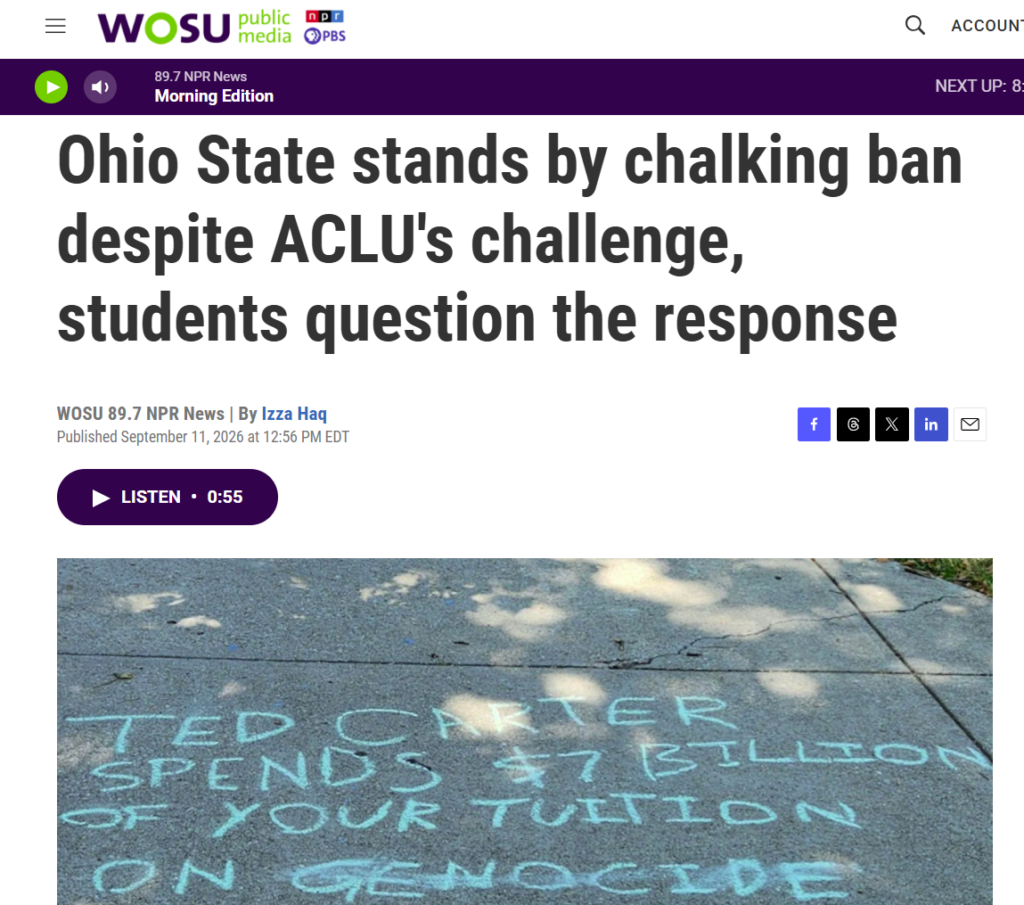
I did this to protest and bring attention to the ridiculous ban on chalking on campus sidewalks upheld by the university upper administration, in spite of legal action by ACLU calling the ban “unconstitutional”. As an OSU student stated in a recent news report on the situation:
It is a very obvious statement that they don’t want students speaking about things that they think are fair…They’d rather just shut them down.
As the ACLU argue in their report, the ban was enacted to suppress statements supporting the rights and lives of Palestinians, including targeting the university administration’s forceful suppression of peaceful protest in Spring 2024. David Carey, managing legal director of ACLU Ohio, said the organization is prepared to file a lawsuit, notes that:
It’s very disturbing that OSU chose to go this route, even though this is sort of superficially couched as a neutral policy, if the reason for putting it in place was to silence one particular viewpoint, then that is a very serious First Amendment violation.
As an OSU faculty member in the Department of Arts Administration, Education and Policy member and a board member of AAUP-OSU, I work to support everyone on campus in their rights to freedom of expression, from discussions in my classroom to the important debates within mechanisms of shared governance at the university. At the same time, my ‘exercise of freedom’ action today is also grounded in my rights to academic freedom by bringing attention to the 10 year anniversary of 34 Exercises of Freedom here and now in Ohio in 2026. I am highlighting my current research project which asks: how can public education programming from the documenta 14 exhibition – which was called ‘aneducation’ – translate to the contexts of a public university within a settler colonial context?
I invite administrators, faculty, staff, students and alumni to openly engage with me by asking ourselves and each other: what does it mean to be together, here, now? What can be done? Who and what are made visible? Whose voices can be heard and which remain silent? How can the public sphere be reorganized?
You are invited to be part of the Parliament of Bodies documenta 14 public program, hosted in the Athens Municipality Arts Center at Parko Eleftherias in September 2016. What will happen here during ten days of programming is neither a conference nor an exhibition.
We have avoided conventional museological names that establish distinctions between talk and performance, theory and action, criticism and art. Instead, we invited forty-five participants to “exercise freedom” within the building, which, not long ago, served as the headquarters of the military police during the dictatorship years. We understand freedom, with Foucault, as neither an individual property nor a natural right, but rather as a practice. We drift in history. There is a space. There are some bodies. There are some voices. But what does it mean to be together, here, now? What can be done? Who and what are made visible? Whose voices can be heard and which remain silent? How can the public sphere be reorganized?
In the Parliament of Bodies, you will find neither individual chairs within the building nor a fixed architecture. We avoid positioning the audience as aesthetic visitors or neoliberal consumers. We also reject the democratic fiction of the semicircular amphitheater. We claim—with Oskar Hansen—the political potential of the “open form.” Andreas Angelidakis’s soft architecture consisting of sixty-eight blocks of ruins (the ruins of a democratic parliament?) can be assembled and re-arranged in endless ways, creating multiple and transient architectures for the Parliament of Bodies. You are invited to actively construct this political theater every day, interrogating location, hierarchy, visibility, scale…
The 34 Exercises of Freedom aim to write a queer anticolonial symphony of Europe from the 1960s, scripting dialogue and giving visibility to dissident, heterogeneous, and minor narratives. We start by bringing together the radical left tradition with the anti-colonial fight for sovereignty of indigenous movements within Europe. The voice of Antonio Negri—one of the founders of the Potere Operaio (Workers’ Power) group in 1969 and member of Autonomia Operaia in Italy—meets the voice of Niillas Somby—the political rights activist fighting for Sámi sovereignty in the north of Norway. Both were accused of different forms of terrorism during the 1970s.
Sidestepping the established opposition of dictatorship and democracy, we try to understand the failures of transitioning to democracy within neoliberal regimes, not only in the case of Greece but also in Spain, Argentina, or Chile: how freedom was misunderstood as the free market. Whereas the 1980s are often portrayed as a time of decline for social emancipation movements, one that heralded the arrival of a new democratic consensus within capitalism—replacing ideological opposition with economic growth—anticolonial, feminist, queer, and anti-AIDS fights started to point out the cracks within western hegemonic discourse. Might it be possible to think the Greek notion of eleftheria (freedom) against the capitalist notion of freedom? Progressively during this ten-day dialogue we aim to introduce contemporary languages of resistance, from the Kurdish revolution in Rojava to the queer, transgender, sex-workers’, and migrant voices in Turkey, Greece, Mexico, or Brazil, from contemporary indigenous fights for restitution to new political and artistic practices dedicated to invent new forms of affect, knowledge, and political subjectivity, such as ecosex, queer-indigenism, and radical performativity. Together they draw a different political and poetic map of Europe than the one designed by the European Union.