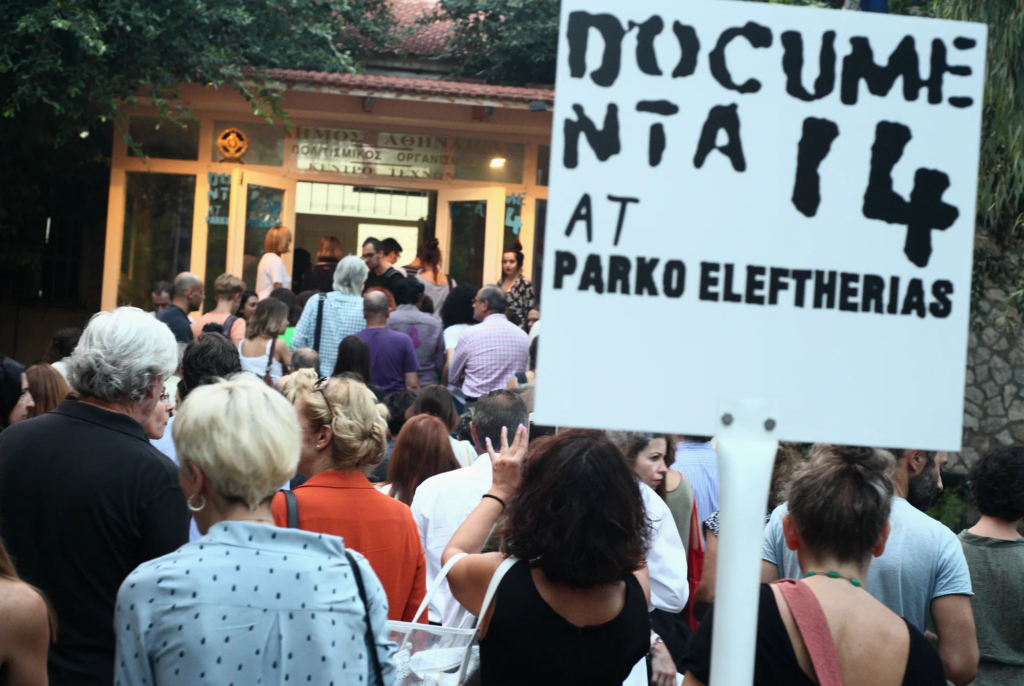
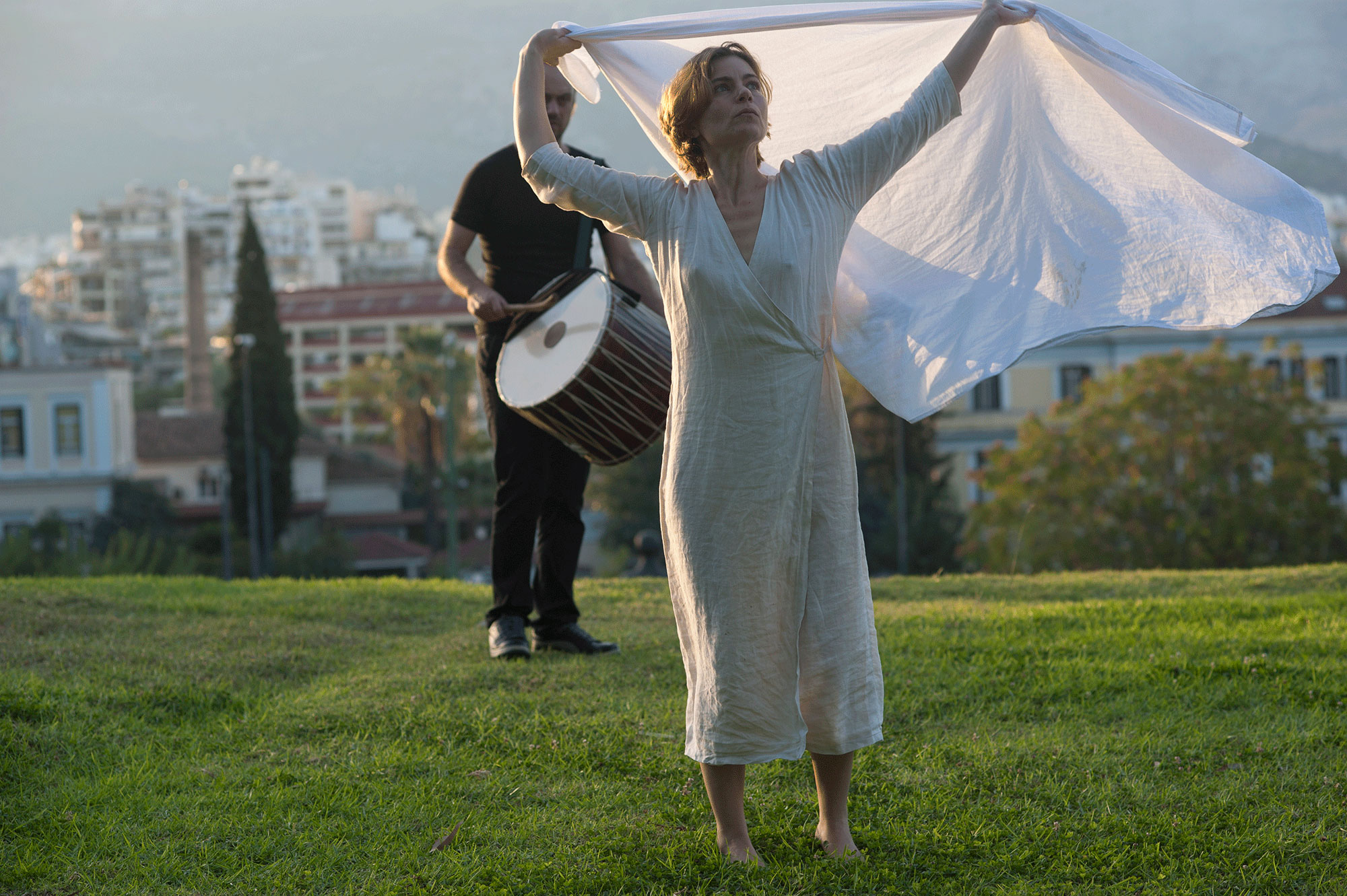
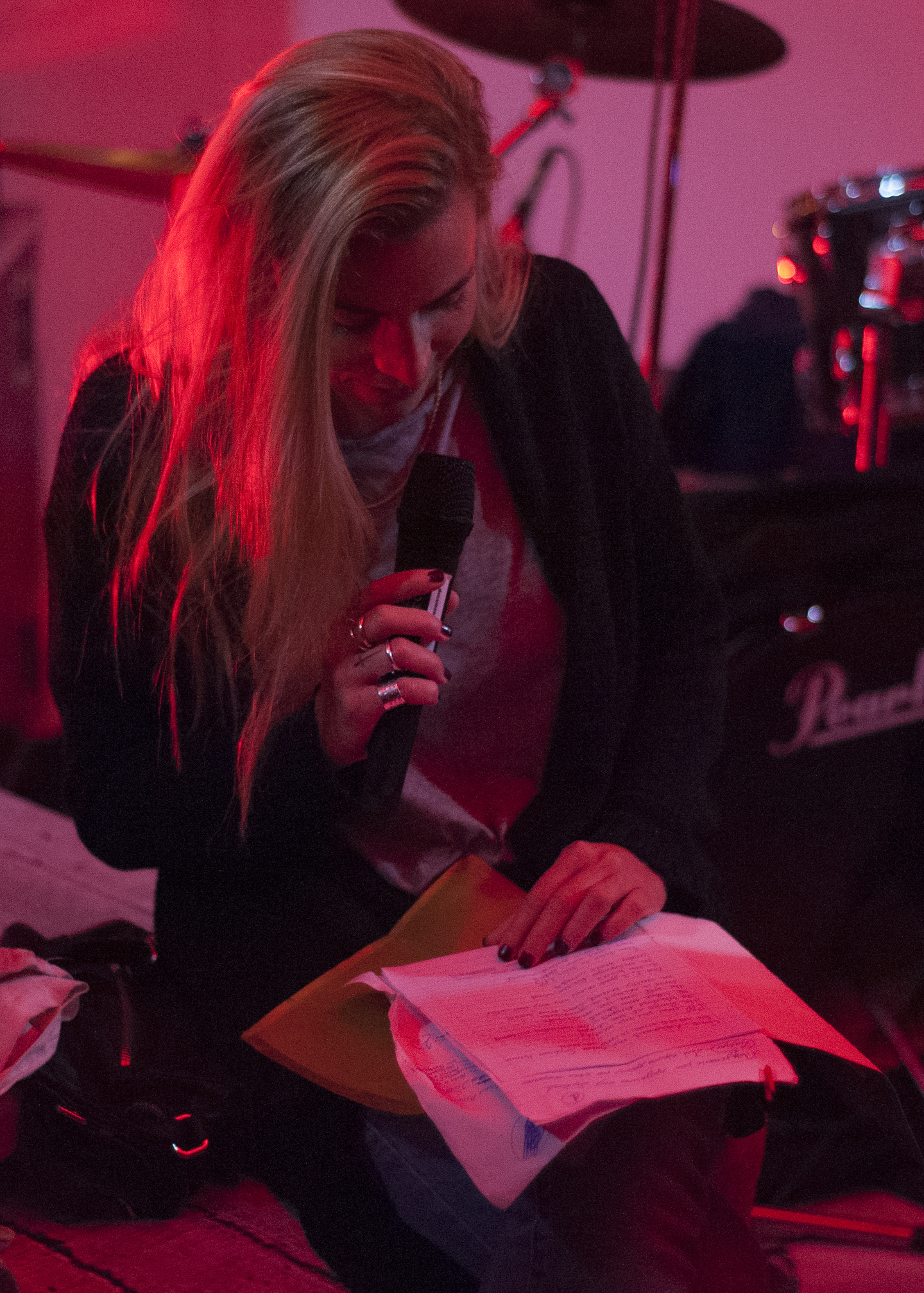
On this day, September 14, 10 years ago in Parko Eleftherias (‘Freedom Park’), Athens, Greece, months before the exhibition’s opening in April 2017, the documenta 14 public program Parliament of Bodies initiated 34 Exercises of Freedom – a series of talks, conversations, artist lectures and performances. See below for the full description of the program, but I want to bring specific attention to the following part:
We have avoided conventional museological names that establish distinctions between talk and performance, theory and action, criticism and art. Instead, we invited forty-five participants to “exercise freedom” within the building, which, not long ago, served as the headquarters of the military police during the dictatorship years. We understand freedom, with Foucault, as neither an individual property nor a natural right, but rather as a practice. We drift in history. There is a space. There are some bodies. There are some voices. But what does it mean to be together, here, now? What can be done? Who and what are made visible? Whose voices can be heard and which remain silent? How can the public sphere be reorganized?
Today, 10 years later, I ask these questions afresh, from a different place and context, a different here and now, to mark the anniversary and my ongoing engagement with and expansion of documenta 14 within the fraught settler colonial context of a corporate land-grab university in central Ohio and as civil liberties and democratic processes are undermined by the lawless Trump administration.
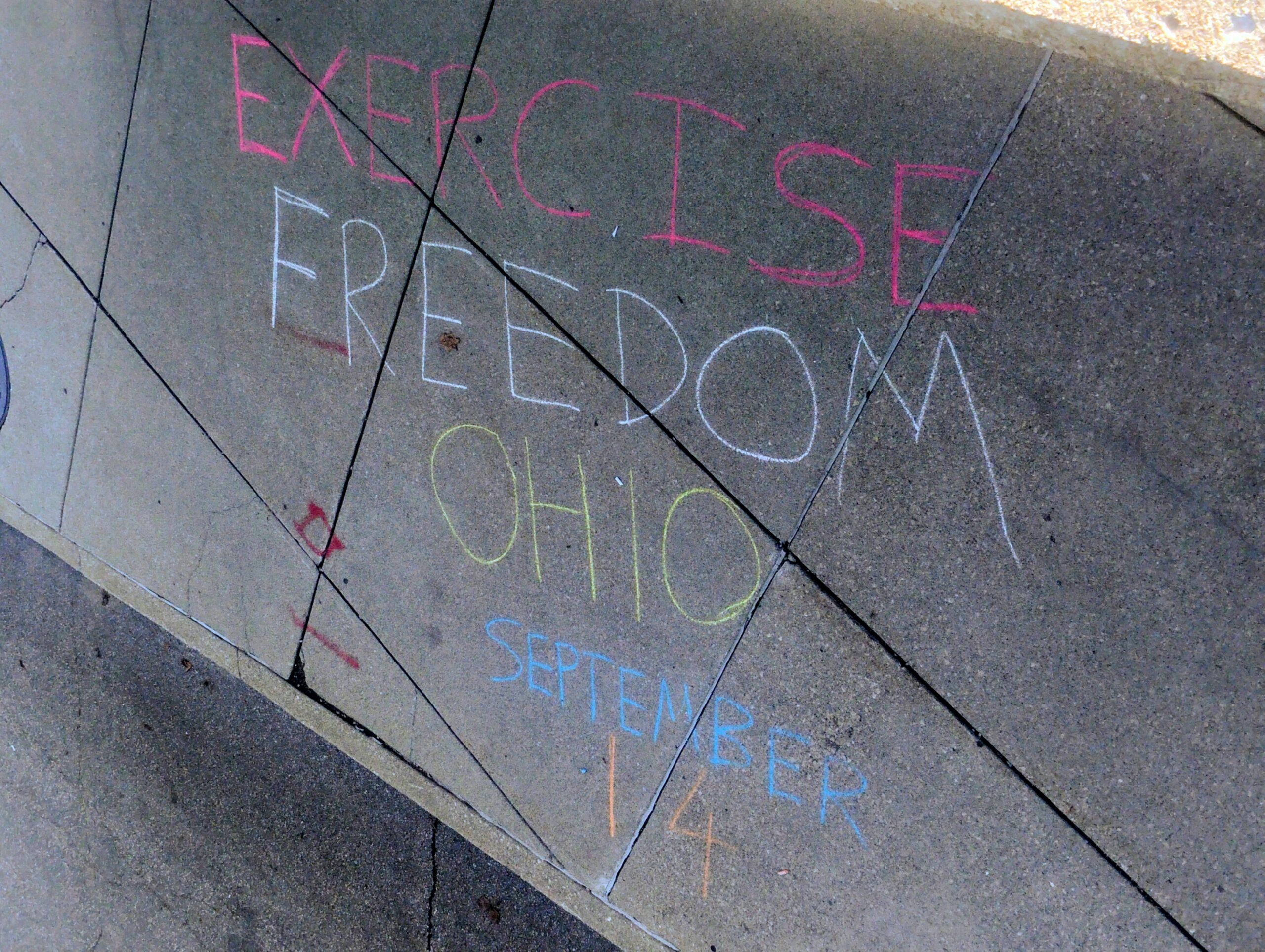
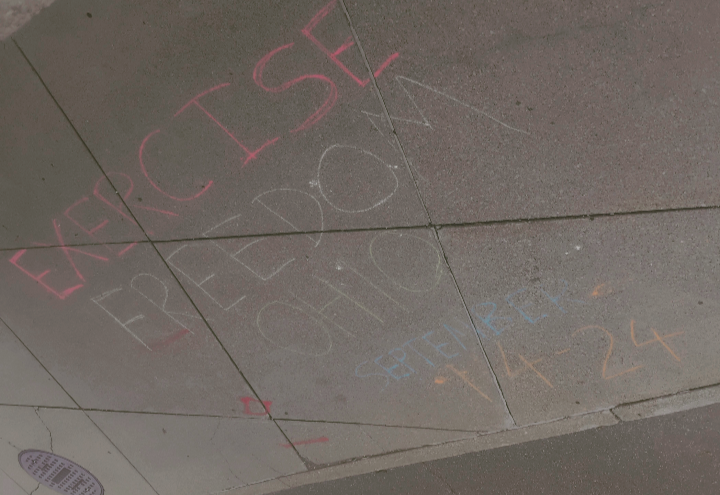
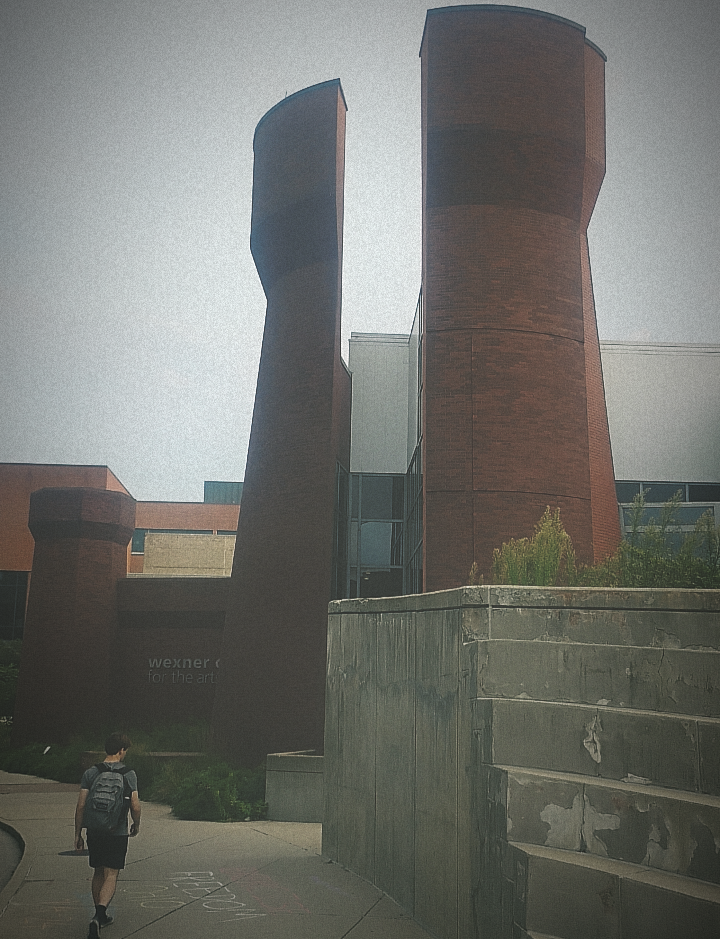
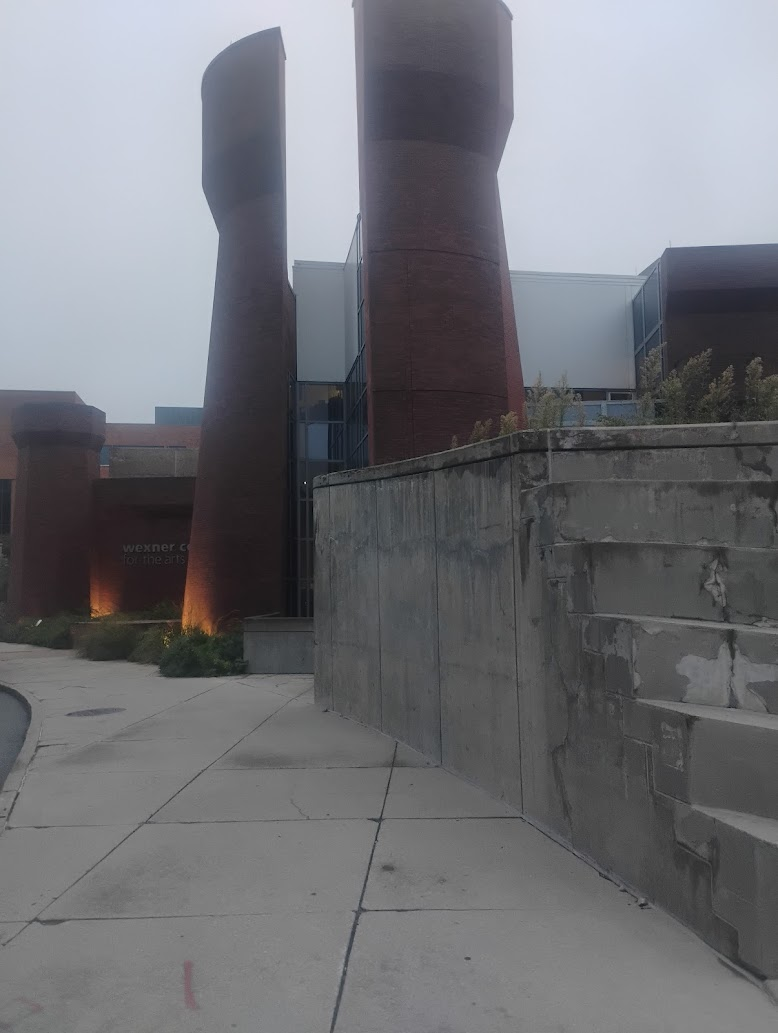
At 7:45am this morning I performed a minor ‘exercise of freedom’ on Ohio State University campus, chalking the words ‘EXERCISE FREEDOM OHIO SEPTEMBER 14’ on the sidewalk outside the Wexner Center for the Arts, facing the Oval (the green space at the heart of OSU’s campus).
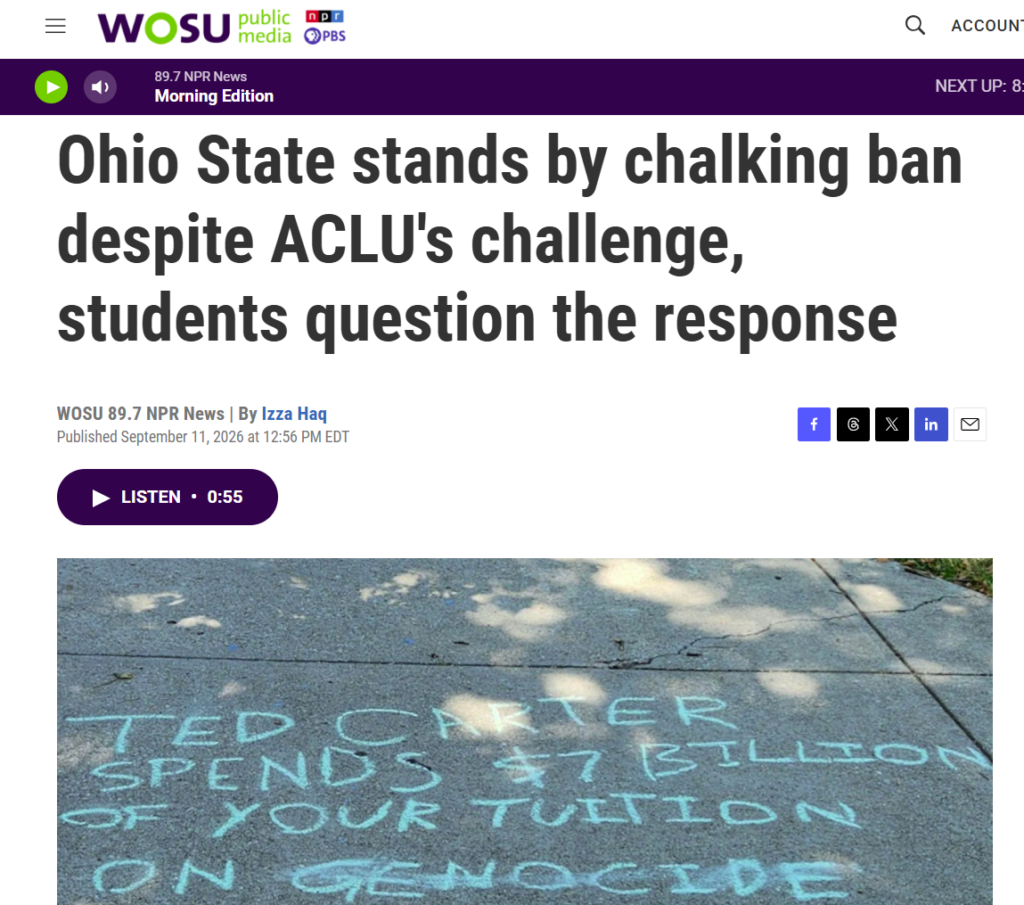
I did this to protest and bring attention to the ridiculous ban on chalking on campus sidewalks upheld by the university upper administration, in spite of legal action by ACLU calling the ban “unconstitutional”. As an OSU student stated in a recent news report on the situation:
It is a very obvious statement that they don’t want students speaking about things that they think are fair…They’d rather just shut them down.
As the ACLU argue in their report, the ban was enacted to suppress statements supporting the rights and lives of Palestinians, including targeting the university administration’s forceful suppression of peaceful protest in Spring 2024. David Carey, managing legal director of ACLU Ohio, said the organization is prepared to file a lawsuit, notes that:
It’s very disturbing that OSU chose to go this route, even though this is sort of superficially couched as a neutral policy, if the reason for putting it in place was to silence one particular viewpoint, then that is a very serious First Amendment violation.
As an OSU faculty member in the Department of Arts Administration, Education and Policy member and a board member of AAUP-OSU, I work to support everyone on campus in their rights to freedom of expression, from discussions in my classroom to the important debates within mechanisms of shared governance at the university. At the same time, my ‘exercise of freedom’ action today is also grounded in my rights to academic freedom by bringing attention to the 10 year anniversary of 34 Exercises of Freedom here and now in Ohio in 2026. I am highlighting my current research project which asks: how can public education programming from the documenta 14 exhibition – which was called ‘aneducation’ – translate to the contexts of a public university within a settler colonial context?
I invite administrators, faculty, staff, students and alumni to openly engage with me by asking ourselves and each other: what does it mean to be together, here, now? What can be done? Who and what are made visible? Whose voices can be heard and which remain silent? How can the public sphere be reorganized?
34 EXERCISES OF FREEDOM
September 14–24, 2016 at Parko Eleftherias, Athens Municipality Arts Center
You are invited to be part of the Parliament of Bodies documenta 14 public program, hosted in the Athens Municipality Arts Center at Parko Eleftherias in September 2016. What will happen here during ten days of programming is neither a conference nor an exhibition.
We have avoided conventional museological names that establish distinctions between talk and performance, theory and action, criticism and art. Instead, we invited forty-five participants to “exercise freedom” within the building, which, not long ago, served as the headquarters of the military police during the dictatorship years. We understand freedom, with Foucault, as neither an individual property nor a natural right, but rather as a practice. We drift in history. There is a space. There are some bodies. There are some voices. But what does it mean to be together, here, now? What can be done? Who and what are made visible? Whose voices can be heard and which remain silent? How can the public sphere be reorganized?
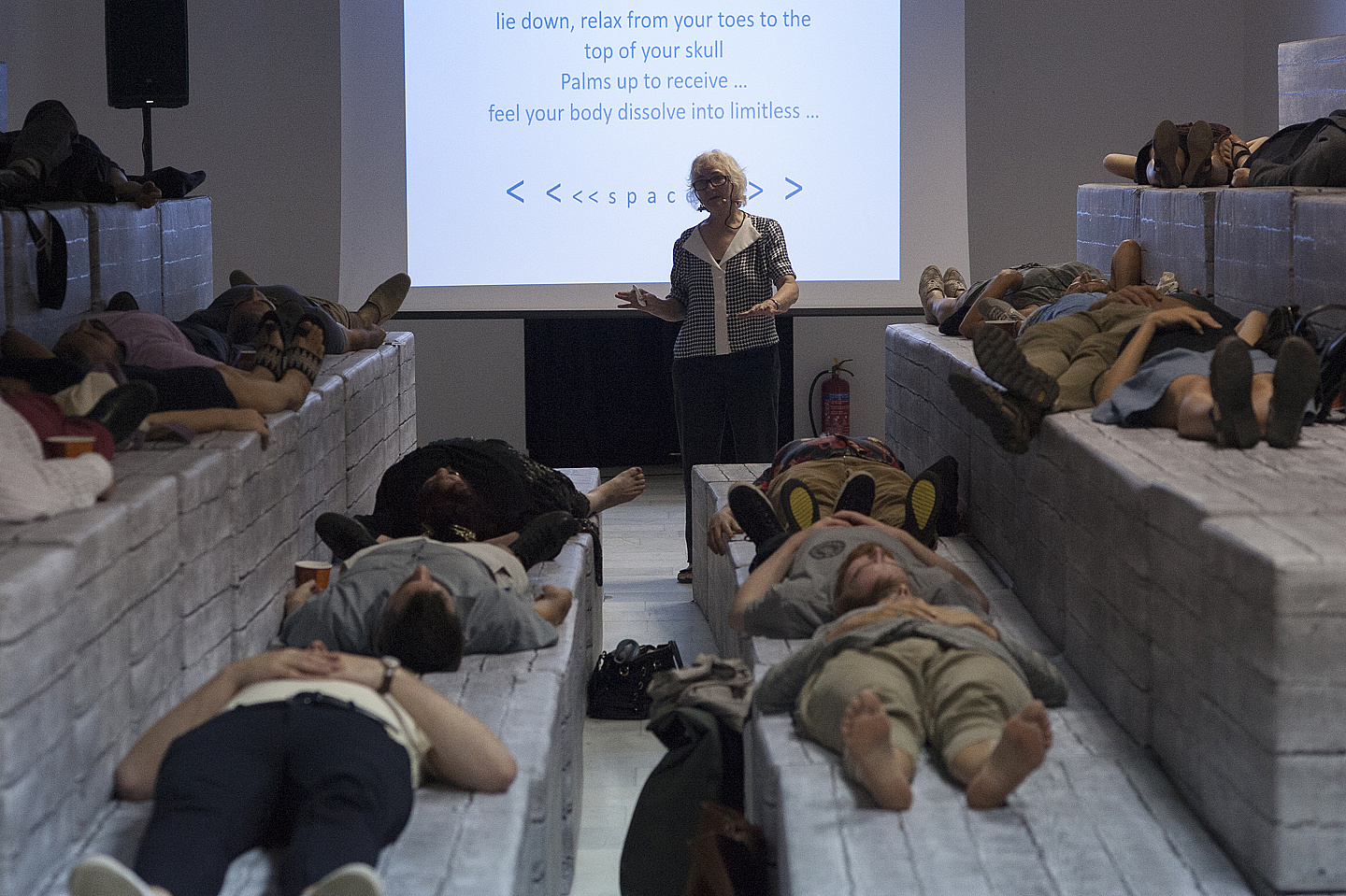
In the Parliament of Bodies, you will find neither individual chairs within the building nor a fixed architecture. We avoid positioning the audience as aesthetic visitors or neoliberal consumers. We also reject the democratic fiction of the semicircular amphitheater. We claim—with Oskar Hansen—the political potential of the “open form.” Andreas Angelidakis’s soft architecture consisting of sixty-eight blocks of ruins (the ruins of a democratic parliament?) can be assembled and re-arranged in endless ways, creating multiple and transient architectures for the Parliament of Bodies. You are invited to actively construct this political theater every day, interrogating location, hierarchy, visibility, scale…
The 34 Exercises of Freedom aim to write a queer anticolonial symphony of Europe from the 1960s, scripting dialogue and giving visibility to dissident, heterogeneous, and minor narratives. We start by bringing together the radical left tradition with the anti-colonial fight for sovereignty of indigenous movements within Europe. The voice of Antonio Negri—one of the founders of the Potere Operaio (Workers’ Power) group in 1969 and member of Autonomia Operaia in Italy—meets the voice of Niillas Somby—the political rights activist fighting for Sámi sovereignty in the north of Norway. Both were accused of different forms of terrorism during the 1970s.
Sidestepping the established opposition of dictatorship and democracy, we try to understand the failures of transitioning to democracy within neoliberal regimes, not only in the case of Greece but also in Spain, Argentina, or Chile: how freedom was misunderstood as the free market. Whereas the 1980s are often portrayed as a time of decline for social emancipation movements, one that heralded the arrival of a new democratic consensus within capitalism—replacing ideological opposition with economic growth—anticolonial, feminist, queer, and anti-AIDS fights started to point out the cracks within western hegemonic discourse. Might it be possible to think the Greek notion of eleftheria (freedom) against the capitalist notion of freedom? Progressively during this ten-day dialogue we aim to introduce contemporary languages of resistance, from the Kurdish revolution in Rojava to the queer, transgender, sex-workers’, and migrant voices in Turkey, Greece, Mexico, or Brazil, from contemporary indigenous fights for restitution to new political and artistic practices dedicated to invent new forms of affect, knowledge, and political subjectivity, such as ecosex, queer-indigenism, and radical performativity. Together they draw a different political and poetic map of Europe than the one designed by the European Union.
Wednesday September 14 (7–11 pm)
Introduction by
Adam Szymczyk, artistic director, documenta 14 Paul B. Preciado, curator of Public Programs, documenta 14 Andreas Angelidakis, architect/artist
DEMOCRACY IS NOT FREEDOM. FREEDOM IS A PRACTICE
Exercises:
#1. Linnea Dick, writer, painter, and ceremonialist of Kawakwaka’wakw, Nisga’a and Tsimshian heritage
#2. Antonio Negri, political theorist and philosopher
#3. Niillas Somby, Sámi political rights activist, journalist, videographer, and photographer
#4. Educación cívica / Civic Education Sergio Zevallos, artist
Mimicking bodybuilding training sessions, Educación cívica / Civic Education attempts to “train” social coexistence between bodies. We are all civilians: Even the soldier maintains a civil identity, if only in his or her sleep. Conversely, even as civilians we all become soldiers. We become soldiers while we work, as part of a war economy.
Zevallos’s performance improvises a game of fighting and reconciling gestures, in an attempt to move back and forth between inhabiting a body with a single identity and a manifold body, a hybrid of several identities and contradictory behaviors. The performance is based on a previous work called Clase Media (Middle Class) by LOT Theatre, Carlos Cueva, Carlos Javier Vega, and Sergio Zevallos, 2005.
Update – September 15, 2026
Since the chalking was still there this morning (Tuesday September 15, 7:48am), I added the original dates of the 34 Exercises of Freedom program – September 14-24. I am also adding the details and some videos of the original program – day by day – which are no longer available on the documenta 14 website.
Thursday September 15 (7–11 pm)
DEMOCRATIC TRANSITIONS… INTO NEOLIBERALISM
Exercises:
#5. Freedom as Market Value. Freedom as Practice of Resistance Judith Revel, philosophy professor, Université Paris Ouest Nanterre La Défense and member of the scientific committee of the Centre Michel Foucault.
What does it mean to be free when the market exceedingly places the demand on individuals to be free, creative, autonomous, and striving? What is the difference between what Foucault, since the end of the 1970s, coined as “homo economicus” and the ensemble of practices of freedom upon which we can perhaps attempt to project something like an act of resistance?
#6. Memory under Construction: Towards a Public Memory of Torture in Greece Kostis Kornetis, UC3M CONEX-Marie Curie Fellow at the Department of History, Carlos III University, Madrid
After Argentina’s economic collapse in 2001, a discourse around body politics became strongly engaged in not only tackling but also actively working through the country’s painful dictatorial past. A project called Memory under Construction brought the taboo issue of torture within the notorious secret detention center at the Éscuela de Mécanica de la Armada (ESMA) into the public space, turning the building into a museum and offering educational tours through the torture chambers. In Greece, as well as Spain and Portugal, the recent great economic recessions have led to a gradual re-examination of post-authoritarian structures and processes—a second wave of historical inquiry. These changing socioeconomic models and political paradigms dictate a re-evaluation of social transitions and prompt questions regarding the quality of democracy itself. Furthermore, social movements from below often act as carriers of memory of a painful past. Kornetis’s comparative lecture focuses on the ways in which a violent past is treated in the case of present-day Greece, focusing on the particular ways in which the private history of torture and suffering turns into public knowledge.
#7. Your Neighbor’s Son: The Making of a Torturer, Jørgen Flindt Pedersen and Erik Stephensen, Denmark, 1981, 52 min Film screening
#8. This is not the Place. Four Visits to Villa Grimaldi: A Chilean Center for Torture and Detention Diana Taylor, professor of Performance Studies and Spanish at New York University
Over the past ten years, Taylor has visited Chile’s notorious Villa Grimaldi with survivors of torture as well as alone, using an audio tour. What does it mean to be in a place of torture and disappearance? To accompany the survivors? To incorporate and translate their words? What are the survivors doing there? What was Taylor doing there? Is this an example of death tourism or does the camp perform a vital strategy against forgetting? This talk uses visual and audio material to recall her four visits to Villa Grimaldi.
#9. Between Terror and Revelry. Collective Strategies of Resistance during Dictatorships in Argentina and Brazil Ana Longoni, writer, curator, and professor of Art History, Universidad de Buenos Aires
Both the Brazilian (1964–85) and the Argentine (1976–83) dictatorships were part of the Operación Condor, an illegal repression plan coordinated by different governments of Latin America, conceived with the aim of carrying out a policy of state terrorism that implied the systematic murder of politicians, workers, students, intellectuals, and artists that opposed the regimes. The methodology employed resulted in the “disappearance” of tens of thousands of people, and involved kidnapping, torture, killing, and other crimes. While the “concentrationary terror” (Pilar Calveiro) flooding out of the detention camps into the public space was clearly paralyzing, it was not absolute. There were also always fissures and alternatives, spaces of resistance, disorder and confrontation, camouflage and reinvention strategies for political action, and new ways of conceiving the body. Between Terror and Revelry speaks of the coexistence or even confluence of different modes of resistance—the denunciations of repression in the public space through the creative actions of human rights movements, but also another mode, which Roberto Jacoby characterizes as a “strategy of joy”: the exultation of being alive, of enjoying our bodies, and of transforming them by disobeying disciplinary norms.
#10. DJ set Lies Van Born, DJ
Update – September 16, 2026
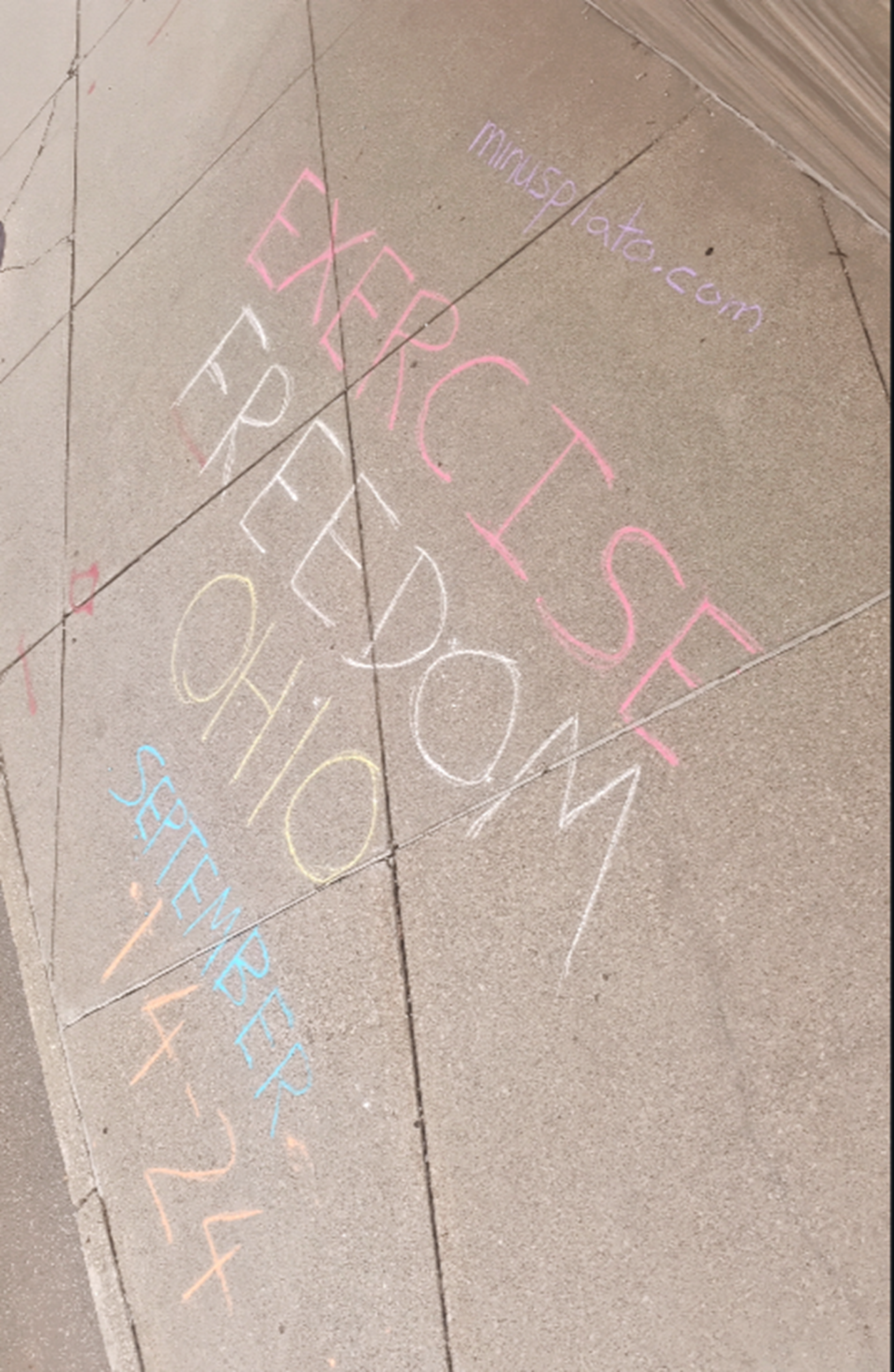
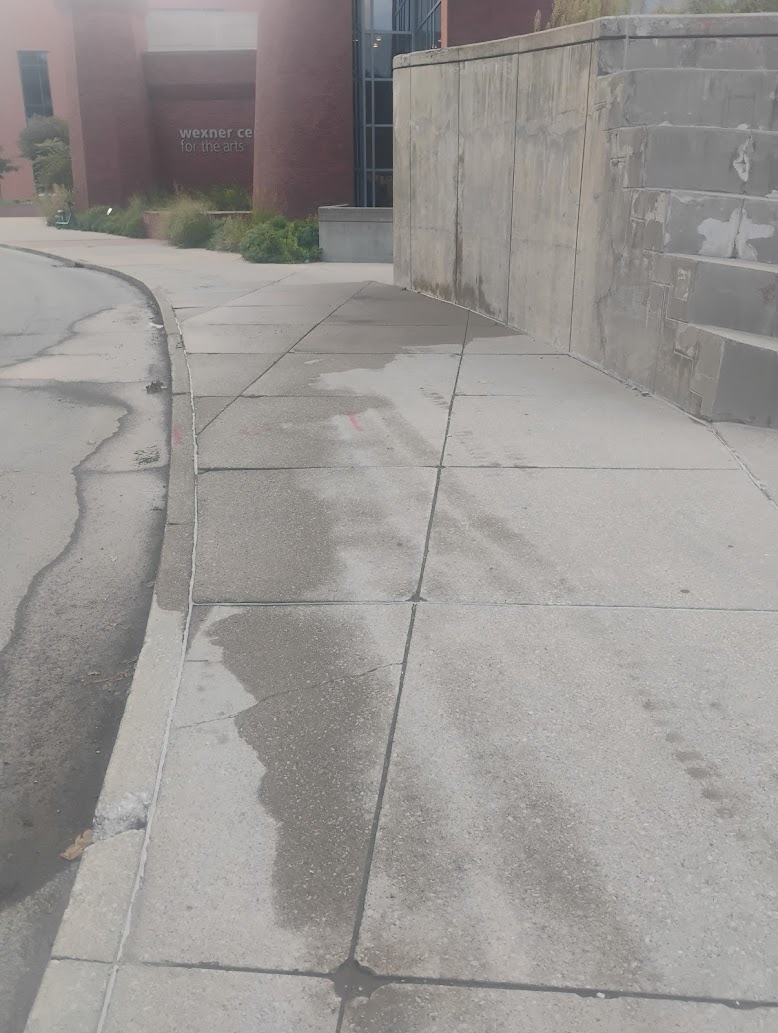
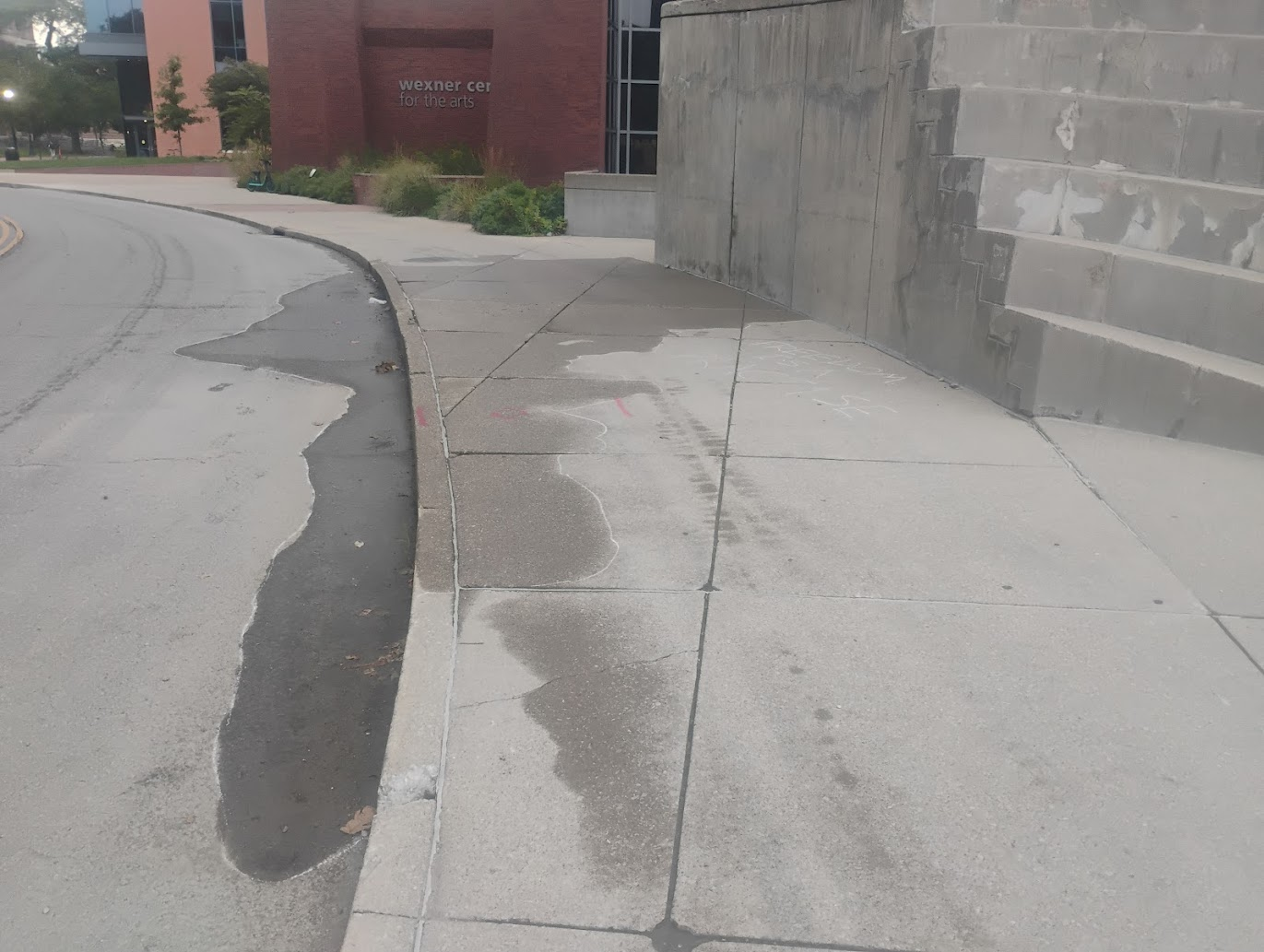
Rain is forecast for later this morning, so I went over to visit the chalking at 7:42am. It has held up pretty well these past two days and hasn’t been removed, so I felt like it deserved a final touch up and minor addition before nature took its course and washed it away. I used up most of my remaining chalk – I still have some white chalk left – to go back over all the words – EXERCISE in pink, FREEDOM in white, OHIO in yellow, SEPTEMBER in blue and 14-24 in orange:

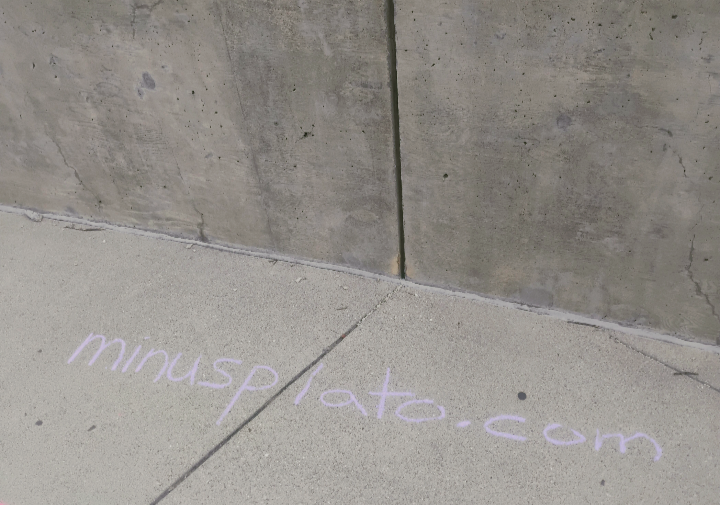
Also, to make sure there was a way to connect with what I’m writing here, I added this website address – minusplato.com. (Please do comment on this post if you saw the chalking in person!):
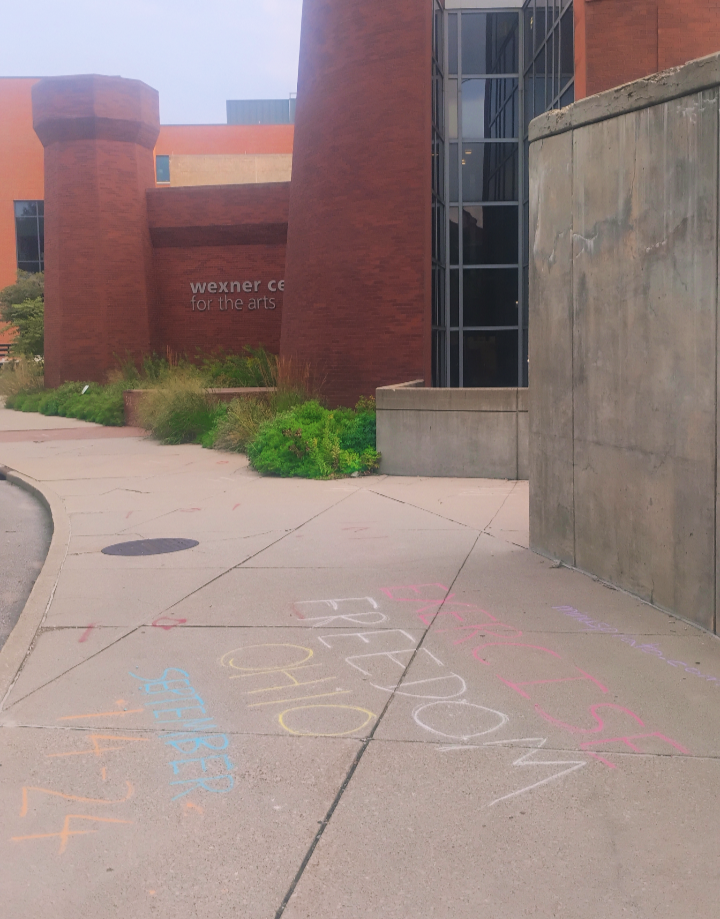
Finally I took a couple of photos to give a better idea of where the chalking is (on the paving outside the Wexner Center for the Arts, my favorite place on campus, but also one that has been through turmoil in the last few years due to mismanagement, threats to the demolition of its wonderful Film/Video Theater and ongoing protest against its name and Les Wexner’s extensive ties to Jeffery Epstein):
And also a photo of an OSU student walking past to give a sense of scale (I like how you can make out both the words ‘Wexner’ and ‘Freedom’ in this photograph and how there is a tension between these words – how can there be freedom in the public space of a campus of a public university when students are banned from chalking yet the name of a major bankroller of a convicted abuser is permanently installed?:
As I mentioned in the original post, this minor action is an invitation to dialogue, about the chalking ban, the connections between freedom of speech and expression and academic freedom, and also a way to continue the debates from 10 years ago during 34 Exercises of Freedom, the documenta 14 public program Parliament of Bodies held at Parko Eleftherias (‘Freedom Park’), Athens, Greece. Here is what happened on Friday September 16, 2016:
Friday September 16 (5:45–11 pm)
Εxercises:
#11. Torture and Freedom Tour of Athens (5:45–8:45 pm)
Collective walk through the city of Athens, in collaboration with ASKI archives, exploring the historical traces of oppression, violence, and the quest for freedom during the military dictatorship of 1967–74.
Tour in Greek Starting point: 5:45 pm at Polytechnion by the Tositsa Street entrance Ending point: Parko Eleftherias
The Greek tour is conducted by Vangelis Karamanolakis (historian, University of Athens) and Tasos Sakellaropoulos (historian, head of the Historical Archives, Benaki Museum, Athens)
Tour in English Starting point: 6:15 pm at Polytechnion by the Tositsa Street entrance Ending point: Parko Eleftherias
The English tour is conducted by Kostis Karpozilos (historian, director of the Contemporary Social History Archives–ASKI, Athens) and Katerina Labrinou (historian, Panteion University, Athens)
In collaboration with the Contemporary Social History Archives–ASKI, Athens.
Meanwhile at the Athens Municipality Art Center, Parko Eleftherias:
#12. The Chronicle of the Dictatorship (1967–74), Pantelis Voulgaris, Greece, 37 min Film screening
Εpitaph for Democracy (9:30–11 pm)
#13. Epitafios II Angela Brouskou – Theatro Domatiou, theater group and MiniMaximum ImproVision, improvisational group of musicians
Epitafios II is a collaboration between professional actors, musicians, students, performers, and the audience. A blanket of human bodies and objects covers the floor of the former headquarters of the Greek military police EAT/ESA. At a time when the world is plunged into economic, political, and social desolation, the performance formulates an ode, a musical installation, that is in dialogue with Pericles’s Funeral Oration from Thucydides’s History of the Peloponnesian War—read by an honorable citizen of contemporary Athens—with excerpts from Cornelius Castoriadis’s text The Problem of Democracy Today (1990).
Epitafios II is open to anyone who wants to participate for personal or shared reasons. The questions being raised deal with the concept of public grief and its expression, death, the end of sexual and family relationships, everyday crime, political and socio-political turbulence, violent displacement and existential dead ends, or simply time’s passing with no return. We are expecting the visitors to express and confess—together and separately—unthinkable public or private losses. The first version of Epitafios was presented at Kunsthalle Athena in 2012.
Update – September 17, 2026
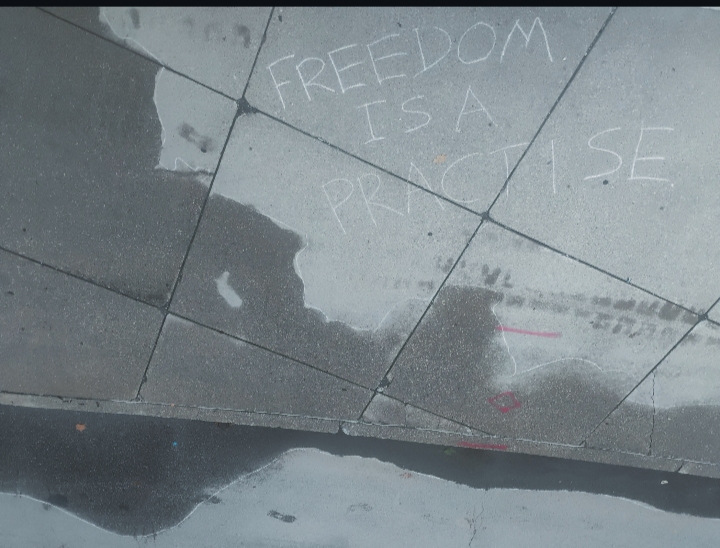
Well, the rain didn’t come, but the cleaning crew did! I went to visit the chalking this morning at 7:35am and it had been power hosed away.
As I had some white chalk left, I decided to mark this moment by drawing a chalk outline around the cleaned area.
I also added the phrase ‘FREEDOM IS A PRACTISE’.
This phrase comes from the title of the topic for the first ‘Exercises of Freedom’ from documenta 14, which, if you scroll up, is called DEMOCRACY IS NOT FREEDOM, FREEDOM IS A PRACTICE. I chose to misspell PRACTISE (even in the British spelling, which has this form with the ‘S’ for the verb, has the ‘C’ for the noun) to make the point further: we all make mistakes, we all fail, but we can also learn from our mistakes, from our failures, so long as we keep trying. This is something I teach my students in every class. It is the same with freedom. Maintaining and exercising our freedom is an ongoing process, filled with failures and defeats, but still, freedom has to be exercised every day.
The forecast is for rain again today – even flooding! – so this will be my final act of chalking, for now. Nonetheless, I’ll still report back tomorrow.
Here is what was happening in Athens 10 years ago today.
Saturday September 17 (7 pm)
ARCHITECTURES OF TERROR, VOICES OF RESISTANCE
Exercises:
#14. Ojo de gusano: Don’t Look Down Regina José Galindo, artist
They fell in Greece They fell in Panama They fell in Venezuela They fell in Brazil They fell in Argentina They fell in Colombia They fell in Ecuador They fell in Chile They fell in Peru They fell in Bolivia They fell in Uruguay They fell in Paraguay They fell in the Dominican Republic They fell in Haiti They fell in Honduras They fell in Nicaragua They fell in El Salvador They fell in Guatemala
The 1967–74 regime of the colonels in Greece was just one more in the long list of bloody dictatorships during the Cold War, supported by the United States against the forces of the communist danger, as they used to say. No matter how distant it seems we are from each other, we share a common past of repression, fight, and resistance. No matter how distant it seems we are from each other, we share a link.
#15. Chronotopes / Dystopic Geometries / Terrifying Geographies Neni Panourgia, anthropologist, visiting associate professor of Anthropology at the New School for Social Research, New York
Mikhail Bakhtin tells us that the chronotope connects temporal and spatial relationships of language to the ideological and political context that has produced them. Time, Bakhtin says, “thickens, takes on flesh, becomes artistically visible; likewise, space becomes charged and responsive to the movements of time, plot and history” (The Dialogic Imagination). The fleshiness of time encloses the texture of experience: experience of pain, power, abjection, danger, and exclusion. Space indexes time and its content when it acquires them, it is imbued and made to perform dystopisms, whether this happens in the Greek torture chambers of EAT/ESA or Villa Grimaldi in Chile, on the Yugoslavian prison islands Goli Otok and Sveti Grgur, through the stories of the Western Apache mentioned by Keith Basso, or the various Holocaust Memorials and their touristification. What, exactly, becomes the object of the tourist’s gaze when such spaces are touristified (that is, undergo the equivalent of gentrification)? How can the presence of raw power be safeguarded from the brutally leveling effect of the tourist’s gaze?
#16. Lingua Tertii Imperii Daniel García Andújar, artist
Democracy has become a matter of aesthetics. The stage of the public has become a kind of orchestrated video game or operetta with a few recited parts; this operetta is performed daily for a people overwhelmed by the consequences of the “crisis,” critically applauding a fake and pre-established, frivolous, affected, and ridiculous script in which the audience is immediately proscribed by the mass media and defused before its fellow citizens, should it dare boo from the stands.
A space for political ventriloquism. Language is never innocent. Architecture is never innocent. Images are never innocent. They are openly involved in a body-to-body fight with history. These buildings were once a hospital. They later became the headquarters of the Special Interrogation Section of the Greek Military Police (EAT/ESA). Now they house the Eleftherios Venizelos Museum, the Museum of Anti-dictatorial and Democratic Resistance, and the site of the documenta 14 Public Programs at Parko Eleftherias (Freedom Park). Take out Diogenes’s lamp and stroll through the park in full daylight to search for an honest language.
#17. Red Star, Crescent Moon / after Sohail Daulatzai Naeem Mohaiemen, artist
In Black Star, Crescent Moon (2012), scholar Sohail Daulatzai charts post-1950s Black internationalism as an intersecting history of black Muslims, black radicals, and the Muslim third world. In response, Mohaiemen argued that these encounters did not always lead to progressive politics, especially when state agencies were involved (“Muhammad Ali, We Still Love You: Unsteady Dreams of a ‘Muslim International’”, The New Inquiry, June 2016). In an expansion of this discussion, and leading into his forthcoming film in two chapters for documenta 14, Mohaiemen explores state-led Muslim International projects of the 1970s as a sometime nemesis of the radical emancipatory possibilities of the Third World International within, and after, communism.
#18. Soundscapes of Detention: Music and Torture under the Junta (1967–74) Anna Papaeti, independent researcher and musicologist
Although torture under the Greek military junta (1967–74) has been subject to scrutiny, with important trials in Strasbourg (1968–69) and Greece (the so-called “Torturers’ Trials,” 1975), the use of music and sound has so far been conspicuously absent from the discourse. In addition to the restrictive legal definitions used for the Torturers’ Trials in 1975, the humanistic perception of music as an inherently positive and enlightening art-form accounts for such omissions and silences. The history of music’s abuse by repressive regimes tells a different story. To expose and reflect on the elusive potential of music to damage human subjects is an exercise of critical freedom.
Papaeti’s presentation examines the use of music and sound as a means of terrorizing, humiliating, and ‘breaking’ political prisoners. Drawing on new interviews with survivors, supported by overlooked testimonies in existing sources, the presentation documents how music and sound were used in the detention centers of the Security Forces (Athens and Piraeus), and the Athens-based Special Interrogation Unit of Greek Military Police (EAT/ESA). It focuses on the practices used at EAT/ESA, exploring how these related to cutting-edge interrogation methods of the time, and exposing the genealogy of current forms of torture as they were practiced in the so-called War on Terror.
#19. Attempt. Come. Georgia Sagri, artist
Attempt. Come. Undefined. Be the point of no-reference. Constant, and as a state of formation. Play. Continue to play with the beat. Vibrate with me, so chaos can enter. It is an invitation. Come. As water. As the beat sounds, the senses awaken. Move. Unrepresented eros hits the drum. And celebration starts, for joy and grief.
Note: Visitors can bring along sleeping bags, comfortable clothes, food, and water and may stay in the space for the twenty-four-hour duration of the piece. Smoking is not permitted. A public discussion with Georgia Sagri follows the completion of the performance on Sunday night.
Update – September 18, 2026
The rain came and by 7:33am this morning, there is no trace of chalk.
There is something very satisfying about the way the rain washes away indiscriminately compared with the targeted power-hosing of the university’s ordered cleaning. It also gets to the heart of the absurdity of a chalking ban – to write a message in chalk is so temporary and there is no damage. At the same time, it reaches people in a way that the algorithmic blinkering of social media simply cannot. I have no idea who saw my messages and what they made of them. But more important than this minor experiment on the intersections of freedom of expression and academic freedom, is what this ban means for the students at Ohio State University. So many student groups and organizations, from advertising events to student elections, used chalking to communicate across the student body and the university population. This is precisely why messages against the genocide of Palestinians, the shutting down of peaceful protest and the university’s various modes of complicity in terms of its business partnerships, needed to take this form of chalking. To shut of this platform, as the ACLU have stated in their case, undermines the First Amendment rights of the students. The good news is that the students are not letting this go and rumor has it there is a chalking action planned today. This insistence, too, is a part of the exercise of freedom, and we can all take our lead from the durational performance of Greek artist Georgia Sagri, who 10 years ago performed her piece Attempt. Come. as the 19th Exercise of Freedom – starting on the evening of September 17 and ending the following day (September 18). Here is Elena Parpa’s description of Sagri’s performance from the artist’s website:
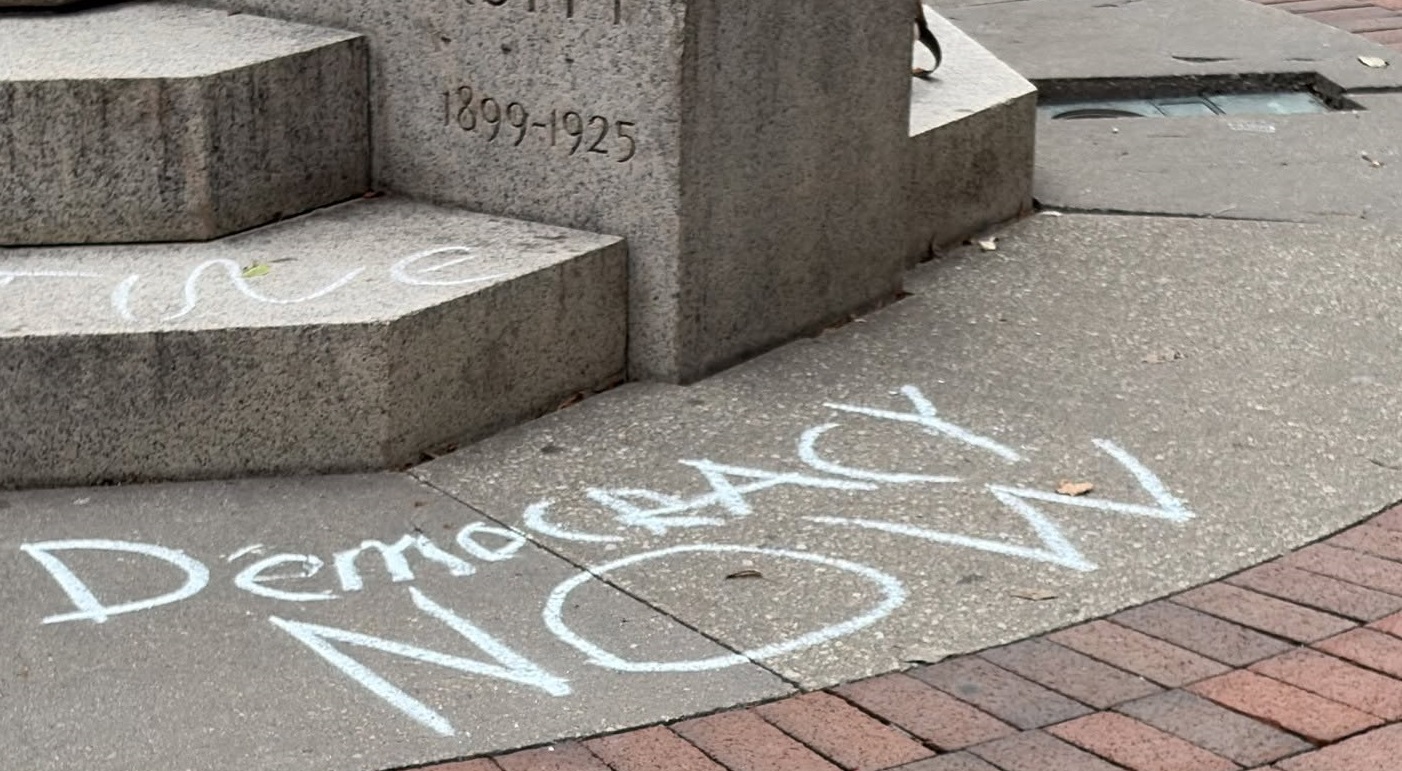
While I wasn’t able to attend the student chalking action on Friday (September 18), a friend, colleague and member of AAUP-OSU gave me permission to share this photo they took:
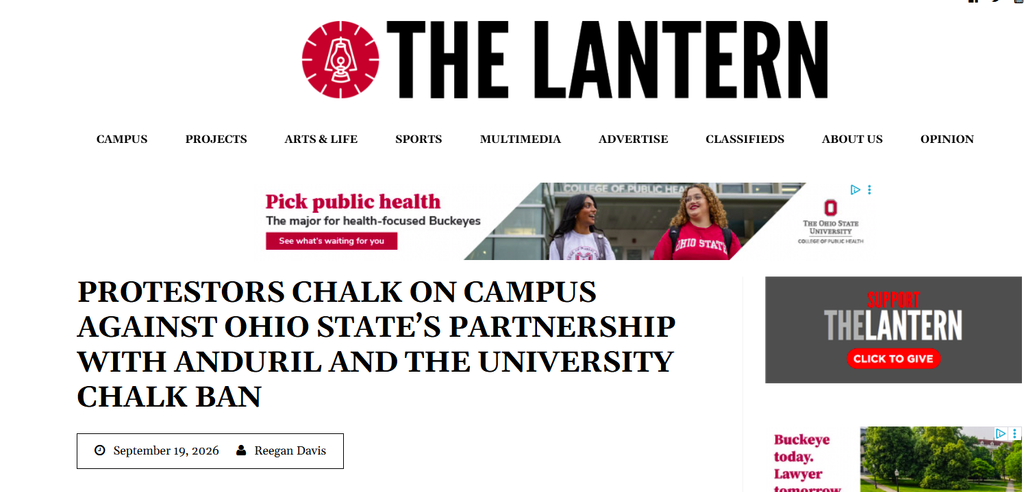
And here’s a link to an article in the student newspaper The Lantern about the chalking action (click image for link):
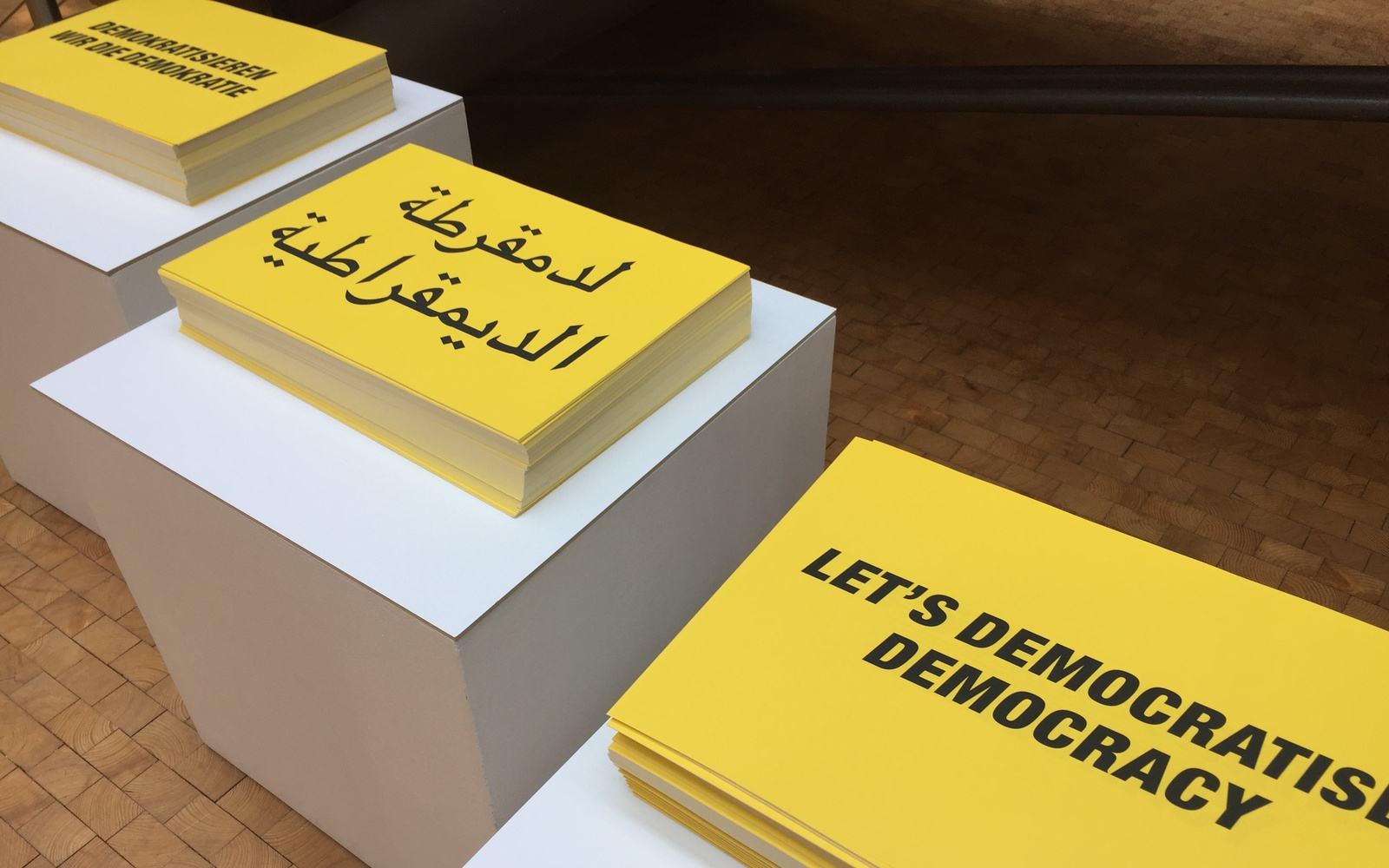
This DEMOCRACY NOW chalking in particular reminded me of the project by Catalan artist Daniel García Andújar called Let’s Democratise Democracy:
Back on September 17, 2016, Andújar spoke at 34 Exercises of Freedom about how:
Democracy has become a matter of aesthetics. The stage of the public has become a kind of orchestrated video game or operetta with a few recited parts; this operetta is performed daily for a people overwhelmed by the consequences of the “crisis,” critically applauding a fake and pre-established, frivolous, affected, and ridiculous script in which the audience is immediately proscribed by the mass media and defused before its fellow citizens, should it dare boo from the stands.
Whether at a public university in Ohio or the US during election season, the students’ chalking protest reminds us that DEMOCRACY IS NOT FREEDOM/FREEDOM IS A PRACTICE.
Update – September 20, 2026
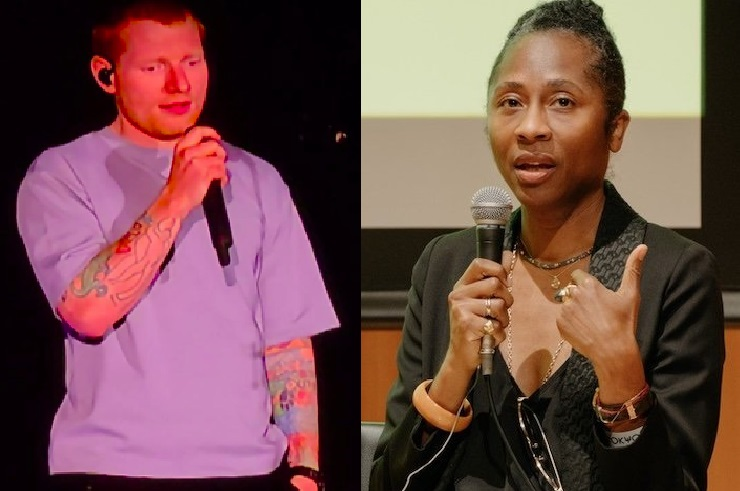
It’s Sunday here in 2026, so I’m not on campus. But reflecting back on this week and this post with its updates, I can’t help think of the ACLU case and how the chalking ban came about because the students wanting to raise their voices against the genocidal violence against Palestinians and the university’s complicity through its business ties. The singer Ed Sheeran has been in the news this week because he was pressured by the powerful owners of stadium venues in the US to drop his support act Macklemore for saying ‘Free Palestine’ at an earlier concert. As his other support acts and house band resigned in solidarity with Macklemore for his rights to freedom of expression, Sheeran continued the tour alone. He delivered an impassioned speech in Philadelphia, which makes his position clearer, however, his both-side-ism during an ongoing genocide, apartheid and occupation of Palestinians in Gaza and the West Bank, was nonetheless still apparent, underscoring his acceptance of the stadium owners’ silencing through his willingness to still perform.
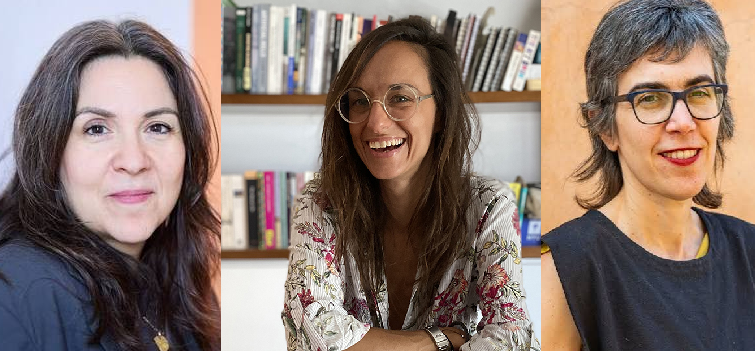
Less newsworthy, but more pertinent to this post and my blog more generally, is another case of both-side-ism by the artistic director of the upcoming Documenta 16 exhibition, Naomi Beckswith. Here is a quotation from her recent interview with the German newspaper Die Zeit:
ZEIT: But you won’t be able to get away from current events that easily. Activists protesting Israel’s Gaza policy will certainly show up at your Documenta, too.
Beckwith: I don’t think we can—or even should—avoid it. People have a right to protest and express their opinions. I’m not afraid of that.
ZEIT: Have artists turned you down because they can’t imagine coming to Germany?
Beckwith: Yes, there have been a few declinations for the team.
ZEIT: What were the reasons?
Beckwith: Some feel that they aren’t free in Germany to show what they want to show. Others criticize Germany’s position on the Gaza war.
ZEIT: What is your own position on the Gaza conflict?
Beckwith: Far more important than my personal stance is the question of how we can overcome this divisive mindset. How can we start talking to one another again?
ZEIT: You’re avoiding taking a clear position.
Beckwith: I understand the need for solidarity and support, but we’re not going to get anywhere with entrenched sides.
As with Sheeran’s speech, Beckwith’s interview initially seems to invite discussion of broader issues of artistic freedom and calls for unity amid division. However, the problem with both is that they are constrained by the broader power structures, whether of the stadium owners or Documenta gGmbH, which are actively and systematically curtailing the freedom of expression of others because of their distaste for specific forms of speech around Palestinian solidarity. They are also statements spoken to a captive audience – fans at a concert and a German newspaper – which are in their own ways complicit with the status quo and not pushing for accountability and change from the forces in power that have set up this situation in the first place.
Of course, Ohio State University students, faculty and staff may feel like very minor actors in their situation pushing back on the chalking ban, but it feels there is a significant consistency here and one which the ‘exercises of freedom’ enacted by the earlier documenta 14 exhibition – its artistic director, curators, educators and participating artists – knew well.
Context matters and the challenges posed by launching the public program of documenta 14 in Athens and not Kassel, with the understandable criticisms by Greek activists (some of which I will share in future updates) and the setting themselves up for failure in the process, feels a lot more open to debate this topic of the limits of artistic freedom when confronted with other forms of freedom and their institutional constraints.
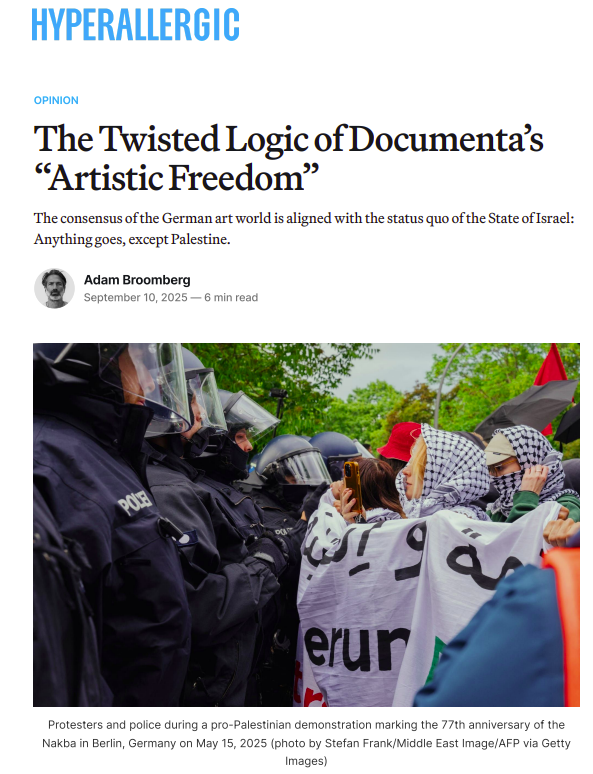
This week Documenta 16 launched their website, but unlike both documenta 14 and documenta fifteen, there has been no public-facing activities to pave the way for the exhibition to come. While this shroud of secrecy around the exhibition may be a curatorial decision, it also aligns with the dominant power structures of the institution to ensure less dissenting voices and friction within the organization and the planning of the exhibition. For a succinct account of this situation, read artist Adam Broomberg’s article in Hyperallergic from last September.
This week made me realize that, just as I would not attend an Ed Sheeran concert right now, I have no desire to visit Documenta 16 next Summer. Of course, I have no doubt there will some amazing artists participating and it could be an incredible exhibition. However, nothing I have seen from Beckwith’s approach to the exhibition has given me confidence that, unlike Adam Szymczyk for documenta 14 and ruangrupa for documenta fifteen, there will be adequate critique of the institution for the efforts they have made to limit freedom of expression, especially at the expense of Palestinians and those who speak up in solidarity with them.
Let’s take some inspiration from what was being said at Freedom Park on this day 10 years ago:
Tuesday September 20 (7–11 pm)
SILENCE AND MASKS South as a State of Mind #7 [documenta 14 #2]
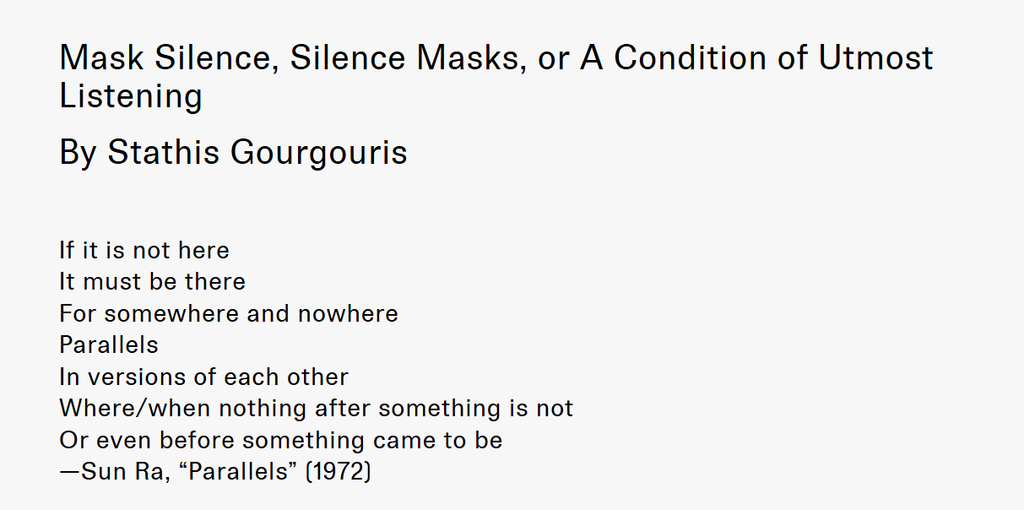
Silence as resistance; masks as resistance. Both, perhaps paradoxically, as means to act and to speak, as modes of aesthetic and political participation. If words and images can be put to the service of critical inquiry, silence and masks, while withdrawing the claim on self-evident truth, can help give sharp contours to political statement, testifying to the need to address the real—without, however, falling into the pitfalls of direct representation. In essay and allegory, artist projects and conversation, poetry and fiction, the second volume of the documenta 14 South as a State of Mind explores issues of masking identity and silencing dissent, orality and recognition, indigeneity and exile, provenance and repatriation, and colonial and gendered violence. To launch the new issue of South at Parko Eleftherias, Clémentine Deliss, Stathis Gourgouris, and Candice Hopkins engage in a series of offerings: readings, listening sessions, and rituals, old and new.
Exercises:
#20. Transgressive Listening Stathis Gourgouris, professor at the Institute for Comparative Literature and Society at Columbia University, New York
#21. Outlawed Social Life Candice Hopkins, citizen of Carcross/Tagish First Nation, is an independent curator, writer, and curatorial advisor for documenta 14 based in Albuquerque, New Mexico
U’mista, in the Kwak’wala language, means the return of something or someone thought to be lost or taken. In Alert Bay and Cape Mudge, First Nations communities along the northwest coast of Canada repatriated ceremonial masks and regalia, and now have U’mista.
#22. I Owe You Everything Clémentine Deliss, writer and curator, currently curating the Dilijan Art Initiative in Armenia.
First act of giving in the series I Owe You Everything, in the presence of Chief Robert Joseph, hereditary chief of the Gwawaenuk First Nation, ambassador for Reconciliation Canada, and a member of the Assembly of First Nations Elders Council
I Owe You Everything is a project that chooses and follows a series of contemporary thinkers, poets, and activists who are invited to construct a public “act of giving,” a critical and poetic ritual, in which they give “everything” to the Parliament of Bodies of documenta 14.
What is worth giving? What do we “owe” to each other? What has to be given back to history in order for history to change? The public act of giving is a critical and poetic ritual in which an artist, activist, thinker, or poet “gives everything” to someone else. The units of giving acts constitute a chain of heterogeneous practices, reservoirs of affect and immaterial value. The acts of giving explore different cultural and political economies such as debt, gift, potlatch, revenge, retribution, promise…
Update – September 21, 2026
Monday morning, back on campus, the start of another work week. For these last days commemorating the 10 year anniversary of documenta 14’s 34 Exercises of Freedom and channeling the energy from those discussions in Freedom Park to the here and now of Ohio, I want to bring attention to some of the critical responses to the program and consider what we can learn from them today. There were 3 review articles published specifically addressing 34 Exercises of Freedom:
Here is a collage of representative quotations from each article (in chronological order):
Democracy, freedom and the body were excellent starting points, but connecting them with such particular manifestations of the terms, at times left audiences lost in translation. It was also a far-fetched claim to juxtapose the notion of Greek “eleftheria” (freedom) against capitalist freedom, in a country where debt was created in some part by over-spending and ample consumerism.
Unfortunately, the well-intended idea and conceptual plan failed to correspond with its execution on a number of levels: the application of equality, dialogue and participation in the programme was left to theory, as opportunities for any kind of discursivity were limited to questions and answers at the end of each day’s events, and the option to voice one’s opinion after each presentation was non-existent. On an average day, a viewer might have to sit through lectures, a performance, and sometimes a ritual, which in total occupied on average four to five hours, rarely allowing time for discussion.
If you add to this nostalgic re-reading of resistance the inevitable references to ancient Greece and an overwhelming performativity and theatricality, which characterised many of the Exercises, engaging easy emotions and romanticism, the first impressions you have of Documenta 14’s take on the local context is a sensory and exotic image of Athens, emphasising strong, charming images produced to captivate an international audience.
If you want to experience 34 Exercises of Freedom for yourself, you can watch the videos above and below. As for what happened 10 years ago today, all that remains is the description and a photograph.
Wednesday September 21 (5–7 pm)
STATE VIOLENCE / DOMESTIC VIOLENCE
Exercise:
#23. Interior Effects as an Outcome of War Workshop with Bonita Ely, artist
You are invited to join artist Bonita Ely in a workshop to discuss the ongoing, inter-generational effects of undiagnosed, untreated posttraumatic stress disorder (PTSD) suffered by family members of returned soldiers. During the workshop, Ely shares her family’s experiences following her father’s return home after the Second World War. The artist has made these often tragic effects of undiagnosed PTSD the focus of her artistic work.
Whenever people suffer the violence of war—when traumatized soldiers return home, when refugees and migrants worldwide flee from war-torn countries to seek safety—generation after generation may be exposed indirectly and directly to the traumatizing effects of war through epigenetic transfer, acute anxiety, insecurities, and family violence.
Open to up to twenty participants, register at: program@documenta.de.
Update – September 22, 2026
After the opening of documenta 14 in Athens in April 2017, Greek art critic Despina Zefkili, who wrote one of the three reviews of 34 Exercises of Freedom, teamed up with artist, theorist and academic Kostis Stafylakis and writer Makis Malafekas to record a conversation for Radio Athenes for their series All: Collected Voices. This is how Zefkili ended her segment:
According to my first impressions, the exhibition of Documenta in Athens, emphasizing unlearning, pluralism, and tactility, ends up in a mélange of safe choices, which one expects to see in a Documenta, along with fetishizing the archives of the 70s avant-gardes, out of any context, and identifying the periphery with craft, sensation overrules context. In that sense, the controversial public program Exercises of Freedom seems more successful. Although it was characterized by overtly emotional works with easy references to history and an uncritical romanticization of resistance throughout the ages, it had at least identity, and it made a statement addressing the time and place, something that the exhibition of Documenta lacks. Szymczyk’s proclamation for Documenta to regain its urgency and change the status quo remains pending. What we are left with is this overdose of artworks difficult to relate with, where only small autonomous moments […]. Although learning from Athens implied an intention to work with here and now, the conservative form of the final exhibition, at least in Athens, hijacks the project and possibly shows the limits and confirms the end of relevance that such mega-exhibitions can have today in the production of critical thought and action. I think what this Documenta will be remembered for in the future is its decision to come to Athens.
In the film Exergue on documenta 14, we see an exchange between Stafylakis and the documenta 14 artistic director Adam Szymczyk:
Adam Szymczyk: So far, we learned that if you say something in Greece that relates to Greece, you are entering like battleground.
Kostis Stafylakis: You are entering the zone of various patriotic layers that it’s very difficult to peel off. It’s a problem. It’s lots of discussion.
Adam Szymczyk: Yeah, yeah, yeah.
Kostis Stafylakis: Public discussion in a certain way.
Adam Szymczyk: But this is exactly why we thought this was a place to…
Kostis Stafylakis: Yeah, yeah, yeah. I do agree with that, but then if someone like Preciado re-inscribes a story of national resistance and et cetera, then I think that the tendencies and the historical layers are tending to be obscure under this kind of patriotic continuity of the idea of Hellenic and Greek resistance.
Adam Szymczyk: You think?
Kostis Stafylakis: Oh, this is really not good.
Thursday September 22 (7–10 pm)
THE VIRAL 1980S: DEMOCRACY, NEOLIBERALISM, AIDS
Exercise:
#24. They Glow in the Dark, Panayotis Evangelidis, Greece, 2013, 69 min. Film screening and discussion with director Panayotis Evangelidis
Update – September 23, 2026
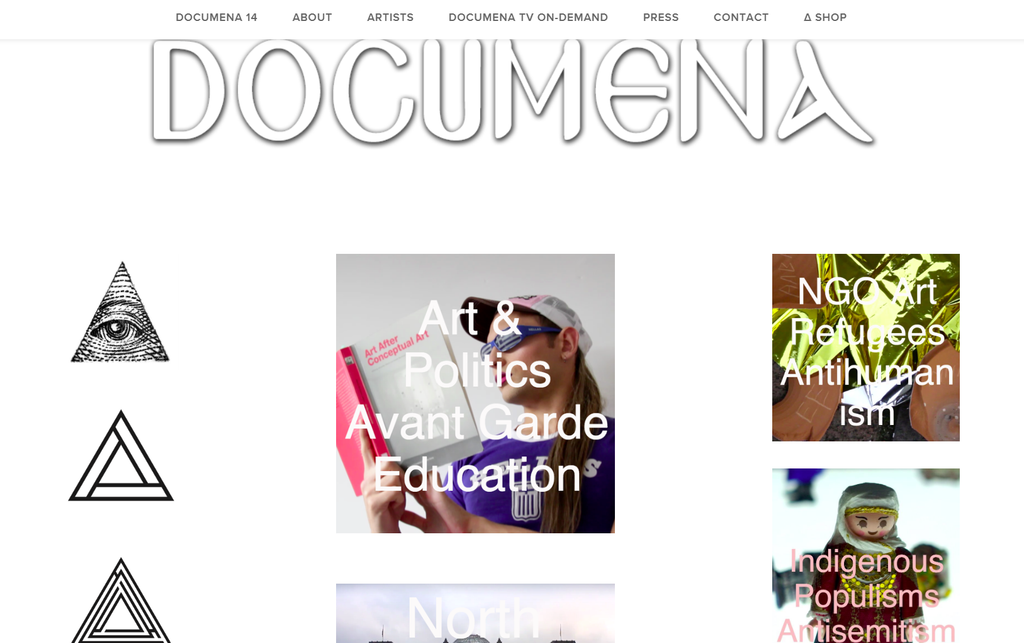
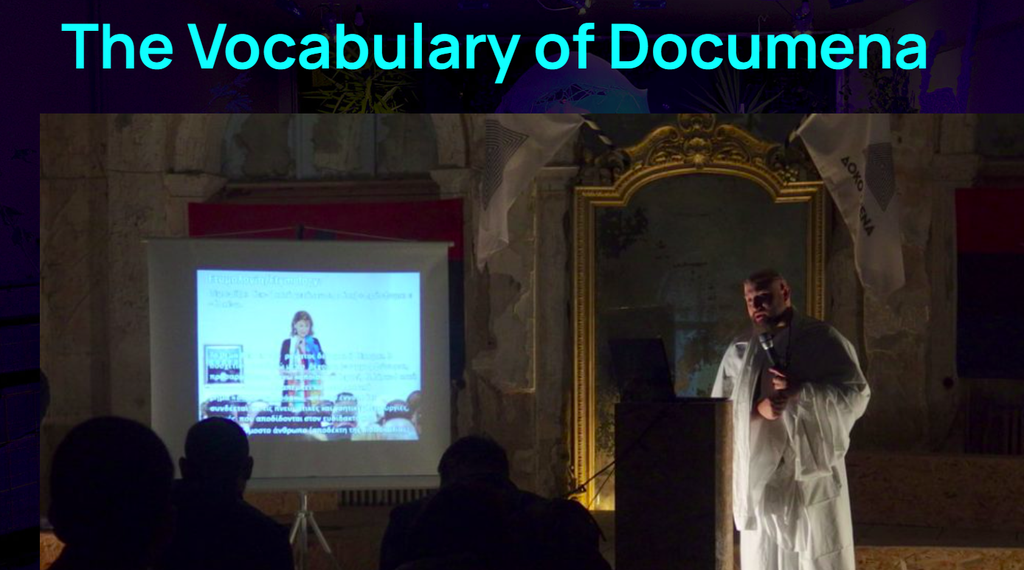
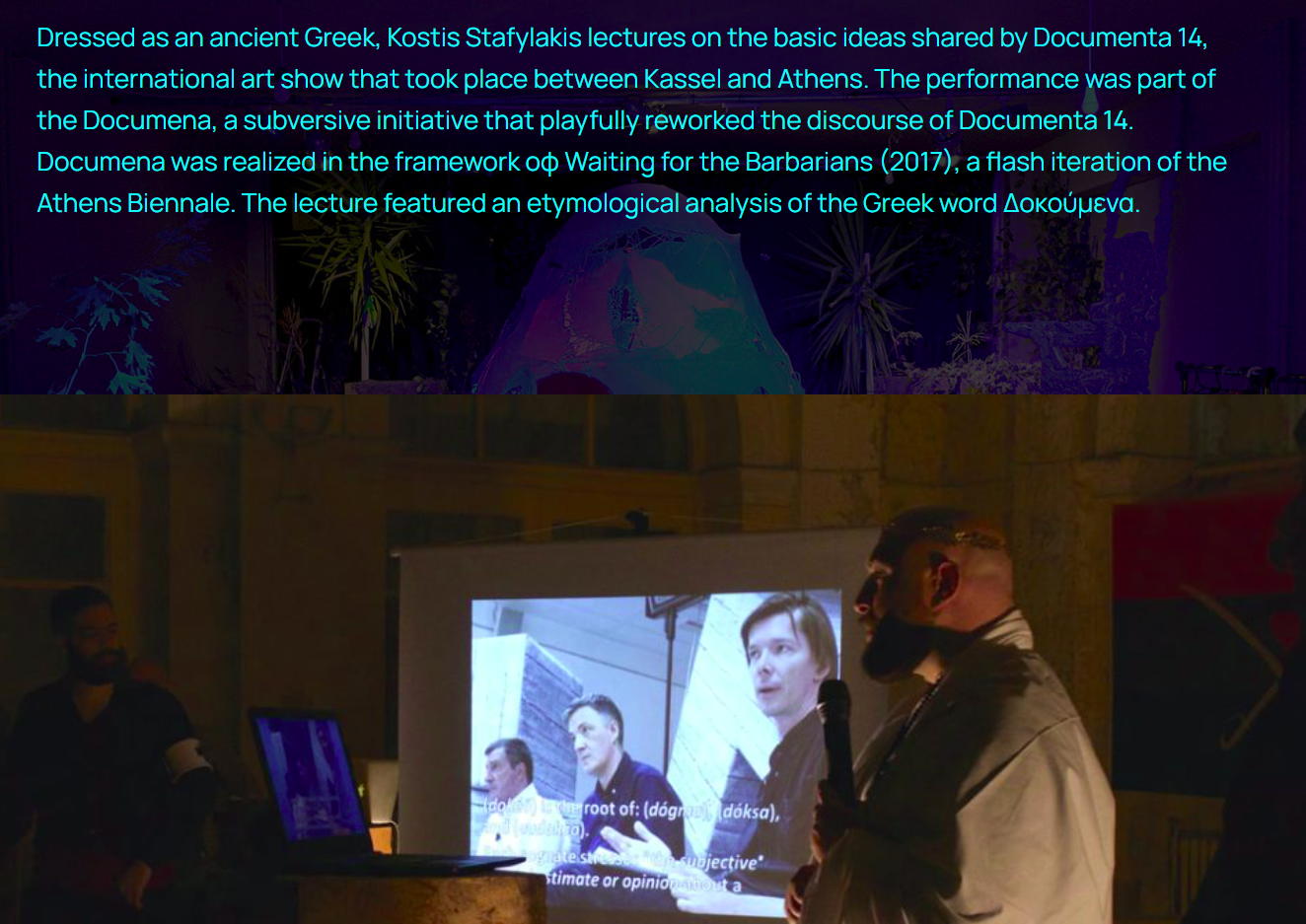
The brief conversation between Greek artist and academic Kostis Stafylakis and documenta 14 artistic director Adam Szymczyk during the opening of 34 Exercises of Freedom, which took place 10 years ago and which is part of the 9th chapter of the 14-hour film Exergue on documenta 14 by Greek filmmaker Dimitris Athiridis, centers on a tension between how Greek history and culture were engaged during this international exhibition with the working title ‘Learning from Athens’. Stafylakis was part of other artistic interventions and critiques about documenta 14, including the project Documena by Athanasios Anagnostopoulos and Fil Ieropoulos (who I had a conversation with in an earlier minus plato? post called ‘Can the Queer Indigenous Greek Subject Speak?).
One of the collaborations between Stafylakis and Documena took place within the framework of the 2017 Athens Biennale Waiting for the Barbarians, which satirized the theoretical language used by documenta 14, targeting the 34 Exercises of Freedom events.
Beyond this collaboration, in a series of short videos, Documena parodied the whole 34 Exercises of Freedom program along with poet Lia Foukis called34 Exercises of Eleftheria.
Returning to the original 34 Exercises of Freedom, this is what happened 10 years ago today.
Friday September 23 (7–11 pm)
POST-PORN ACTIVISM AND ECOSEXUAL FREEDOM
Exercises:
#25. An Evening with Annie Sprinkle and Beth Stephens and Wet Dreams Water Ritual
Annie Sprinkle, activist, artist, and educator and Beth Stephens, ecosexual performance artist, filmmaker, activist, educator, founding director of the E.A.R.T.H. Lab and professor of Art, University of California, Santa Cruz. Together they authored the Ecosex Manifesto.
An invitation to partake of the pleasures and perils of water. In collaborating with local artists, activists, musicians, sex workers, refugees, and other humans and non-humans.
Note: Please bring some water from your home or town/city for the water ritual. Wear the colors of water; aqua, blue, and black. Be costumed, naked, painted, adorned, or as you like.
#26. The Waltz of the Dirty Streets Adespotes Skiles, self-organized music and theater collective
This performance is inspired by all those people who at some point, in some place, in some way reacted to what was putting them down by posing thousands of questions. By all those who, if only for a brief moment, questioned the status quo or doubted their deepest convictions—all those who experienced even for one moment a personal encounter with life and the world that fell outside of a preconceived view.
Update – September 24, 2026
For this final update on the 10-year anniversary of the 34 Exercises of Freedom public program for documenta 14 in Athens I want to make the case for the significance of this program and its call for the practice of freedom for the here and now. But before I bring you to the campus of this public university in present day Ohio where student chalking is banned yet rightwing indoctrination centers claim to teach civics, I want to turn to Dimitris Athiridis’ 14-hour film Exergue on documenta 14 as a way to counter the criticisms levelled against 34 Exercises of Freedom, The Parliament of Bodies public program (led by Paul B. Preciado) and documenta 14 as a whole. The basic outline of the critique, made in the reviews of the program and the artistic interventions of Documena, is that this well-funded German mega exhibition failed to engage sufficiently with the arts and cultural scene in Athens, romanticizing leftist Greek politics and history in the process, avoiding tense questions around Hellenic nationalism. I do not have either the expertise or understanding of these issues to weigh in on them directly, but I do want to share one moment in the 9th chapter of Exergue on documenta 14 – called ‘Exercises of Freedom’ and which focuses on the program – that I believe offers a more nuanced perspective of its aims and their strengths, there and then in Athens, as well as here and now in Ohio.
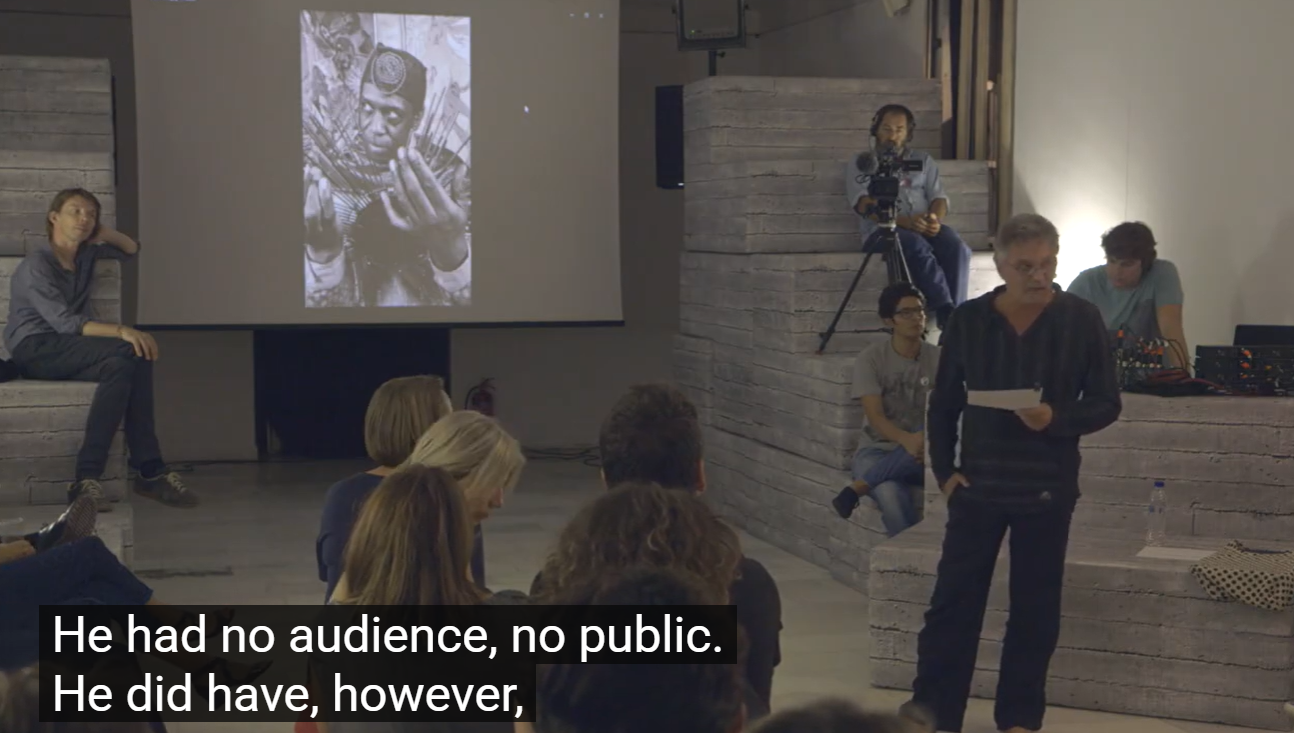
In the chapter, Athiridis juxtaposes the speakers and performances at 34 Exercises of Freedom with members of the curatorial team discussing the nature of the public program and what The Parliament of Bodies means for them in terms of individual and collective orchestration (where it is the work of all the curators, as Pierre Bal-Blanc initially prefers, or led by one of them, Preciado, with the other curators playing accompanying roles). One of these moments of juxtaposition really stood out to me. Stathis Gourgouris, professor at the Institute for Comparative Literature and Society at Columbia University, New York, is giving his presentation on ‘Transgressive Listening’ (you can watch the whole thing in the video above – from the September 20 update or click on the still below). This section of the program was focused on essays published in the second issue of South as a State of Mind – the Greek arts magazine founded by Marina Fokidis and which hosted documenta 14 for 4 issues. Gourgouris’ presentation follows an introduction by Adam Szymczyk and editor of documents 14 publications, Quinn Latimer, and is followed by curator Candice Hopkins talk based on ‘Outlawed Social Life’, based on her own article in South.
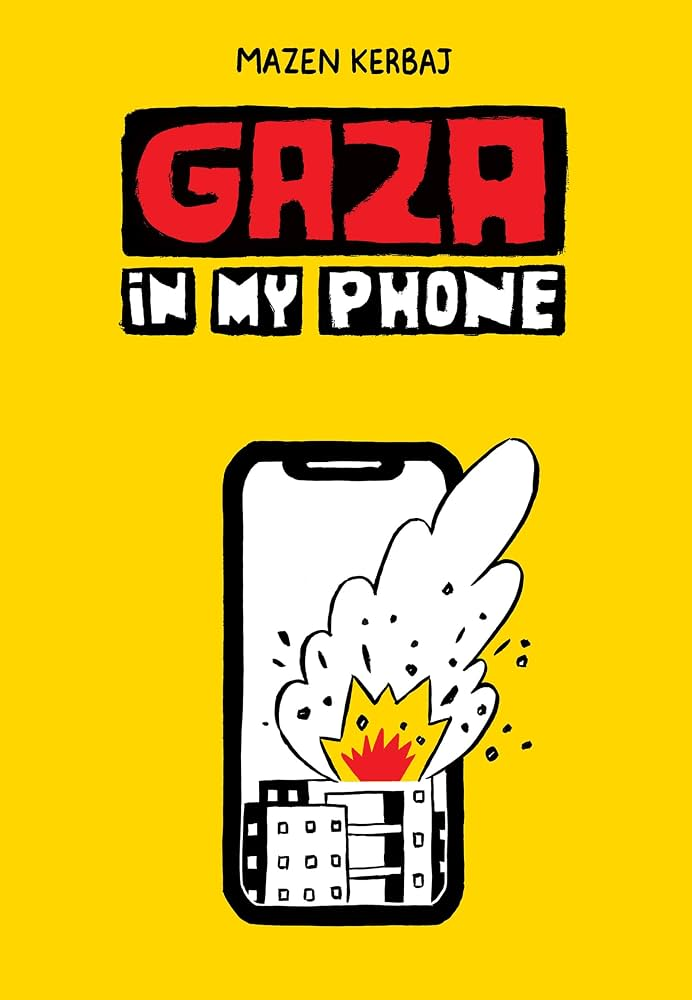
Deviating from his essay in South, Gourgouris tells a series of stories that he selected specifically for the occasion of 34 Exercises of Freedom to expand on ideas of listening and the relation of bodies. The first story, which he calls ‘Starry Night’, tells of Lebanese artist Mazen Kerbaj, who, during the Israeli bombing of Beirut on July 15, 2006, alone in his apartment, went outside and played a duet with the bombers on his trumpet. After giving this information, Gougouris sits down in reverent silence, listening as he plays the sound recording of that night accompanied by a selection of Kerbaj’s iconic drawings (more recently made during the genocidal violence in Gaza).
Before pressing play, Gourgouris states:
This is a real documentum.
In the context of Exergue, Dimitris (who you can see filming in this still) edits Gourgouris talk with the footage of Kerbaj’s recording and drawings, which brings out the interplay between the speaker and the artist, at times showing the speaker listening and watching, as well as speaking. Athiridis also includes the crucial observation by Gourgouris that Kerbaj wasn’t playing his trumpet against the Israeli bombers, but accompanying them and in the process changing their impact. This method of accompaniment is then expanded by Athiridis in the film by following overlapping this scene with a moment that in the sequence of the program came before it: Adam Szymczyk reading from the editorial of the South issue, which begins with Kerbaj’s drawings still on screen. The Editorial reads:
Words and images can be put to the service of critical inquiry; silence and masks, while withdrawing the claim on self-evident truth, can help give sharp contours to political statement. Through poetic elision or dramatic mise-en-scène, in a public performance of storytelling or by retelling a personal story in private, an epic dimension can be restored amidst the contingencies of shattered everyday life.
Following these words, Athiridis returns to the Kerbaj’s music and drawings, ending with this specific image:
To experience 34 Exercises of Freedom all these years later, through watching the videos of the talks and performances, and through this long blogpost, is obviously a different experience from being there in Parko Eleftherias. While it is not the same, it also differs witnessing the bombing of a city through social media and TV, and being there in an apartment building. The shattering of everyday life in the latter, has some echo with the insistence of the daily programing in the former – long nights of gathering, listening and discussion. Yet as Kerbaj’s music and drawings, as well as Athiridis’ film, demonstrate, there are ways of bringing those of us who were not there into relation to what happened. In my opinion, I think this is what the criticisms levelled against 34 Exercises of Freedom and documenta 14 in general, were not willing to reflect on. ‘Learning from Athens’ was a way to encourage this relational mode, it was never meant to somehow tell Greeks who they were anymore than Kerbaj’s duet with the Israeli bombers was intended to stop them from dropping their bombs. I am deeply grateful to Dimitris Athiridis for making Exergue on documenta 14 because he enacts this relational mode that is at the very core of the practice of freedom that participatory democracy demands.
This brings me, finally, back to Ohio and to the university I teach at, which I like to call This Ohio State University. Even though I’ve centered this post and some of its updates on my minor act of protest against the ridiculous chalking ban, there are some more dangerous challenges to both freedom of speech and academic freedom at work at my university and across the state of Ohio and the country as a whole, something that could be called the Civility Industrial Complex. Here is how the collective UNCIVIL describe the phenomenon (click on the image to learn more):
Billionaire funders and extremist politicians are funneling millions into campus dialogue programs and civics centers. They claim to be reducing “polarization” and promoting “pluralism,” but their real goal is to silence dissent.
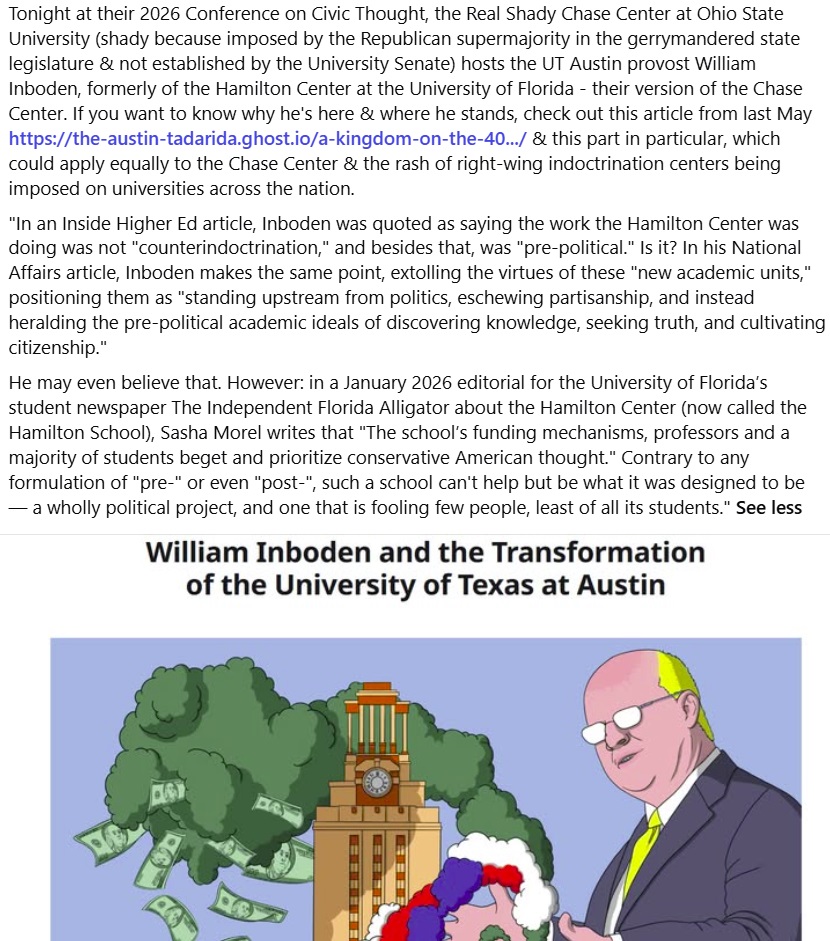
One such civic center is the Salmon P. Chase Center for Civics, Culture and Society which was imposed on our university by the Republican supermajority in the Ohio legislature without being approved by the University Senate and which uses taxpayer dollars and shadowy funders to bribe students to take their courses, undermine established departments and their curriculum and embark on extensive, rushed hiring practices (including hiring a professor who assaulted a local journalist). But perhaps most concerning for our freedoms and democracy, as a forthcoming report by UNCIVIL will show, they are part of a well-financed network that aims at silencing any voices in the university that challenge their limited conception of what civics education might look like. For example, just last night, during their annual Conference on Civic Thought, there was a keynote talk by the Provost of University of Texas Austin, William Inboden, who recently eliminated four undergraduate majors at the university: African and African diaspora studies, Mexican American and Latino studies, women’s and gender studies, and race, indigeneity and migration. Here is what I posted on Instagram last night (if you click the image you’ll get to the article I mention).
It is this self-serving, shady network infiltrating and destroying our universities from within that I want to play my metaphorical trumpet in accompaniment with. I know that posts like this cannot stop them, but it is an act of freedom to not let them take the stage of our campus to play their own tune. So, following this trip down memory lane to Freedom Park in Athens 10 years ago, with the last talks from the 34 Exercises of Freedom program posted below, please join me in raising your voices and making as much noise as you can to work together for change and at the very least, not allow any powerful voice to go unaccompanied by a chalked or trumpeted message of real freedom.
Saturday September 24 (7 pm–3 am)
“APATRIDE” TRANSFEMINIST QUEER NIGHT
Exercises:
Organized in collaboration with AMOQA (Athens Museum of Queer Arts).
#27. Decolonizing Memory: Vita Futurities in the Americas Macarena Gómez-Barris, chair of the Department of Social Science and Cultural Studies at Pratt Institute, New York
In this talk, Gómez-Barris asks how we might decolonize memory to activate different potential alternative and anti-capitalist futures. Specifically, the talk addresses how the evacuation of colonial and dissident memories in the Americas has reproduced settler-colonial and genocidal logics that are imbricated with and steeped in authoritarian state histories. Gómez-Barris explores spaces “en el Sur,” or Southern spaces, such as former concentration camp Villa Grimaldi in Chile, the southern territories of Wallmapu, and post-colonial formations in Bolivia to address living futurities through submerged perspectives, or rather those modes and potentials that perceive beyond coloniality and patriarchal state narratives in order to pursue other forms of seeing and being. The analysis centers on indigenous and feminist forms of visuality and communal living that interrupt normative processes of capitalist accumulation and western aesthetics. Gómez-Barris discusses indigenous experimental film, anarcho-feminisms, inverted visuality, and other forms of anti-capitalist, anti-extractivist representation in the Americas to show how these submerged perspectives decolonize the inevitability of capitalist decimation and the anthropocene, while foregrounding different, regional, queer, and feminist planetary futures.
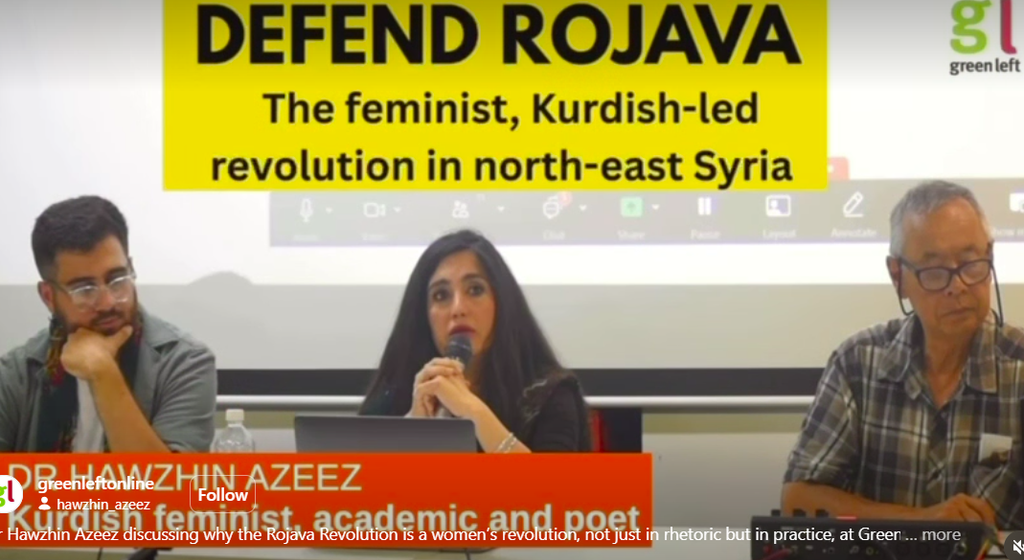
#28. Rojava is a Women’s Revolution: Jineology as Women’s Science Hawzhin Azeez, political theorist and activist, Kurd from south Kurdistan (northern Iraq)
The revolution in Rojava in western Kurdistan has been gaining international traction across leftist groups and organizations. Despite the immense socio-political gains and the colossal fundamental changes that have occurred within the spheres of gender, democracy, and ecology, the international media still regards Rojava from perspectives that are dominated by Eurocentric and Orientalist views of the Kurds, especially Kurdish female fighters. Less attention, even on the left, has been awarded to the ideology driving the women fighters forward, which has ensured a solid, democratic, and feminist foundation for Rojava. Media interest, if at all, has been in regard to radical democracy and its “anarchist” roots in connection with Murray Bookchin’s Libertarian Municipalism. It is, however, the ideology behind women’s liberation known as Jineology (womenology) that is the force underpinning the radical democracy of Democratic Confederalism. This school of thought has been produced entirely by Kurdish women activists and fighters. It is this ideology, in connection with stateless democracy, which requires further exploration and attention in Rojava.
#29. Trans*: Bodies and Power in the Age of Transgenderism Jack Halberstam, visiting professor of English and Comparative Literature and Gender Studies at Columbia University, New York
Halberstam’s recent research has focused on the exponential increase in the last decade of public discussion in the US and Europe around transgenderism. In his upcoming book Trans*. A Quick and Quirky Account of Gender Variability (forthcoming 2017), Halberstam analyzes the reasons that transformed what was formerly considered an unusual or even unfortunate disorder to become an accepted articulation of gendered embodiment as well as a new site for political activism. How did a stigmatized identity become so central to articulations of self and other? What fuels the continued fascination with transgender embodiment and how has the recognition of its legitimacy changed current gender protocols in the US? What is the history of gender and how does it sit alongside histories of sexuality, race, ability, and health? Whether it comes in the form of Preferred Gender Pronouns (PGP) or even new classifications of gender identity (agender, androgynous, cis-gender), the visibility of transgender must be seen as part of a larger shift in habits and customs around classification, naming, and inhabiting the human body. While new gender protocols as expressed on Facebook and in other forms of social media seem to register advancement, flexibility, and even a decentering of normative gendering, increased flexibility with regards to gender may also be part of new regulatory regimes.
Trans* pays attention to the ebb and flow of regulation and innovation, governance and experimentation. In addition to placing shifts and changes in trans identities firmly within a matrix of gender and sexuality identities and practices, in his presentation for documenta 14, Halberstam argues that new visibility for any given community has advantages and disadvantages, liabilities and potentialities.
#30. #Direnayol (#Resistayol), documentary by Rüzgâr Buşki, Turkey, 2016, 60 min. Film premiere
#31.Voices of Trans and Queer Politics in the Mediterranean with: Rüzgâr Buşki, multimedia artist and producer, member of Kanka Productions Gizem Oruç, musician, producer, and multimedia artist, member of Kanka Productions Şevval Kılıç, sex worker, queer and trans activist working in Istanbul Nelli Kampouri, gender scholar, Centre for Gender Studies KEKMOKOP, Panteion University Athens Margarita Tsomou, publisher of Missy Magazine, author, dramaturge, and curator based in Berlin Maria Mitsopoulou aka Maria F. Dolores, visual artist and performer, AMOQA (Athens Museum of Queer Arts) Anna Apostolelli, activist, currently a member of Beaver, a women’s co-op café in Athens, AMOQA (Athens Museum of Queer Arts) Tina Voreadi, visual artist and educator, AMOQA (Athens Museum of Queer Arts)
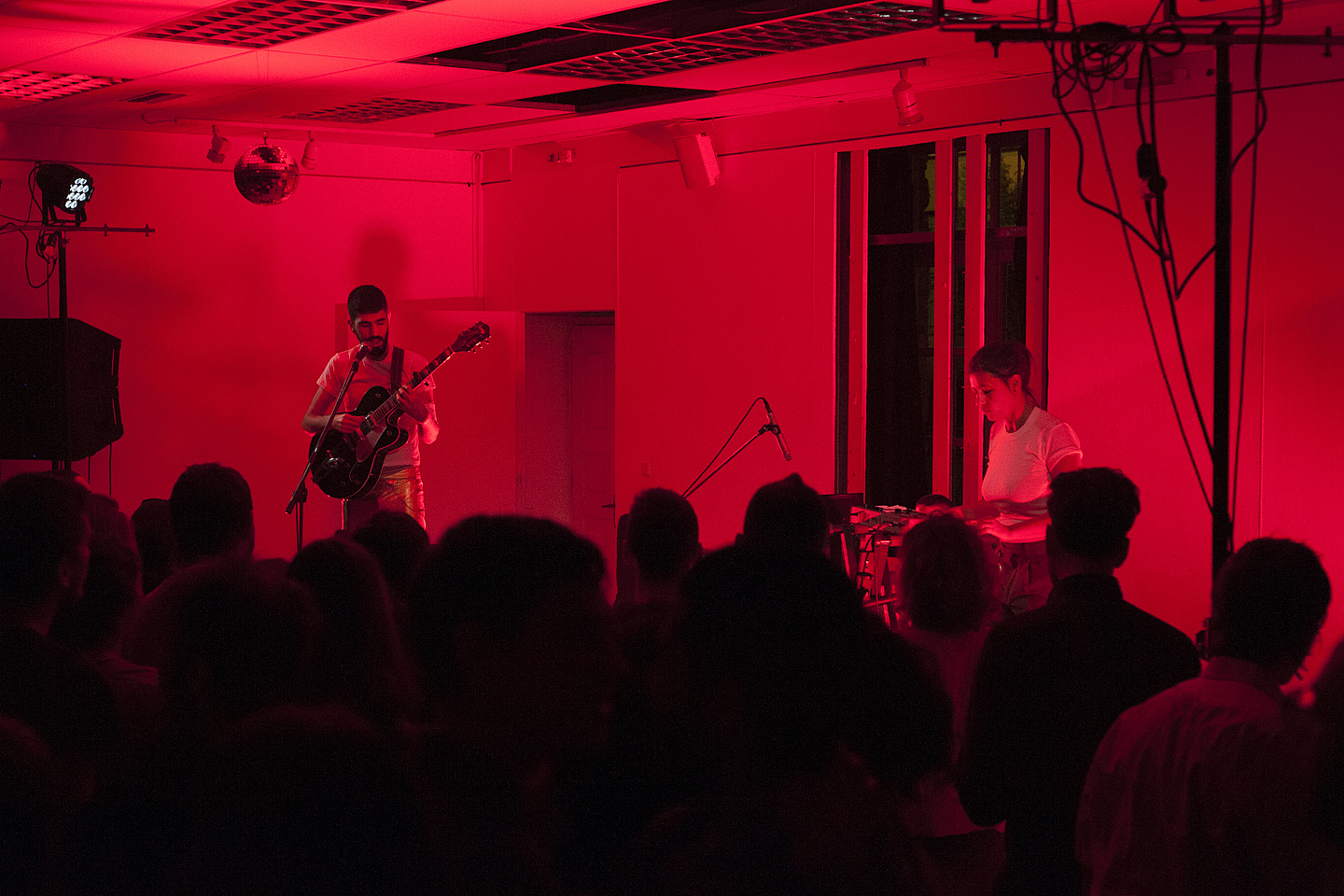
#32. Queer Indie Gig, HTH Green to Blue Shock Treatment Prasini Lesvia, musician
#33. DJ set Gizem Oruç, musician
#34. The Epic of Eleftheria Irena Haiduk, artist and Eirini Vakalopoulou, writer and poet
In the East and Far East, the South, deep South, the other side of North, and the Far and the Deep West, history is mostly an oral technique. The poet is a witness. She records and weaves history and allows others contact with it through the act of listening and re-telling. During the Ottoman occupation that lasted for five centuries, Serbian history was recorded and transmitted mostly through oral means by singers called guslars. The tradition persists to the present day. The poems tell a range of histories both public and private: of births, deaths, weddings, treaties, battles, migrations, and retaliations. In the early 1800s, the majority of the poems were collected by Vuk Stefanović Karadžić and published in Serbian in Vienna and Leipzig.
To mark the last event of the inauguration of the Public Programs of documenta 14 at Parko Eleftherias, Haiduk presents the process of creating an oral epic telling of the event. The poem shall serve as a historical record.
General dramaturgy for the Exercises of Freedom: Prodromos Tsinikoris, artistic co-director of Experimental Stage -1 of the National Theatre, Athens.