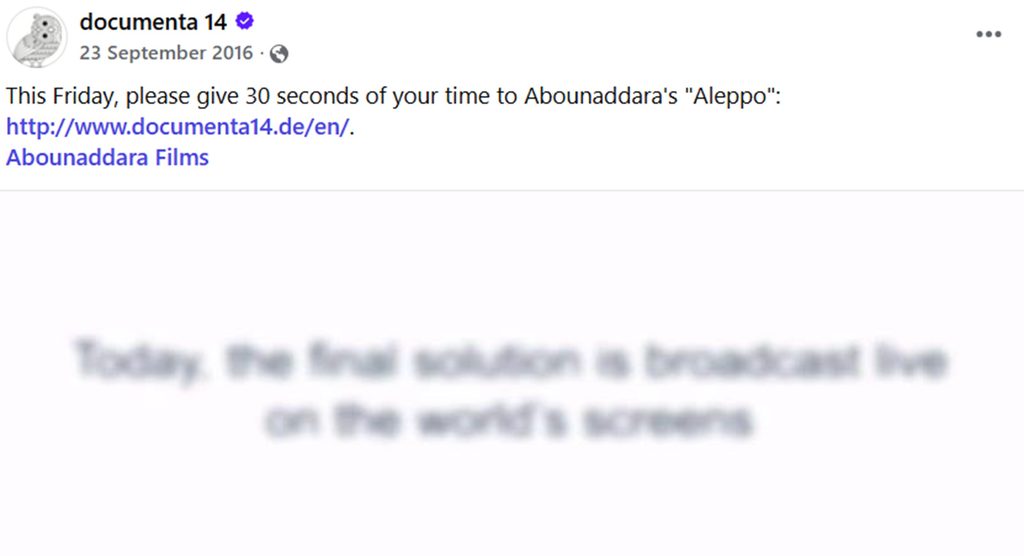
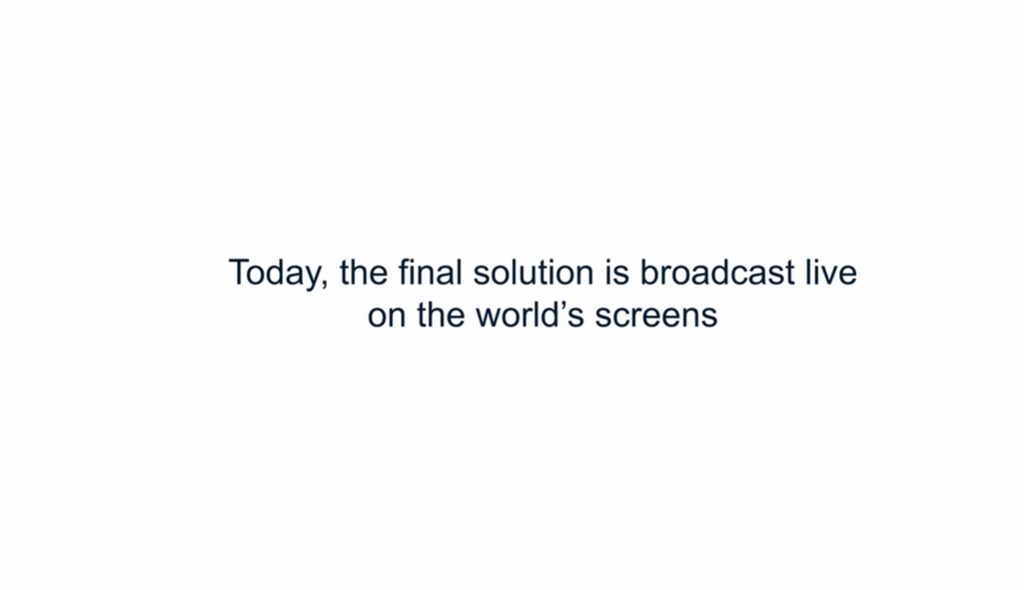
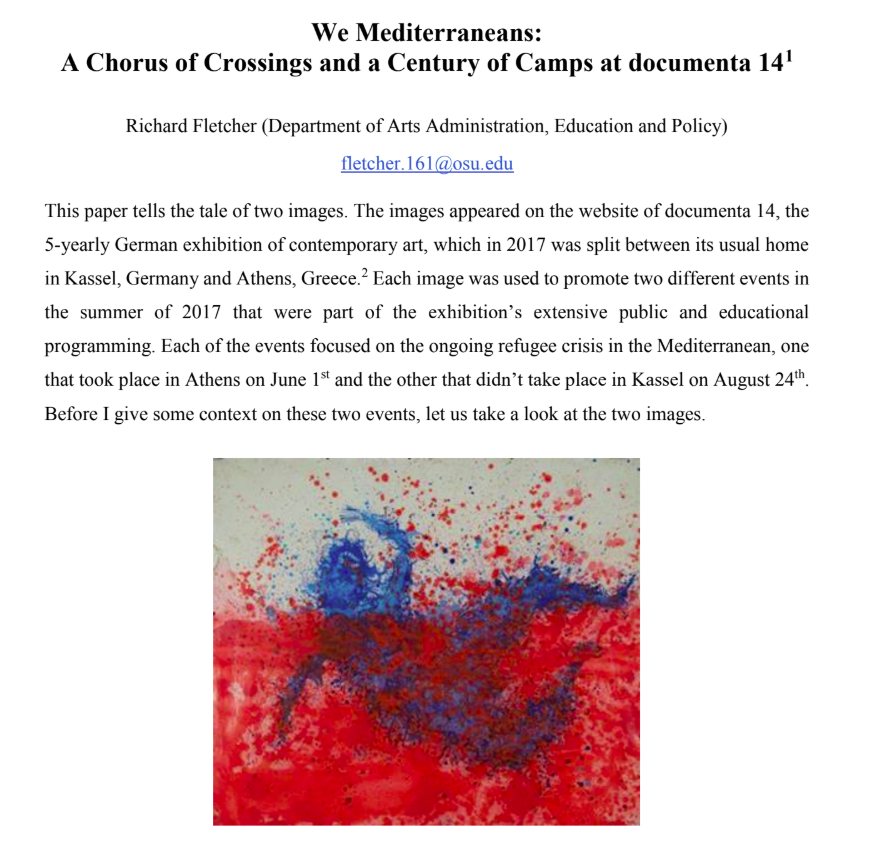
Why did the documenta 14 team blur the still from Abounaddara’s film Aleppo on their Facebook page?
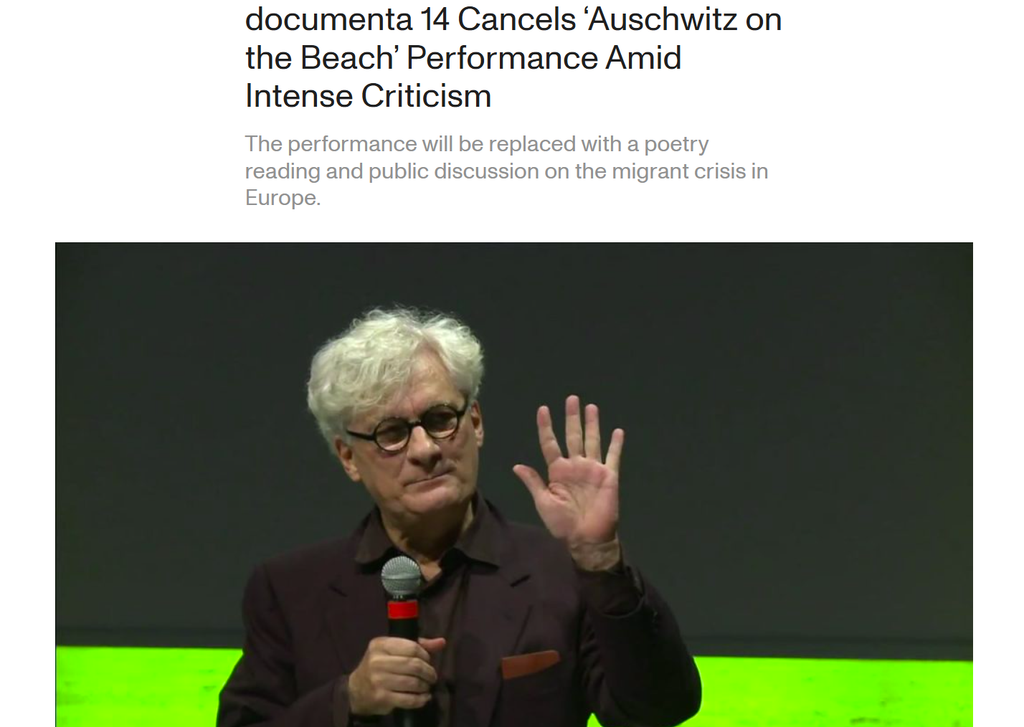
Speaking to the German daily Frankfurter Allgemeine Zeitung, Charlotte Knobloch, commissioner for Holocaust Memorials of the World Jewish Congress, criticized the canceled performance as “a grotesque production,” explaining that “to describe the refugee debate within the context of the systematic extermination of the Jews is untenable, bears witness to unspeakable ignorance and lacks all feelings of shame. The Holocaust is a singular, unprecedented crime. Any relativization or denial is forbidden.”
“We are going towards an extermination – I dare to use this word”
To justify his use of this word he cites official figures – 30,000 people drowned in the Mediterranean – to prove how the violence that is coming again is, Berardi says, ‘a looming holocaust’, then asking himself ‘was I right or was I wrong?’ to use this word. To support his argument, Berardi (who is speaking in English throughout) then quotes the American diplomat and political theorist Zbigniew Brzezinski from his article ‘Toward a Global Realignment’ in The American Interest:
“Periodic massacres of their not-so-distant ancestors by colonists and associated wealth-seekers largely from western Europe (countries that today are, still tentatively at least, most open to multiethnic cohabitation) resulted within the past two or so centuries in the slaughter of colonized peoples on a scale comparable to Nazi Wold War II crimes: literally involving hundreds of thousands and even millions of victims. Political self-assertion enhanced by delayed outrage and grief is a powerful force that is now surfacing, thirsting for revenge, not just in the Muslim Middle East but also very likely beyond.”
Berardi follows this quotation by describing how we need to emerge from the violence of modernity, colonialism and capitalist exploitation, not for moral reasons but because the alternative is fascism and massive destruction of life, of our life, not only the life of the others. He then pivots to the controversy itself and his meeting earlier that day with members of the Jewish community in Kassel in an attempt to understand the problem if he uses or says that name. Turning to the specific accusation of ‘relativization’, Berardi reframes it as ‘contextualization’. Such contextualization means there is an affinity across the violence of white supremacy, specifically in terms of 1930s Germany and today’s America, wherein humiliated exploited workers are emboldened as white warriors. Berardi explains that this is why he decided to contextualize Nazism and to ‘use that despicable word’. Turning back to his conversation with the Jewish community, he heard how they spoke of suffering and trauma and Berardi noted how suffering is the decisive word. In his final flourish, Berardi turns to his poem, how it is not a bad poem, its contents are not bad, but if someone is suffering, he will forget about his poem, he will write better poems. At that moment, he rips up his poem and casts it away, finishing with the call for us to find a way to come out of the abyss that financial capitalism and nationalism has brought us.