I just read today’s Facebook post by Abounaddara – the anonymous Syrian film collective who participated in documenta 14 in 2017 and whose weekly films from 10 years ago I have been posting each Friday. In the post, which acts as a press release (and which I have copied and pasted in full below), Abounaddara explain their withdrawal from a research project with The French National Museum of Natural History. They describe how they are doing so:
in protest of the Museum’s failure to honor its obligations regarding the preservation of the remains of Soliman al-Halabi (1777-1800), which the Museum keeps as a specimen of a “Syrian fanatic.”
In addition to refusing this characterization of Soliman al-Halabi, a figure of resistance against colonial Western powers, as a religious fanatic, Abounaddara have been petitioning for the return of his remains to Syria and his posthumous naturalization. The museum had previously claimed that it was holding the remains in keeping with the “principle of dignity” (a principle that is central to the work of Abounaddara in terms of the dignity of human life and the dignfied image), yet the research program had found that was not the case. Rather than work together to rectify the situation, the museum
raised its own “ethical and conservation concerns.” The Museum thus considers itself unaccountable regarding a plundered body that it keeps in defiance of the very ethical standards it invokes. Abounaddara therefore have no choice but to withdraw from the research program, unless they were to condone an injustice compounded by contempt.
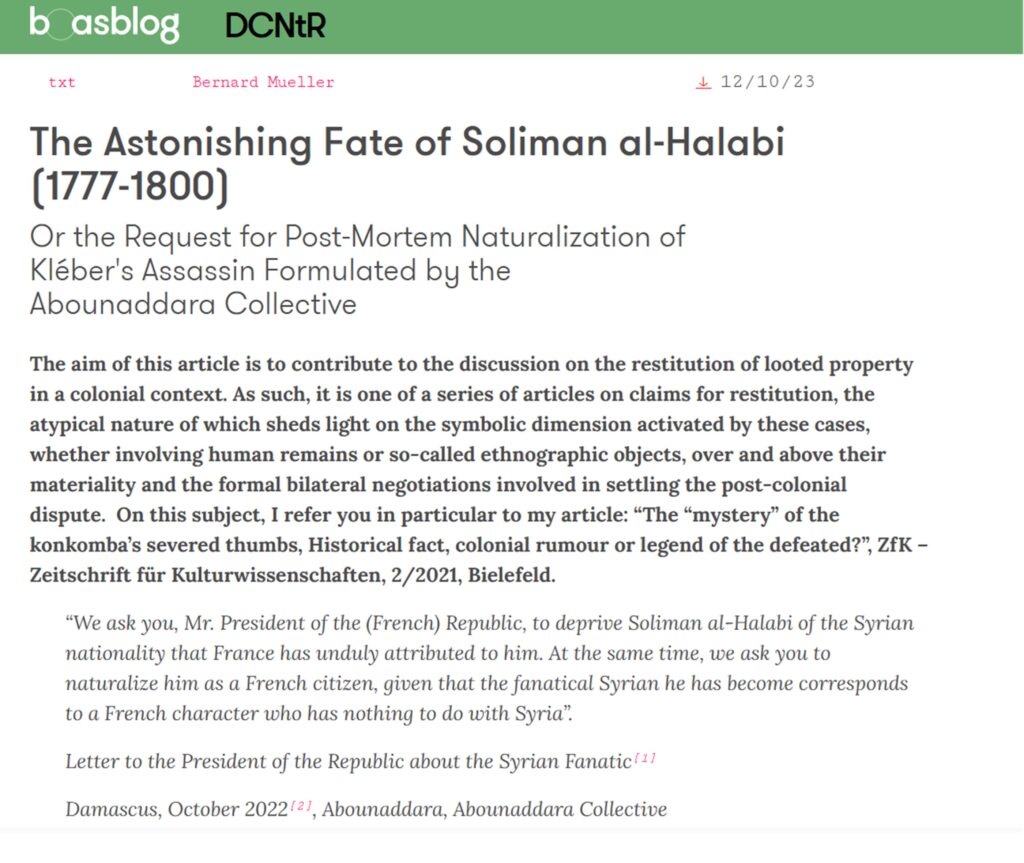
I am sharing this press release today to remind readers of minus plato? that while I have been reposting Abounaddara’s films from 10 years ago as part of my engagement with the public aneducational legacies of documenta 14 (as part of my series Our Curriculum of Imposters (Here & Now, There & Then; On & On), their important work continues. Also, in reading an online article (click on the above image to read) about their earlier efforts to return the remains of Soliman al-Halabi from France, I realized recognized the digital collage called The Murderer Returning to the Scene of the Crime (2013) that Abounaddara used to represent their work on the documenta 14 website and Daybook publication (their ‘day’ was a week ago today – August 17).
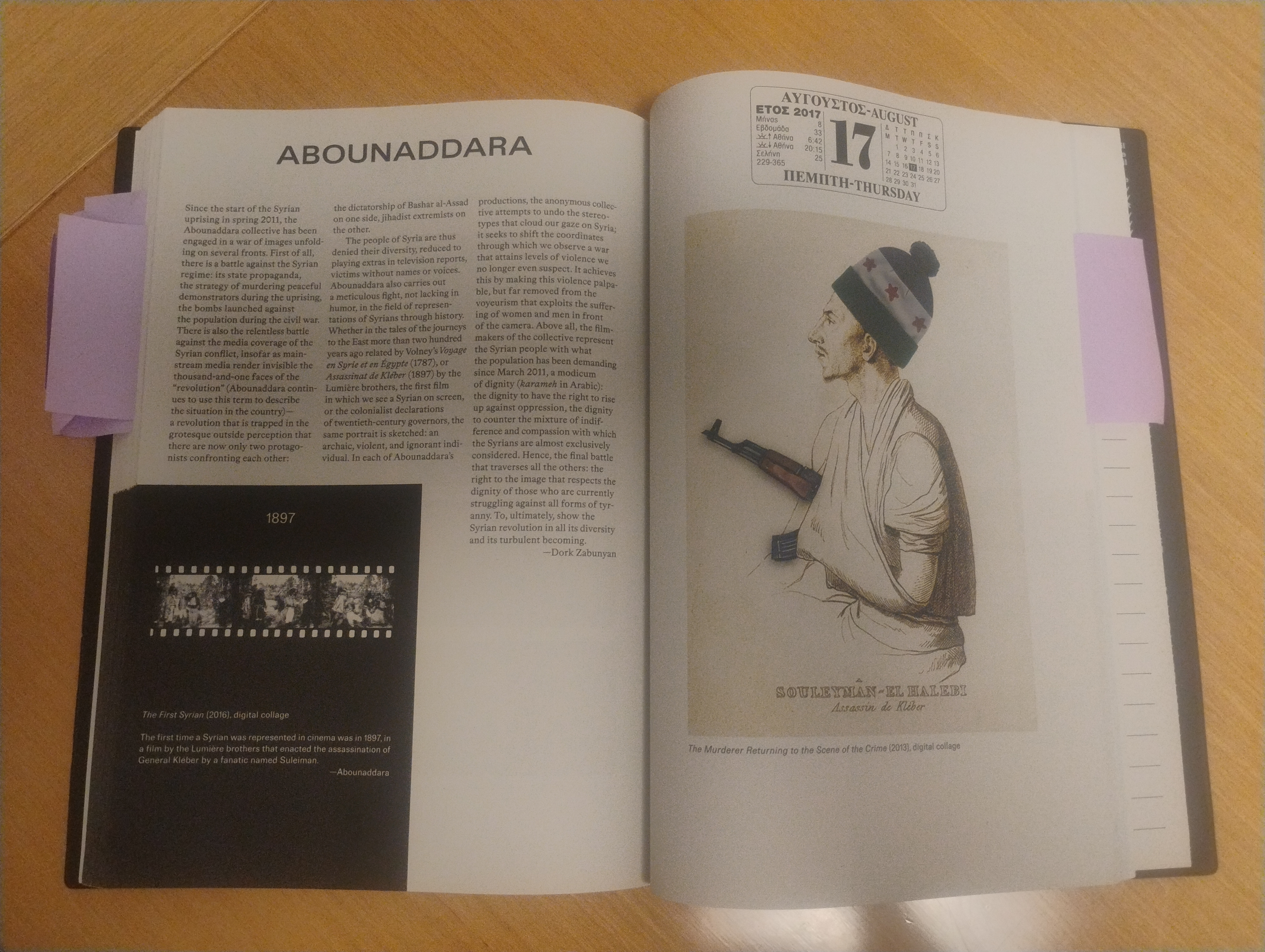
It was only then that I realized that the image was an altered colonial depiction of Soliman al-Halabi (which is still used in the Wikipedia entry on al-Halabi).

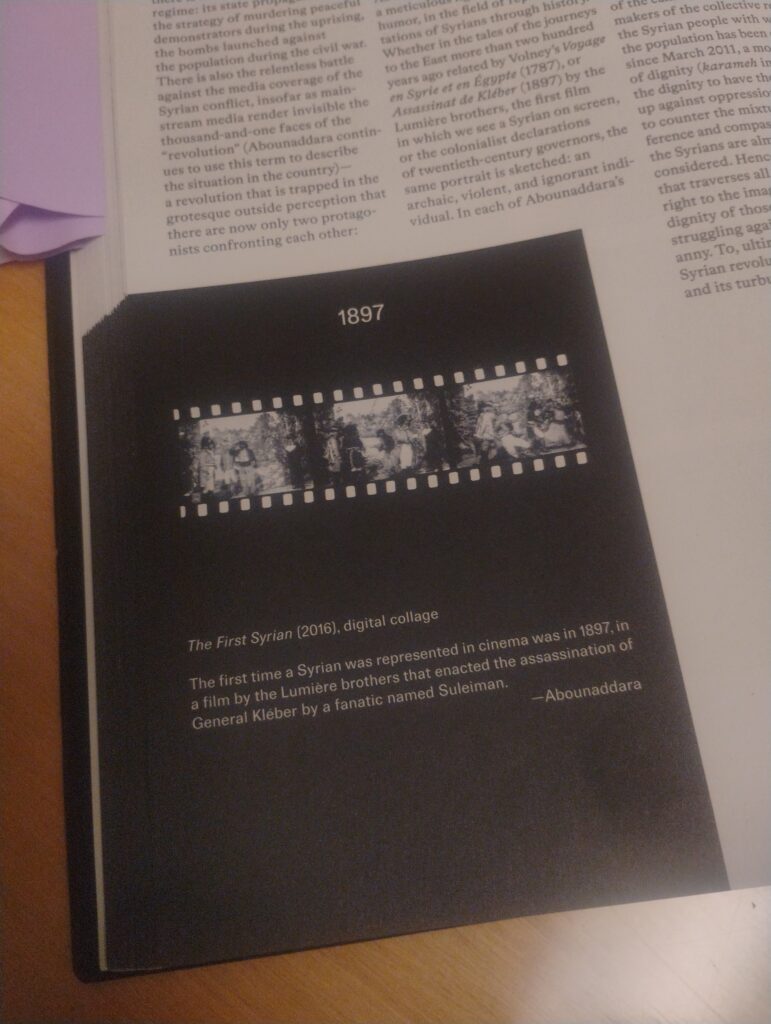
In addition, their date selected in the Daybook – each documenta 14 artist was asked to choose a date that was important for them and the whole catalog was ordered chronologically according to those dates, from the future to the distant past) – and represented in a small black rectangle in the bottom left corner of the spread – was 1897. This year was chosen because it was when the Lumière brothers’ film Assassinat de Kléber, was made that enacted the assassination of General Kleber by a fanatic named Suleiman.
As they note in today’s press release:
In the 19th century, Soliman al-Halabi embodied the religious fanatic. French scientists claimed to detect in his body traces of so-called Muslim fanaticism, an affliction that was blamed for the ruin of Greco-Roman Syria.Generations of writers and artists subsequently passed down this colonial representation, which cinema enshrined in the figure of the treacherous bearded man (Assassinat de Kléber, a Lumière film, 1897).
As Dork Zabunyan writes in the Daybook:
The people of Syria are thus denied their diversity, reduced to playing extras in television reports, victims without names or voices. Abounaddara also carries out a meticulous fight, not lacking in humor, in the field of representations of Syrians through history. Whether in the tales of the journeys to the East more than two hundred years ago related by Volney’s Voyage en Syrie et en Égypte (1787), or Assassinat de Kléber (1897) by the Lumière brothers, the first film in which we see a Syrian on screen, or the colonialist declarations of twentieth-century governors, the same portrait is sketched: an archaic, violent, and ignorant individual. In each of Abounaddara’s productions, the anonymous collective attempts to undo the stereotypes that cloud our gaze on Syria; it seeks to shift the coordinates through which we observe a war that attains levels of violence we no longer even suspect. It achieves this by making this violence palpable, but far removed from the voyeurism that exploits the suffering of women and men in front of the camera. Above all, the filmmakers of the collective represent the Syrian people with what the population has been demanding since March 2011, a modicum of dignity (karameh in Arabic): the dignity to have the right to rise up against oppression, the dignity to counter the mixture of indifference and compassion with which the Syrians are almost exclusively considered. Hence, the final battle that traverses all the others: the right to the image that respects the dignity of those who are currently struggling against all forms of tyranny. To, ultimately, show the Syrian revolution in all its diversity and its turbulent becoming.
I share this post today in solidarity with the people of Syria as they rebuild after years of devastating war and colonial violence and in gratitude to the brave and brilliant filmmakers of Abounaddara for their powerful, insistent work, both in relation to documenta 14 and today.

ABOUNADDARA WITHDRAWS FROM FRENCH NATIONAL RESEARCH PROGRAM CONCERNING THE PLUNDERED BODY OF THE GENERAL KLÉBER’S ASSASSIN
Abounaddara, a collective of Syrian artists, is withdrawing from a public research program conducted in partnership with The French National Museum of Natural History in protest of the Museum’s failure to honor its obligations regarding the preservation of the remains of Soliman al-Halabi, which the Museum keeps as a specimen of a “Syrian fanatic.”
Soliman al-Halabi (1777–1800) is known for having assassinated General Kléber, who had succeeded Bonaparte as head of the French expedition in Egypt. A public scribe, he was originally from Aleppo, then a province of the Ottoman Empire. He was arrested in Cairo and sentenced to death by impalement by a French military tribunal. His body was brought to France upon the expedition’s return and given to The French National Museum of Natural History, where it was publicly exhibited until the 1980s.
In the 19th century, Soliman al-Halabi embodied the religious fanatic. French scientists claimed to detect in his body traces of so-called Muslim fanaticism, an affliction that was blamed for the ruin of Greco-Roman Syria. Generations of writers and artists subsequently passed down this colonial representation, which cinema enshrined in the figure of the treacherous bearded man (Assassinat de Kléber, a Lumière film, 1897).
In the 20th century, Soliman al-Halabi embodied the national hero. Arab nationalist and Islamist movements found in him a model of resistance against colonial Western powers and Israel. Syria named streets and schools after him, as did Egypt and other Arab countries.
In October 2022, Abounaddara petitioned the French president for the posthumous naturalization of Soliman al-Halabi, on the grounds of his post-mortem residence in France. They also launched a petition calling on the Museum to bury his remains, which Syria did not request be returned. Finally, they partnered with French researchers on a research program into the history of this figure, funded by the French National Research Agency.
The Museum committed itself as a partner in this program, presenting it as a break with its colonial past. It also hosted part of the program’s work and took part in it through the head of its anthropology collections. Previously, in an article in Le Monde on 21 March 2023, it had stated that the Museum preserved the body of Soliman al-Halabi in keeping with the “principle of dignity.”
The Museum nevertheless changed its stance after the research program established that the body of Soliman al-Halabi was not being preserved under the conditions of dignity required by the ICOM (International Council of Museums) Code of Ethics. Rather than remedying this together with its partners, it raised its own “ethical and conservation concerns.” The Museum thus considers itself unaccountable regarding a plundered body that it keeps in defiance of the very ethical standards it invokes.
Abounaddara therefore have no choice but to withdraw from the research program, unless they were to condone an injustice compounded by contempt. They wish to commend the commitment of its French colleagues, while regretting that the Museum did not take the hand extended to it at a time when it stands accused of harboring hundreds of skeletons and skulls of formerly colonized peoples. Finally, they hope that the supervising authorities, having been duly informed of the situation, will assume their proper responsibilities.
Link to the press release in English = https://www.facebook.com/photo?fbid=1603206504835613&set=a.270527684770175
Link to the press release in French = https://www.facebook.com/photo?fbid=1603241184832145&set=a.270527684770175