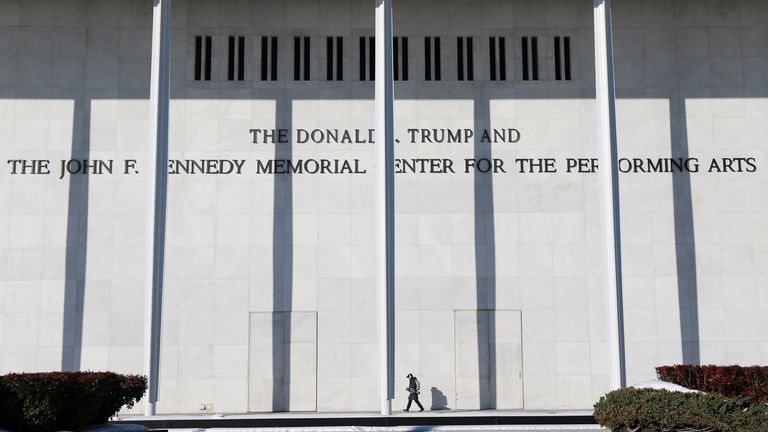
[Frederic Rzewski’s The People United Will Never Be Defeated] is a large set of piano variations composed in 1976 for the pianist Ursula Oppens. Rzewski is well known for his virtuosity and for his support of and definitive performances of new music. He is also known for quite a bit of music with political themes. […]. Rzewski took as his starting point a popular song by Sergio Ortega (1938-2003), a Chilean composer and pianist. He wrote the song in 1973 with lyrics written by members of the musical group Quilapayún who subsequently recorded it. Quilapayún recorded no less than 26 studio albums from 1966-2009 along with several live albums. They are a part of the Nueva Canción Chilena which sought political change through new songs defining those changes. The Nueva Canción movement became a subset of Latin American and Iberian folk-inspired protest music which saw groups form worldwide producing songs which became part of the soundtrack of political protests in those various countries. After the 1973 coup which deposed and likely assassinated Salvador Allende the song was popularized also by another Chilean group, Inti-Illimani. Both groups along with many political dissidents sought and found asylum in other countries. Inti-Illimani found refuge in Italy, Ortega and Quilapayún settled in France. This major opus was written on commission for Ursula Oppens who asked for a companion to the Beethoven Diabelli Variations, certainly a tall order. Rzewski wrote the piece in 1975 no doubt inspired at least in part by the 1973 coup which deposed Salvador Allende and installed the dictator Augusto Pinochet. The piece consists of 36 variations grouped in 6 sets of 6 variations each. In a nod to Bach’s Goldberg Variations the final variation is a restatement of the theme. In addition to the main theme there are quotations from an Italian socialist song, “Bandiera Rossa” and “Solidarity Song” with words by Bertold Brecht and music by Rzewski’s former teacher, Hanns Eisler. Oppens premiered the piece on February 7, 1976 at the Bicentennial Piano Series at the John F. Kennedy Center for the performing arts in Washington, D.C. She made a grammy nominated recording of the work in 1979 and the piece has enjoyed numerous subsequent performances and recordings. The piece is structured symmetrically in six sets of six variations each. It also allows for a bit of improvisation. But this is an eminently listeninable piece which seems rightfully to be gaining its place in the repertoire. […] Rzewski himself has recorded the piece four times (1977, 1990, 1999 and 2007). […] Whether this work had any impact on the atrocitie.s of the repressive Pinochet regime is certainly doubtful but the fact that this piece has essentially entered the repertoire for virtuoso pianists and stands as a monumental achievement in the variation form will pretty much guarantee that the atrocities and their perpetrators will be recalled and hopefully reviled at each and every performance.
[I]n 1975, a serious political event caused Rzewski to rethink the nature of political music, prompting the composer’s most
famous piece of protest The People United Will Never Be Defeated! After Chileans elected socialist Salvador Allende as their president in 1970, the United States, fearing the spread of Soviet influence in the Western hemisphere, worked to undermine
Allende’s government.60 President Nixon assigned a special task force of the CIA to put economic pressure on the country, depose Allende, and help to establish a new, nonsocialist government. The CIA helped Chilean General Augusto Pinochet stage a coup
d’état on September 11, 1973 after which Chile was ruled by a military junta until 1990. Pinochet’s coup and the brutal tactics of his military regime incited outrage throughout the world, inspiring numerous protests outside Chile. […]Rzewski’s message of political solidarity remains at the forefront in The People United. Pianist Ursula Oppens commissioned the piece for a performance at the Kennedy Center celebrating the American Bicentennial. Premiered just two years after Pinochet’s takeover, Rzewski’s setting provided a bold commentary on the precepts of American freedom and respect for democracy.