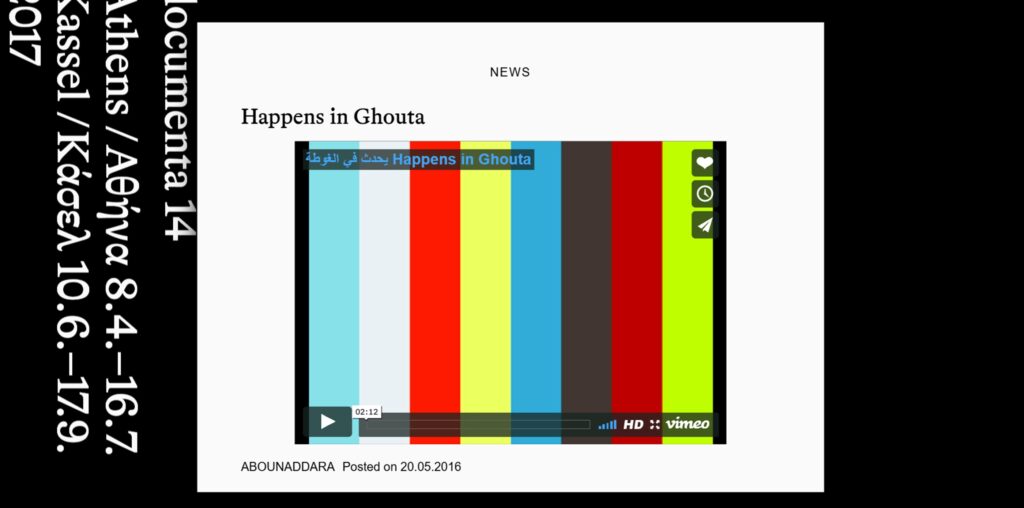
In 2013, Mohammad Ali Atassi and several colleagues formed Bidayyat: an organization that sought to teach Syrians how to make documentaries so they could take ownership of their wartime narratives. It was one of several such initiatives in Syria. An anonymous collective called Abounaddara had been active since 2010 with a focus on “emergency cinema,” i.e., cinema rendered as an essential public service akin to health care. They released short, low-budget, and artisanally produced videos weekly via social channels, focusing on the testimonies and acts of resistance of ordinary citizens. According to their bio, their MO was “evoking horror without ever showing it” to “defend the rights of the nameless to a dignified image.” While Bidayyat shared many of Abounaddara’s objectives, it employed a different approach. Its films would be carefully and artfully constructed, professionally edited, and rooted in the filmmaker’s personal vision.
[…]
The 2018 Bidayyat production Still Recording…comprises footage recorded between 2011 and 2015 by two art students, Ghiath Ayoub and Saeed Al Batal, as young men around them took up arms against Assad’s forces. In 2013, while filming, Al Batal was at the site of the chemical attack in Ghouta that killed over 1,000 people and injured nearly 6,000 more. The scene is not in the film because Al Batal put down his camera and started helping people. He also refused to include footage of the attack shot by comrades. We only see two brief shots that he had taken almost by accident: The first is of a chemical missile arcing in the sky, and the second of some dead chickens on a stained-red ground. The events are conveyed via on-screen text. It’s a strange gap in a film that otherwise establishes how essential it was for Ayoub and Al Batal to film constantly; the camera was his “shield,” Al Batal wrote in an essay for the Bidayyat website. It is the absence that confirms his presence: He could no longer film precisely because he was there.
– Devika Girish (2026) ‘Avant Grief: The Experimental Cinema of Syria’s Wartime Film Collectives’