The Syrian Who Wanted the Revolution, Part Seven: The Salvation – The Nation, March 18, 2016
This week [March 18-24, 2016] marks the fifth anniversary of the Syrian revolt. It’s nearly impossible to fathom the destruction unleashed on this country that, we must admit, no longer exists as a country. Syria is fractured and destroyed, much of it now unrecognizable. Overrun by foreign mercenaries and carved into pieces by militias and the Assad regime, the once-proud nation has become a Disneyland for the world’s most violent criminals, craven politicians, and psychopathic ideologues.
The revolution began differently. In January 2011, a peaceful protest movement, inspired by the Tunisian and Egyptian examples, was slowly blooming. It sprouted cautiously at first, spreading over the country and growing more daring over time. When 15 boys were arrested in Dara’a in March for scrawling “the people demand the fall of the regime,” a popular slogan of the Arab uprisings, on walls, the residents of this small southern town near the Jordanian border became enraged. They gathered on March 18 to demand the release of their boys. Instead, Bashar al-Assad’s security forces opened fire, killing at least four protesters. The Syrian spring had sprouted blood.
Five horrific years later, even the United Nations has stopped counting the dead. In August 2014, the UN put the death toll at 191,369. By August 2015, it would only offer an estimate of “over 250,000 dead,” citing a lack of reliable information. This February, another organization, the independent Syrian Center for Policy Research, released a report detailing its survey of the number of people killed, either directly or indirectly, by the war. That total reached 470,000 dead.
If we put this number into context, the situation becomes even more stark. In 2010, life expectancy in Syria was 70.5 years. By 2015, it had nosedived to 55.4 years. During these five years, over a million people were injured. And this year, more than 45 percent of the nation’s school-age children will not attend classes, almost certainly producing a lost generation. According to UNICEF, one in three Syrian children—around 3.7 million kids—has been born during these last five years, including 306,000 born as refugees. Over 80 percent of Syria’s total child population—8.4 million children—are in desperate need of humanitarian aid. The only world these children know is one fashioned by war and brutal violence. Almost half the population of 23 million people have fled their homes, with 4.6 million forced to leave the country and 6.6 displaced internally. The catastrophe is inconceivable.
And yet, for five years the world has basically averted its eyes from this grim reality, largely abandoning the Syrian people through tepid international diplomacy. In 2012, Kofi Annan came, and then Kofi Annan left. (He stayed five months.) Multilateral efforts to stop the violence have been disgracefully ineffectual, while multilateral efforts to escalate the violence have succeeded phenomenally. Only in the last few weeks are there glimmers of hope that the violence may lessen.
The uprising has begotten no end of evils and terrors, and yet the only attention the rest of the world pays is either to the war’s grotesque spectacles of violence in the form of the war porn of ISIS and others or, more lately, to the images and reality of a world-historical refugee crisis. Even then, attention was paid only when these ragged figures began knocking on the doors of Europe or washing up lifeless on its shores. Left to wallow in tyranny and torture or desperately escape their misery and abjection, Syrians have become the damned of this world. The wretched of the earth.
If the world’s reaction has been to turn away, Abounaddara forces us to look.
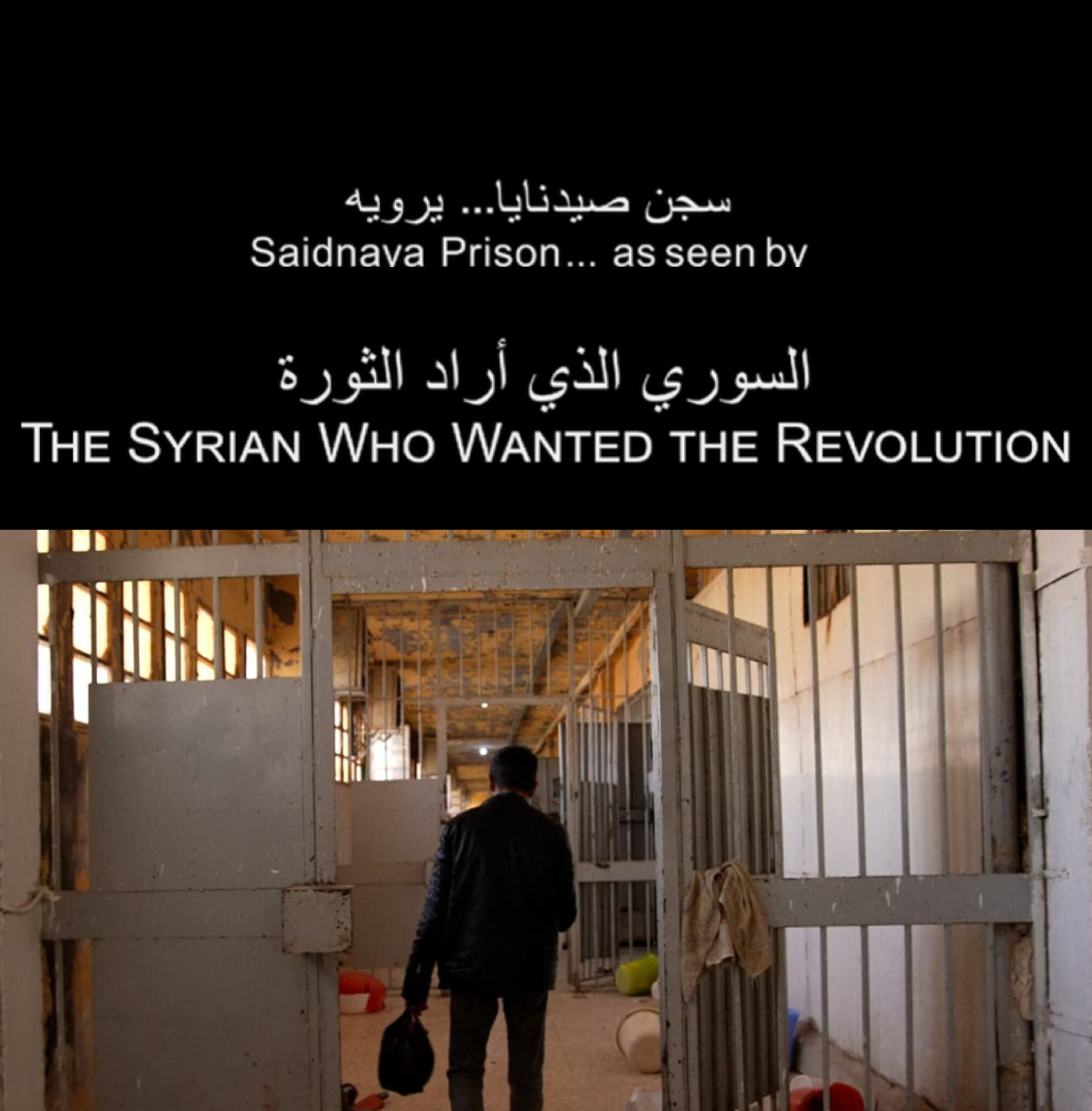
Enter Abounaddara, the anonymous Syrian film collective that, despite all odds, has been releasing a new film every Friday chronicling the many sides of the Syrian war. If the world’s reaction has been to turn away, Abounaddara forces us to look, not at the pornography of war but at the human consequences of violence. Engaging in self-labeled “emergency cinema,” Abounaddara—the name translates to “the man with the glasses,” which is to say the man who, through his lenses, can see clearly—has produced a seven-part series, titled “The Syrian Who Wanted the Revolution,” timed for release with the five-year anniversary of the war. The Nation is proud to showcase the series over the course of this week.
Throughout the series, we hear the testimony of a secular protester who joined the revolution in Aleppo in March 2011 but was arrested by the regime in June of that year. He spent more than three years as a prisoner in Saidnaya Prison, the regime’s worst and most notorious prison, until he was freed in July 2014 after having been given up for nearly dead from tuberculosis. In the series, we learn about how the initial protests were organized, what kind of conditions dissidents endure, the torture the regime freely engages in, how hospitals become sites not of life but of death, how the dissidents sat out the rise of the militias, and much more. The information, and the humanity with which it is delivered, is invaluable.
Like many of Abounaddara’s videos, “The Syrian Who Wanted the Revolution” ends abruptly. Its focus is on one person’s experience rather than on a full human or national story. These videos are almost by definition fragmentary, difficult, unresolved, and disrupting, but so is Syria’s revolution. This series, like all of Abounaddara’s videos, does not seek to explain the politics of Syria to viewers or to argue for a tidy political solution to the butchery Syrians (but not us) are constantly menaced by. It is precisely this open-endedness that makes the work bracing, relevant, honest, and incomplete, which I mean here as a positive value. “It is not the office of art to spotlight alternatives,” the German Jewish philosopher Theodor Adorno writes, “but to resist by its form alone the course of the world, which permanently puts a pistol to men’s heads.” There is perhaps no better description of the work of Abounaddara.
Part 1: The Demonstrations
Part 2: The Welcome
Part 3: The Punishment
Part 4: The Holiday
Part 5: The Hospital
Part 6: The Visit
Part 7: The Salvation
A former prisoner shares what life was like in the infamous Sednaya prison in Syria – NPR December 12, 2024
The fall of Bashar al-Assad’s regime in Syria has meant freedom for thousands of people imprisoned in inhumane conditions across the country. Men, women and children have been held underground – some for decades.
(SOUNDBITE OF ARCHIVED RECORDING)
UNIDENTIFIED SOLDIER: (Speaking Arabic).
UNIDENTIFIED PRISONER: (Speaking Arabic).
UNIDENTIFIED SOLDIER: (Speaking Arabic).
UNIDENTIFIED PRISONER: (Speaking Arabic).
UNIDENTIFIED SOLDIER: (Speaking Arabic).
UNIDENTIFIED PRISONER: (Speaking Arabic).
UNIDENTIFIED SOLDIER: (Speaking Arabic).
SUMMERS: CNN’s Clarissa Ward captured the moment when a prisoner was freed and taken outside for the first time in months.
(SOUNDBITE OF ARCHIVED RECORDING)
UNIDENTIFIED PRISONER: (Speaking Arabic).
CLARISSA WARD: “Oh, God – the light,” he says. “Oh, God – there is light. My God – there is light.”
SUMMERS: There are prisons across Syria, but the most infamous is the Sednaya prison, which has been dubbed the Human Slaughterhouse. Given the notorious nature of what went on there, this could be a difficult conversation for some people to hear. It will last for about 8 minutes.
The prison is located just north of Damascus. The intricate complex held tens of thousands of Syrians who were tortured, subjected to rape, and deprived of food, water and basic sanitation. One of those Syrians is Omar Alshogre. He was held in Sednaya for years, starting in 2014. Omar Alshogre, welcome to ALL THINGS CONSIDERED.
OMAR ALSHOGRE: Thank you.
SUMMERS: You were detained multiple times in Syria at the hands of the Assad regime. What was your reaction to seeing the regime fall?
ALSHOGRE: There has never been a moment that beautiful. I mean, the joy I felt was so extreme that I cried. I cried almost endlessly. It’s a moment that we’ve been waiting for for a long time.
SUMMERS: If you could, Omar, can you take us back to your time in Sednaya? What was it like?
ALSHOGRE: Just imagine the darkest place you can be in. Imagine missing color, dreaming of seeing a tree, dreaming of drinking water once, be full, and then die, dreaming of eating food once to be full and just die. The pain – the physical pain they put you through is miserable, from the bones that are being broken to the nails that have been pulled out. But more than that, the physical pain is something you sometimes get used to. But there’s the mental suffering they put you through. Imagine when you sit in your room with your cellmates, and the guard comes. And with his very soft voice, he tells you, you have to choose one of you to be executed tomorrow. If you don’t choose one of you, I will choose three of you to die. Then he leaves. And then you have to sit with your cellmates, and you have to ask them the question – who wants to be murdered brutally tomorrow? Who wants to volunteer to never see their family again? And such a volunteer is not that easy to get. So we had to find a way to do a lottery, so we can get the results or have a winner in the most just way possible. And any time, I could be the winner of the lottery that no one wants to win.
It’s been a place of hopelessness, helplessness. It’s been a place that reminded us that the world doesn’t care. The world knows, but the world doesn’t care. The world is doing nothing. And when you believe no one cares about you, no one is doing anything to save you, you give up.
SUMMERS: How is it that you ended up in Sednaya? Why were you arrested?
ALSHOGRE: In Syria, you don’t need a reason to be arrested. They arrest you, then they find the reason. I was sitting, chatting with my cousin when they stormed in, and they took me with my cousins to prison. And under torture, they asked me, how many officers have you – I have killed. And I said, you know, I’m still a teenager. I didn’t kill anyone, and most importantly, nobody died. And then I realized that if I don’t give a false confession, I’ll be giving away my life. I will be killed. So I give a false confession. And they give you the hope that if you give the false confession, they will stop the torture. And at that moment, you don’t care about the future. You care about the pain stopping now, so you give them the false confession they want. And as soon as you give it, that’s when the real torture starts.
SUMMERS: You’ve talked about the years that you spent there in Sednaya – the way that you were treated, the darkness that you described. I’m curious, what was it like when you realized that you yourself were being freed?
ALSHOGRE: I wasn’t freed like someone wants to be freed. I was informed that I was taken to execution, and they put me in a room for two days. Every single hour, day and night, they would come and open the small window. And the guard would ask me, how do you want me to kill you? And I had to answer that question 68 times within 48 hours – different ways of how they could kill me. And every time I have to think about it, I have to imagine. And it feels like they did it, just in my imagination. It felt it was so real. And then 48 hours later, they take me, they put me on the road or somewhere – I just felt like it’s outside of prison. And they load their guns, they aim, and they shoot. And I thought I died. But apparently, I didn’t.
My mom has bribed everyone. She bribed the people on the top and in the bottom. Even the execution guards were bribed. And from there, I was smuggled to meet my mom for the first time. I didn’t realize I was freed. And for over half a year, I was yet afraid that I will wake up and I will be still in prison. Or maybe I died, and I’m on my way to heaven or something. But it was very difficult to believe that I got out because the only thing I remember is them shooting and me dying. But apparently, I have the most magnificently strong, fabulous, beautiful mother in the world.
SUMMERS: What was it like being reunited with her, knowing that she fought so hard for your release, for your safety, for you to emerge from Sednaya?
ALSHOGRE: Just before I met my mom, I saw myself in the mirror – 20 years old, 75 pounds. I could barely walk. There’s blood coming out of my eyes, out of my ears, out of my teeth, out of my nose. I have no hair, no eyebrows. I don’t look like a human, and I don’t think anyone would recognize me. And then I am among a lot of people, and my mom walks towards me. I could barely recognize who she is. So she comes closer. And she holds her hands on me, and then she says, my heart, my life, my son, Omar. And she hugs me very strongly. And I missed – I have missed – severely missed being hugged. It was such a beautiful moment that I ruined it by not understanding that I was alive because I thought that I was dead because I was told that my mom died. And if she died and I am dead, that means we’re meeting in heaven. Everything was so confusing. Half a year later, I really felt for the first time that I actually am alive.
SUMMERS: Omar, what are your hopes for a Syria that is no longer under the rule of Bashar al-Assad?
ALSHOGRE: The worst nightmare that Syria has lived is over. Whatever come next, it’s better. And if it’s bad, it won’t be as bad as the regime. And if it’s bad, we have the power to bring it down because the Syrian people that fought alone, demonstrated alone, were tortured, starved, killed, bombed with chemical weapons alone. They dreamed alone. They hoped for a better future alone. And the world was silent for 14 years without doing anything – no international community, no United States, no Europe, no Western democracy. No – everybody was silent. And yet, we prevail. Yet, we win.
Imagine, whoever comes next wouldn’t dare to challenge the Syrian people. And that gives me hope. That gives me hope because I know people like my mom. She’s the hero. And like her, there are hundreds of thousands in Syria. I would never give up because even though they tried to break me both physically and mentally, after years of torture, yet I could be talking to you – smiling, happy, excited about the future. That tells you something about the Syrian people. They won’t settle before they have the freedom and the democracy they spoke about since 2011.
SUMMERS: Omar Alshogre, formerly detained in the infamous Sednaya prison in Syria. Thank you so much for joining us and sharing your story.
ALSHOGRE: Thank you.