Abounaddara Collective’s Journey in Winter – Aesthetics of Material Absence
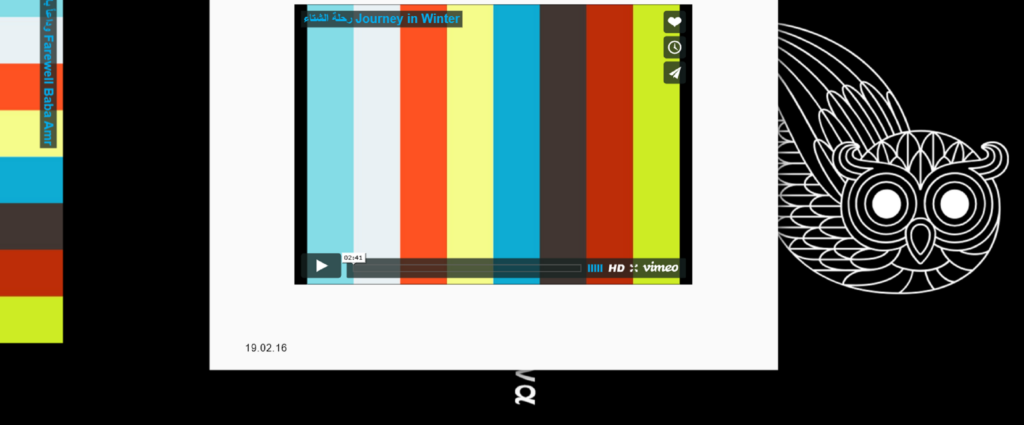
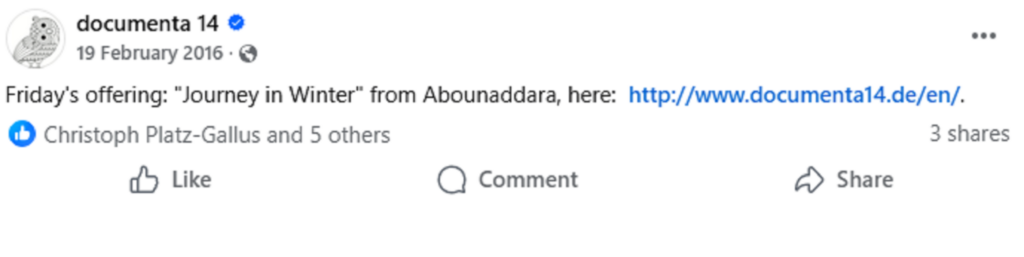
Another view of the journey’s materiality as a narrative of dissent comes from the short film Journey in Winter by the Abounaddara collective, which operates from inside Syria. The collective is made up of a group of anonymous Syrian filmmakers whose works have raised awareness about the political and social realities of life in Syria. They produced a series of short films that address issues such as freedom, dignity, and social justice, and have gained a following both within Syria and internationally. The collective does not target international audiences as such, but wants to empower the local population and reclaim their ‘right to the image’.5 The collective represents the effort to portray an alternative and dignified image of the Syrian population in their Vimeo channel. Since the early days of the conflict in March 2011 up until 2017, the Collective released a short video every Friday, in the years since the Collective has continued to release films and has exhibited internationally. They criticise the way violence is portrayed and consumed while attempting to offer an alternative representation to mainstream media. Their channel contains more than 450 videos and they have won international recognition. In 2014, they were awarded with the Short Film Grand Jury Prize at the Sundance Festival for their film ‘Of Gods and Dogs’.
The collective has repeatedly declared their interest in devising an ‘emergency cinema’ (Popan 2016), following Walter Benjamin’s idea that ‘the tradition of the oppressed teaches us that the ‘emergency situation’ in which we live is the rule’ (in Bayoumi 2015). This definition of emergency counters both the humanitarian and securitarian discourses that underpin various representations of the Syrian conflict and the so-called refugee crisis, within European politics and mainstream media (Musarò 2017). Nyers goes even further in his interpretation of Benjamin’s notion of ‘emergency’ and states that ‘the constitution of the normality requires the identification of difference, an Other through which coherence and unity of sovereign states and subjectivities are constituted and maintained’ (2006). Narratives of ‘crisis’ therefore serve the purpose of protecting European identity boundaries, presenting migrants as the exception: an Other against whom the norm can be established. As stated by Schmitt, ‘Sovereign is he [sic] who decides on the exception’ and must therefore protect the rule (2005). However, by looking at the so-called ‘refugee crisis’ as the rule in Benjamin’s terms, not the exception, artists can invent ‘new rules of representation’, as is the case of Abounaddara’s Journey in Winter (Bayoumi 2015).
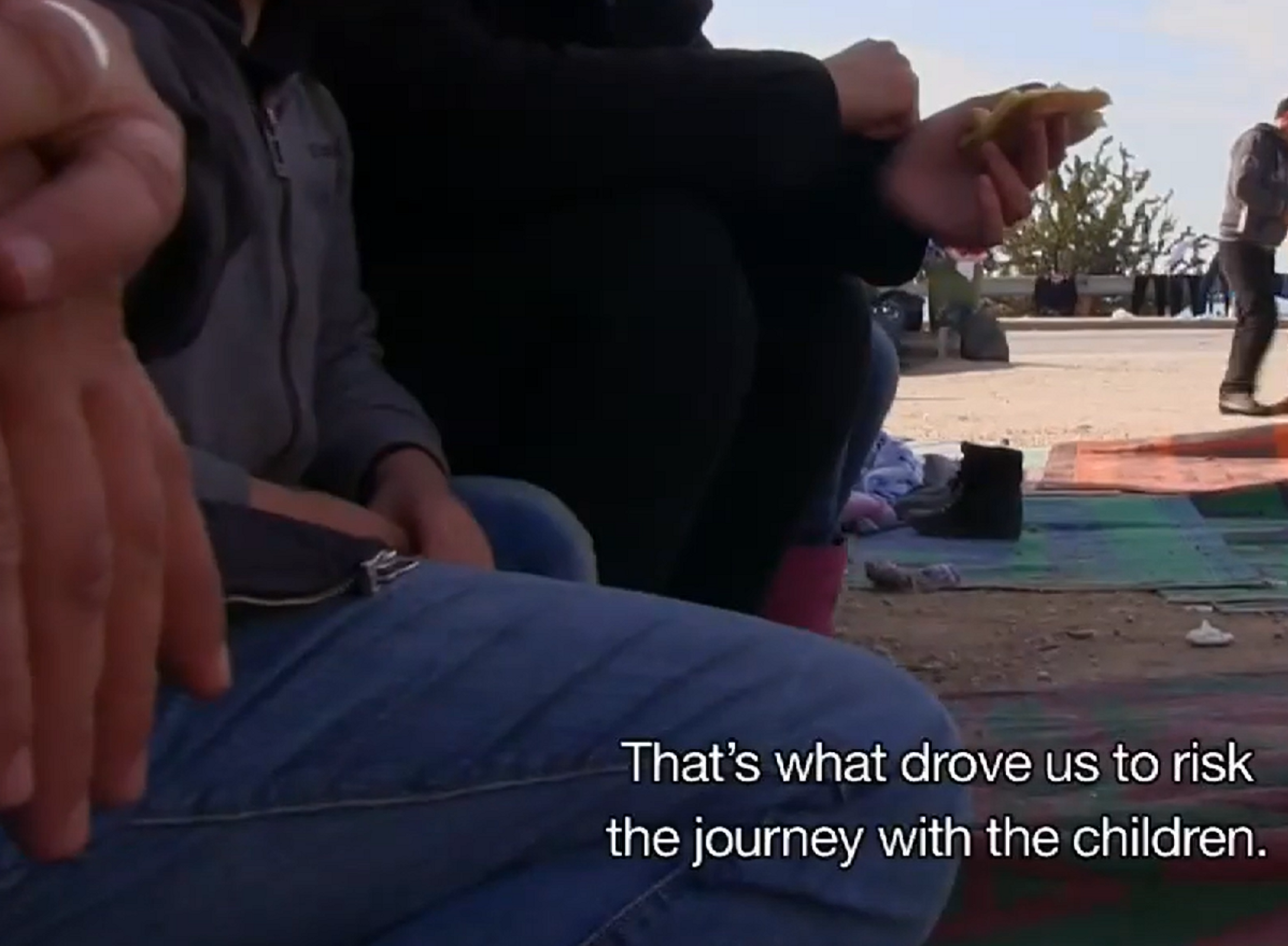
In their very short film Journey in Winter, produced in 2016, Abounaddara engaged with the materiality of displacement and the infrastructures of mobility in a way that echoed Barakeh’s focus on passport stamps. Abounaddara’s video presented a man whose face does not appear on camera. His voice appears over an image of two children playing on the beach, surrounded by safety jackets and remains of inflatable boats. His hands are now in the foreground and a child rests his head on his lap as he speaks:
We sold everything because we probably wouldn’t be back for years. Everything was valuable to us, even the cheapest things: the glasses, the pillows … Everything was dear because we worked so hard for everything. No matter the price, it couldn’t make up for that because it was our home, our mattress, our blankets, our television, the fruits of years of labour (in Abounaddara 2016).
He then explains the business that arose in Syria from salesmen buying in bulk at a very low price the belongings of people who want to migrate in order to finance their trips. With the money that they received for these belongings, his family could only afford travelling during the winter, when the sea is more dangerous and the risk of drowning is greater. At no time during the video can the viewer see the face of the man, who speaks with a calm and detached voice.
Abounaddara’s video reminds the viewer of the materiality of refugee life and the possessions that are left behind. In the same way as migrants are marked as illegal by their belongings during the trip (Andersson 2014), Journey in Winter lays out the testimony of this man almost as a photo negative, focusing on gaps and absences. The focus is not the objects that they decided to bring with them, but the items that they had to leave behind. In this sense, the man talks about the actual price of the journey and how all their belongings were sold to fund their trip and then were bought by other families: ‘There were people coming to our region. So, the salesmen buy the belongings of those who leave and re-sell them to those who stay’ (Abounaddara 2016).
The focus on materiality is a strategy for contextualising and asserting a certain kind of material agency, while at the same time speaking to the loss – or at the very least to a re-framing – of other forms of identity through the rupturing of familiar connections to place and community. In both Barakeh’s and Abounaddara’s works, the subjects are represented and ‘speak’ through inarticulate material objects. In this, there are forms of silence that bolster a ‘practice of community-building and maintenance against processes of essentialization and historical decontextualization’ (Chatzipanagiotidou and Murphy 2021: 13). These artists assert their presence through objects, as a strategy to counter the erasure of refugee individuality and humanity and, in the context of Europe’s border regimes, ‘attempts to eradicate (their) visual and material presence’ (Ibrahim 2020).
By hiding the subject’s identity and only showing his hands, Abounaddara’s video puts the emphasis on the voice (both sound and silence). As the Syrian film collective explains: ‘Our spirit of filmmaking has always been to go for the countershot, not to go where the mainstream media typically go. Our notion of emergency cinema is based on disturbing and inventing’ (Bayoumi 2015). Abounaddara’s anti-representative cinema rejects the notion that there can be any meta-image of refugee-ness. In the case of Journey in Winter this rejection is literal, by relegating the image to secondary and focusing on the absence of identity, thereby offering an alternative narrative.
Following that objective of disturbing and inventing, Abounaddara positions the spectator in a similar fashion to that which Susan Sontag describes in her essay The Aesthetics of Silence: their videos do not demand the spectator’s understanding. As Sontag puts it: ‘Contemplation, strictly speaking, entails self-forgetfulness on the part of the spectator: an object worthy of contemplation is one which, in effect, annihilates the perceiving subject’ (Sontag 2013 [1967] [2013 [1967]]). This is, we argue, a fundamental difference with other pieces of art that privilege the gaze of the Western spectator, conveying a certain image of refugees that seeks to trigger particular emotions. Indeed, the artistic representation of the refugee experience contributes to confronting and opposing media and state discriminatory discourses that feed fear of the outsider. However, in offering an alternative narrative there needs to also be recognition of the risk of victimisation and the excessive focus on the audiences, leaving aside the centrality of spaces in which the experience of refugees is lived and narrated and the power of individual experience and its materiality.