In 1889, Congress openly seized land in Indian Territory for white settlement. The land runs thundered. Many of the settler towns created in the land runs are ghost towns now. Timber, railroads, and mining leaving a host of cavernous emptiness in their wake. What is a ghost town in a nation whose settlements, roads, and parks are directly superimposed over Indigenous cities, trails, and sacred sites?
– Laura Da’ ‘Passing the Frontier’, from Severalty , University of Arizona Press, 2025.
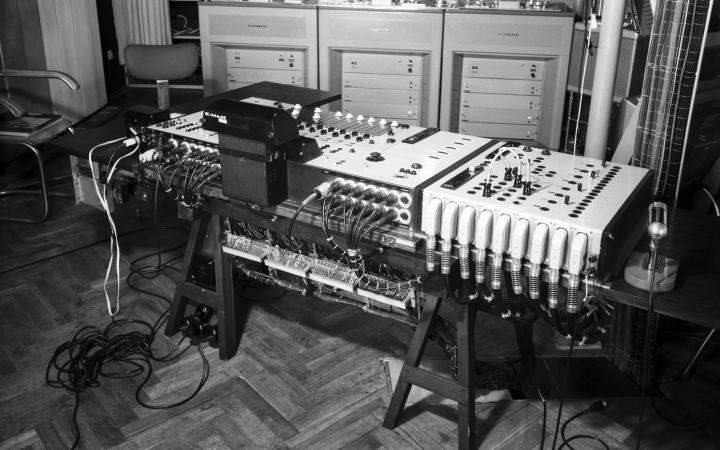
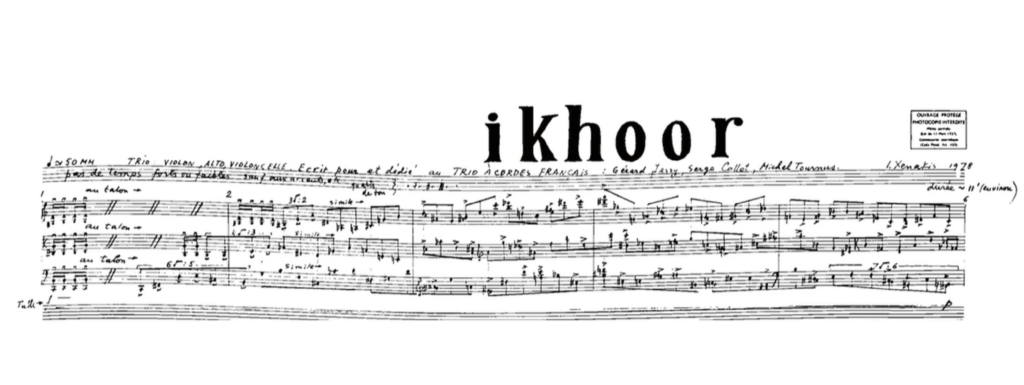
In 1966 Oskar Hansen, who had recently redesigned the working environment of the Polish Radio Experimental Studio (PRES), went to Stockholm to participate in the Fylkingen congress, an annual meeting of experimental composers. Gathered in the National Museum of Science and Technology under the banner Visioner av Nuet (Visions of the Present), the congress set out to explore new relationships between music, art, and science. Many leading figures in the budding field of intermedia art— creative practices that crossed the boundaries of different art forms, often employing new technologies—participated: Korean-American artist Nam June Paik showed one of his robots playing audiotaped speeches, and American composer Alvin Lucier attempted to control brainwave signals to create sounds in a rendition of his extraordinary Music for Solo Performer (1965). Yet it was a musical composition by Iannis Xenakis that drew Hansen’s attention:
The piece, a background of musical events of the same pitch but of a changing, fluently modulated intensity, caused even the smallest sounds of different pitches to be heard very clearly (a candy wrapper being unfolded, a cough, a chair creaking). A background “crawling” on the floor, climbing on the walls and the ceiling, as if looking for events to reveal, only to disappear through the window like sonic fog. A clearly visual piece—a monochromatic continuity characterized by formal insufficiency—awaiting events .
At the time, Xenakis, a Greek composer who had trained as an architect and worked with Le Corbusier on the much-lauded Phillips Pavilion featuring the Poème Electronique multimedia presentation at the Brussels Expo in 1958, was developing his ideas of polytopes, installations featuring sound, light, and architecture. Exploring what he called stéréophonie cinématique , Xenakis presented his Fylkingen audience with the sensation of mobile sound. This was, Hansen declared in his personal notes, “an important experience—Open Form music.
– David Crowley ‘Spatial Music: Design and the Polish Radio Experimental Studio’, Post – notes on art in a global context, MoMA, January 14, 2014.
In the Parliament of Bodies, you will find neither individual chairs within the building nor a fixed architecture. We avoid positioning the audience as aesthetic visitors or neoliberal consumers. We also reject the democratic fiction of the semicircular amphitheater. We claim—with Oskar Hansen—the political potential of the “open form.”
– Opening of the first public venue and the Public Programs of documenta 14 – 34 Exercises of Freedom
Cover my eyes with
– Laura Da’ ‘Doctrine of Signatures’ from Severalty , University of Arizona Press, 2025.
Inspired both by the “Open Form” methodology of artist and architect Oskar Hansen, and by the potential of spontaneous meetings to generate social and political change, the Open Form Societies work like self-learning, self-organized micropublics that generate their own activities.
– The Open Form Societies, documenta 14
Many perceive heaven
– Laura Da’ ‘The Meadow’ from Severalty (University of Arizona Press, 2025)
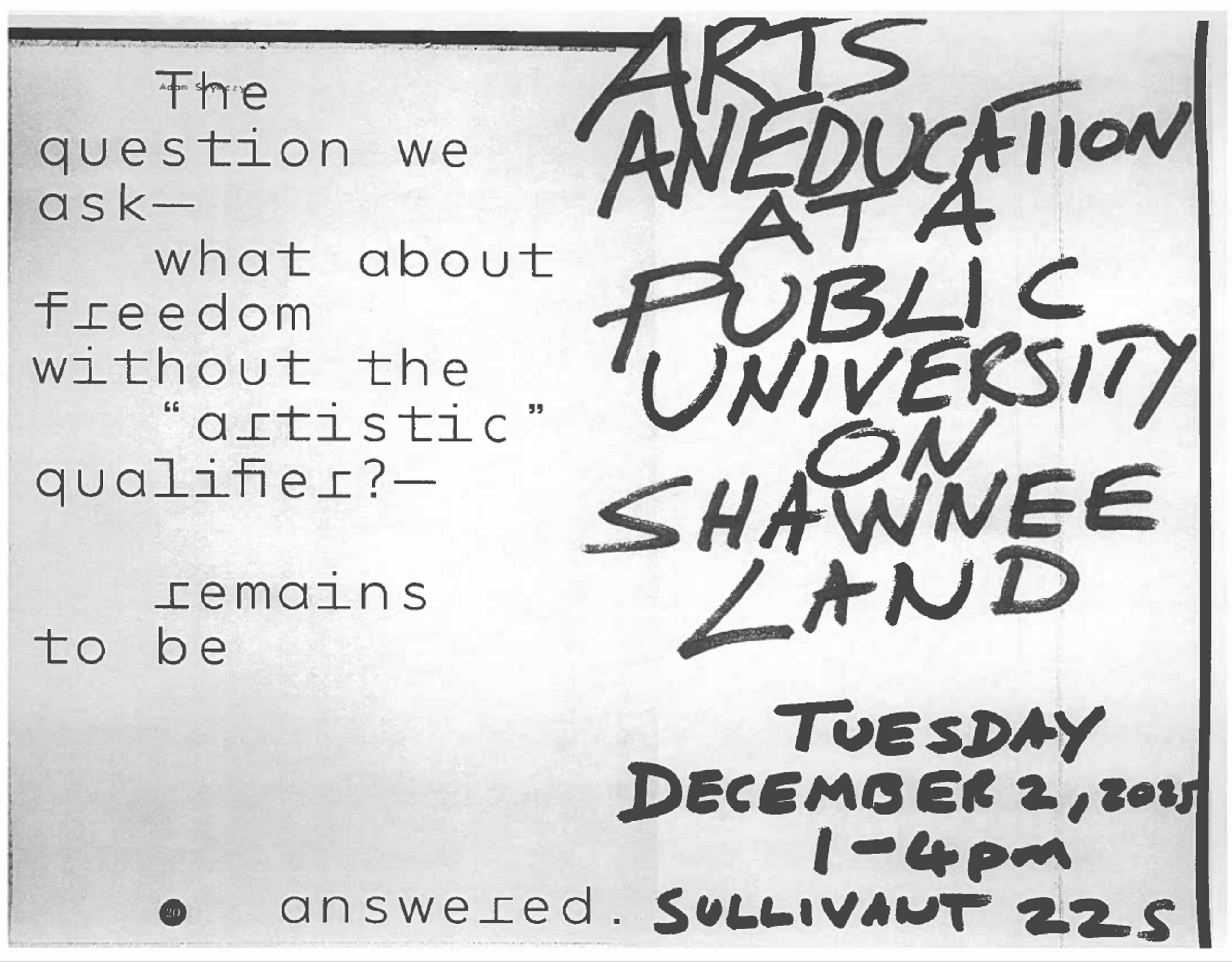
In Athens and in Kassel, aneducation is a daily practice and a public learning. It addresses education as an open form, referring to the methodology of Oskar and Zofia Hansen, and as a space for spontaneous gestures and occurrences that “will awaken the desire of existence.” aneducation is a walk through rather than a walk around: walking into rumors and strategies of silence and the unpredictability of art.
– Public Education – Aneducation – documenta 14
In a place in time
– Laura Da’ ‘Bead Workers’ from Severalty , University of Arizona Press, 2025.
Q: Anna, you have travelled a lot and also lived in several countries… In what dimension does your work and your idea of art belong to your home, Naples? A: I wouldn’t say Naples, I would say Campania, the south of Italy… the south , more broadly. I certainly bring my homeland with me in my own voice, in the language I use to express myself. Although I know four, five languages, I speak all of them with a Neapolitan accent. I think that this is part of my artistic path, as I work with my voice and through translation, thus always starting from my own way to communicate, from my language. In addition, and I do mean it, I think that the fact of being from Campania has made me closer to Morocco, where I have been working for years, and to Africa as a whole. And to South America, if you like… to the southern part of the world, I may say. What really interests me in this culture is the openness to create the public sphere, public spaces … The idea to develop spaces for the collectivity is a sort of constant, spontaneous, organic, and fluid and informal approach… being open-minded towards others, curiosity… Perhaps is indeed a feature of the south…
Q: What is an artistic intention, then? A kind of premeditation, an impulse…? A: In gestures, in the way you talk, there is always intention… this is like a spring. Listen to how this word sounds… in-tension … yes, it is like a spring, to me! It points at a specific direction, which is nevertheless vulnerable, as you do not always get what you want, and it doesn’t actually represent an objective, a goal…In the case of (In)visible Radio Creatures#2, my intention is to open myself to a condition, that of clandestinity, which I don’t experience and I don’t thus know, which I live ‘from outside’, through the representation provided by the media. I may say that this project has been a sort of excuse to me, so that I could understand something I don’t know and then tell it to others in a new and personal way.
– Anna Raimondo and the Radio Creatures’ Atlas of Transitions, 06/21/2018
Honor the harvest—the opener of the blade
– Laura Da’ ‘Upon my return I am mistaken/for a gardener’, from Severalty , University of Arizona Press, 2025.
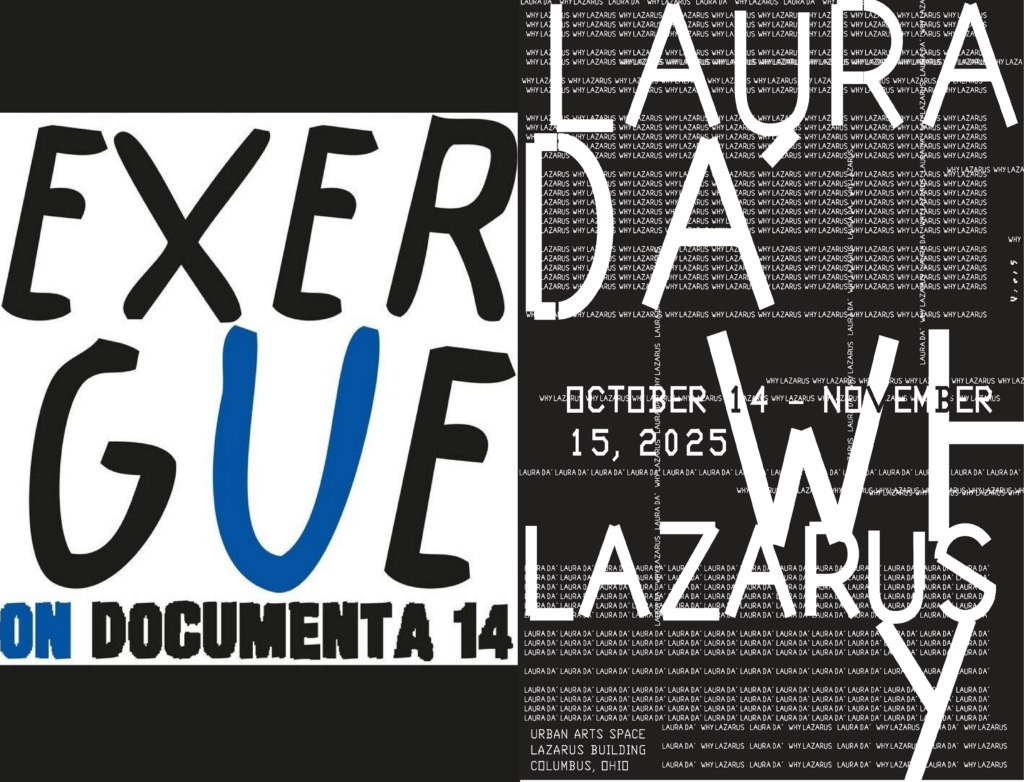
[This post is accompanied by the final episode of the radio show A Curriculum of Imposters connected to the classes Contemporary Theory & Art Education & The Social World of the Arts from Fall semester 2025, which I taught in the Department of Arts Administration, Education and Policy at This* Ohio State University, on the ancestral & contemporary lands of the Shawnee, Miami, Wyandotte and many other Indigenous nations. Thanks to all the students in these classes & especially to Iyana Hill, Mah Rukh Raja & Peter Freeman for bringing their voices together in this episode to reflect on our shared work this semester, connecting the film Exergue on documenta 14 (2024) directed by Dimitris Athiridis, produced by Faliro House and distributed via an educational license by Kino Rebelde, and Shawnee poet Laura Da’ and her collection Severalty , published in the Sun Track Series of the University of Arizona Press, 2025.]