Welcome back to A Curriculum of Insistence* (Here & Now, There & Then, On & On) I’m your host, Richard Finlay Fletcher and it is Friday October 31st, 2025.
So, I’m trying something different today. I guess, something old and something new. The old part is me typing out a blog post on minus plato? instead of transcribing the audio of the radio show and posting that. In the history of the blog, there were times where I would be posting everyday and it would mean that’s I’d have to squeeze moments between other work and life to not only think of something to write about but also to actually write. This week has been something else – so much has happened, so much has changed. And sadly, so much has not changed. As Billy Bragg sings, ‘when things fall apart, some things stay in place.”
[As as uncanny echo of the silencing enacted by the university and its restrictions, my voice recorder batteries just ran out and so if you were listening, now you will have to imagine my voice speaking as I type these words. As I am sitting outside, we’ll also have to see how long my computer battery lasts as well! So, as I was saying…]
…the Shawnee, Wyandot, Miami, Delaware, Peoria, Delaware, Seneca-Cayuga, Potawatomi, Ojibwe and other Indigenous nations.
But this week, I have experienced ways in which the act of land acknowledgement can exceed not only such ignorant restrictions, but also other performative settler moves to innocence, including my own. Because, this week, I witnessed the brilliance of Elissa Washuta, a creative nonfiction writer, member of the Cowlitz Indian Tribe and director of the American Indian Studies program at OSU, and Laura Da’, a poet, member of the Eastern Shawnee Tribe of Oklahoma and a teacher, in action. Elissa, in a presentation at an event organized by the OSU Center for Ethnic Studies called Land Acknowledgments at Land-Grant Universities: A Teach in, on Tuesday and Laura, in a virtual visit to my class The Social World of the Arts on Thursday (and remember this radio show – now being enacted without the sound and voice of radio (although I am still mumbling to myself as I type!) – is a third space between this class and another class – Contemporary Theory and Art Education – and so my main audience here and on the radio show is the students in both of these classes, even if they do not have time during the semester to read or listen to these meanderings). While I cannot in any way do justice to the profound power of Elissa’s and Laura’s words and insights in these two contexts this week, I want to record here my reaction to them and also how they resonate, not only with each other, but also with a third thing that happened this week and the reason I am sitting here in the morning cold talking to myself and typing these words.
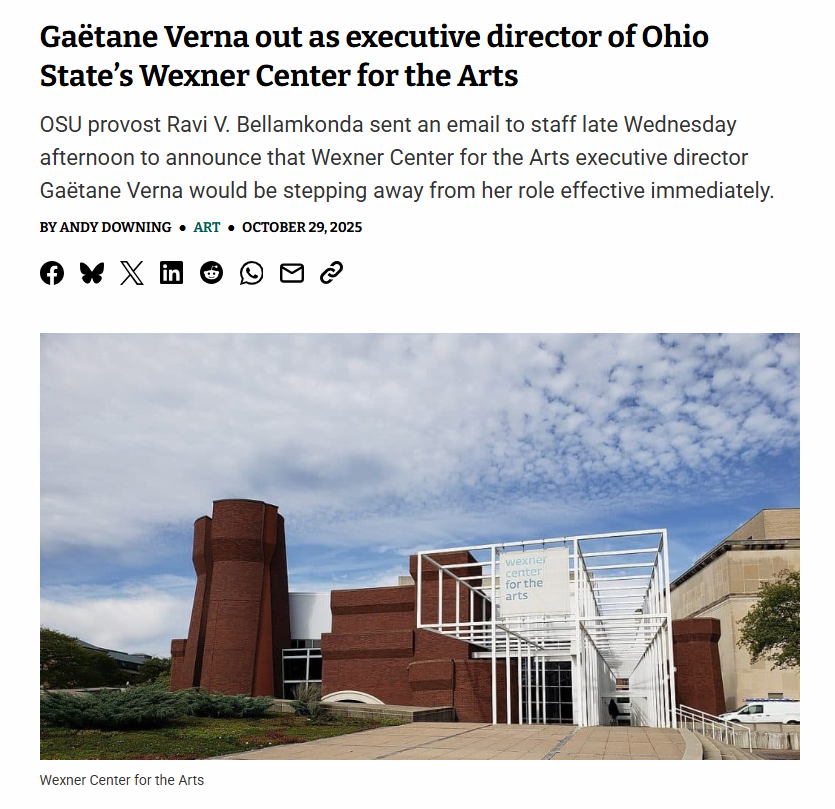
After over 3 years of well-documented problems, creating a toxic work environment and mismanaging resources, the director of the Wexner Center for the Arts has stepped down. Since news articles about the devastating situation emerged last year, there has been a flurry of recent reports, documenting letters of no-confidence in the director, damning statements by current and former staff and revelations about the extent of financial overextension.
But sitting here in the cool and calm of this Friday morning, this is a fresh start for this place that plays such a central role in the lives of so many people here committed to the transforming power of the arts. The air is filled with a palpable collective sigh of relief, but also some trepidation for what the future may hold for the place and the people who work there. In cost-cutting initiatives that the university may adopt, two that have been reported on are the closing of the WexStore (which, if you look back over Minus Plato posts across its 12+ years, you will see, has played a pivotal role in my work) and cuts to jobs. Both of these initiatives would have a damaging impact and so, I write in the hope that they will be abandoned along with the departing director. But we will see.
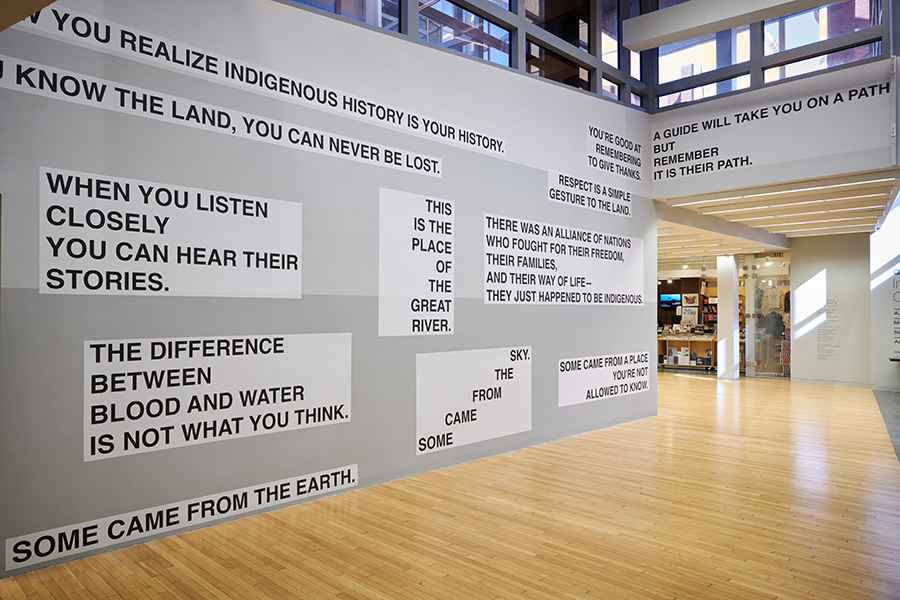
Yet what connects land acknowledgments, the words of Elissa Washuta and Laura Da’ and the Wex? The words and work of Indigenous writers in their more-than acknowledgment of the land amid university restrictions and the change in leadership and issues facing a campus arts center? Of course, there are some obvious connections. For example, as my American Indian Studies colleague Aaron Katzeman spoke about in his presentation at the Land Acknowledgment event on Tuesday, there is the art work Native Guide Project: Columbus by Navajo, Creek and Greek artist Anna Tsoularakis shown at the Wex a few years ago.
[I should pause here for a moment to let you know what is happening around me. Two men who work for the university just drove a white truck to near where I am sitting and are proceeding to stack chairs and take away cushions – so maybe in addition to my voice recorder dying and my computer running out of juice – I’m at 36% – I may not have anywhere to sit soon!]
But the connection I want to share with you here and now comes from the connection between two memorable moments in Elissa Washuta’s talk and Laura Da’’s class visit.
Elissa spoke of taking the moment of the teach-in on land acknowledgments among a supportive community to be (and I quote) ‘fully and publicly Native at work’ and how she marked this with both a gesture (raising her hands) and a word (‘anyway’) as (and again I quote) her ‘Native thought spilling over, needing to be damned and forced to reservoirs’ in the settler colonial structures of the university. Elissa then described how it was no longer safe for her to be Native at work beyond this supportive community space of the teach-in because, according to the OSU guidance on land acknowledgments under SB1 wherein they are only allowed if relevant to the topic or lesson at hand, being Native is (one last quote) ‘not deemed relevant to the topic of teaching creative nonfiction.’
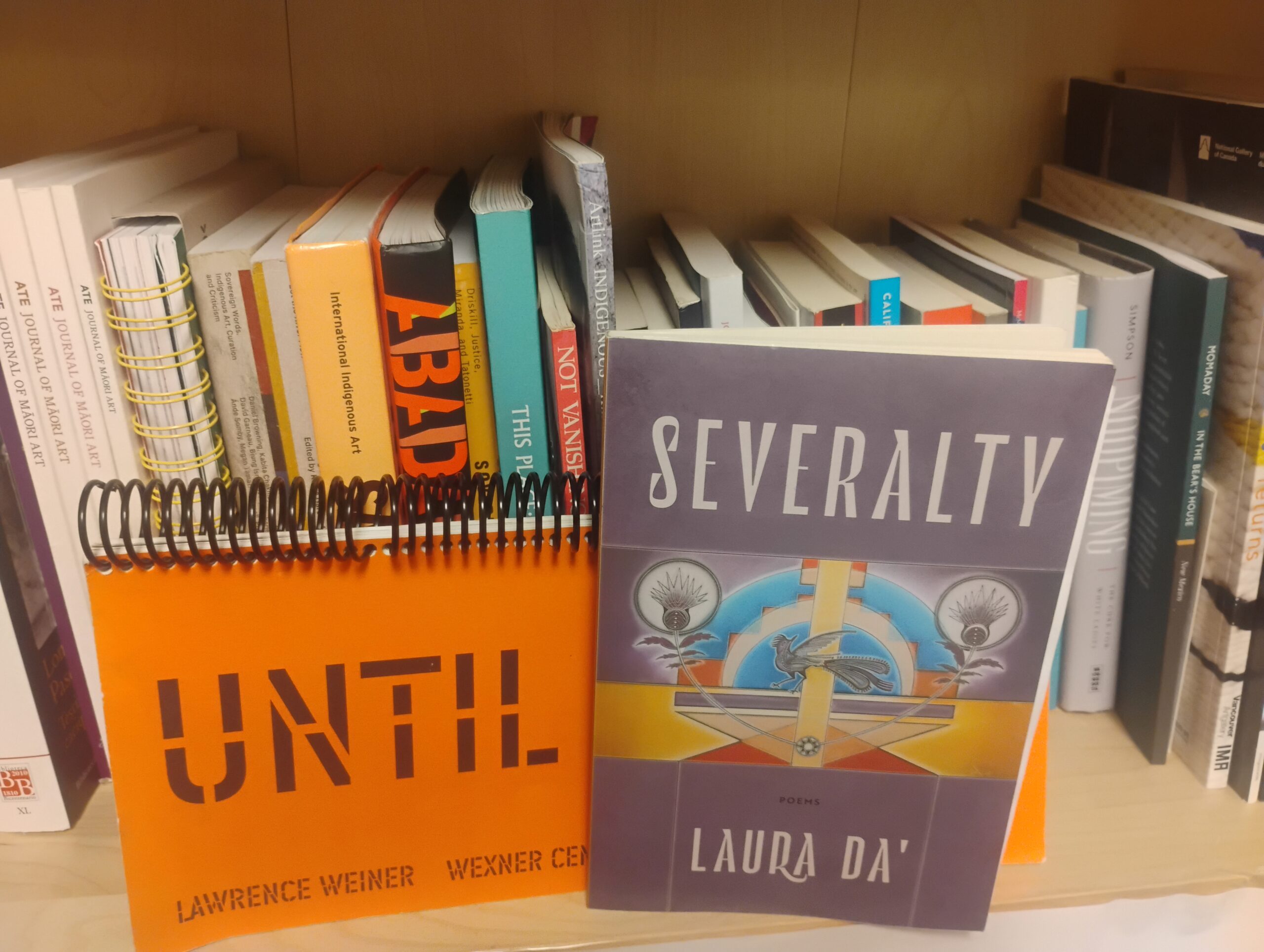
Elissa Washuta’s gestures and words on Tuesday returned to me on Thursday when Laura Da’, anwering a question from a student about the title of her new poetry collection Severalty that it not only marked the historical and political division and forced claiming of Native land by settler governance powers, but any (and I quote) ‘artificial division of something that is naturally a thing of integrity’.
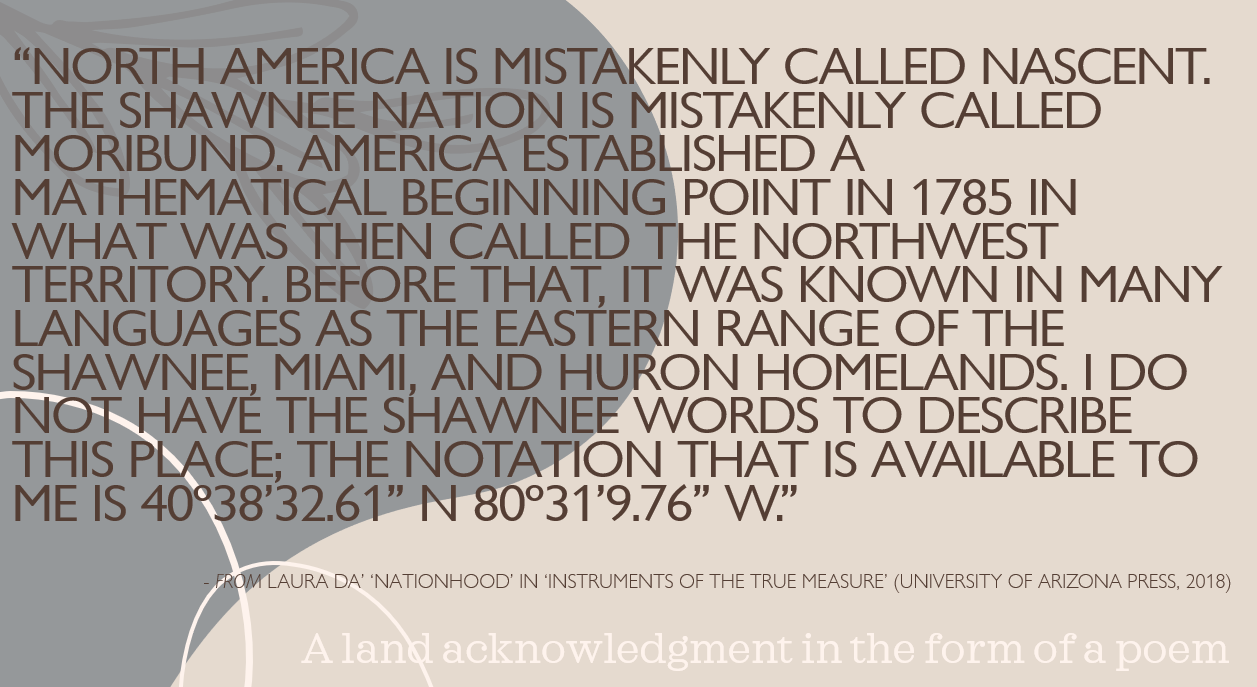
As with my PowerPoint quoting the second stanza of Laura Da’’s poem ‘Nationhood’ (above) from her 2018 collection Instruments of the True Measure, as ‘a land acknowledgement in the form of a poem’ to open the class she visited via Zoom, perhaps the best way for me to proceed here is through one of Laura’s poems from Severalty – the poem called ‘The Meadow’.
The poem has 5 parts and it feel like it belongs to the genre of epic poetry because of its expansive scope and scale. The first section (‘The Preterist View’) describes how:
this was
a place of boundless plenty.
And the inhabitants lived
in abundance here,
girded by the protective trident
of the many-forked
river. And at that time
the river was the great
street, clear and strong,
as that of the heavenly city.
Da’ doesn’t specify which place or river she is describing here, but fresh from a poetry walk along the Scioto River, in which I led guests in the reading of her poetry across her three published collections, which make mention of the Scioto River, it could very well be here she is writing about. In the class, Laura said that her work begins from place. Later in the same section, she describes the changes to this place as follows:
sickles thrust
into the lands beckoned forth
orderly rows. Forts
became farms. Schools and lyceums
and territorial post offices
were built over the longhouses.
Culminating in the explicit description of colonial violence against:
the Natives
who were shot from the banks
of the river for sport
[They are getting close to taking away my chair and table, so I have to wrap this up more quickly than I would have liked]
The next section (‘The Symbolic History View’) centers on the meadow, both as a place and word, as ‘an optimal gathering place’, but also its origins through the Middle Ages monastery system in Europe, ‘the routine cadastral measurement of land’ and also, metaphorically, ‘heaven as a form of meadow’. The institutional and spiritual Christian valence of the word is expanded in the next section (‘The Prophetic Future View’) with the Rapture in the heavenly city ‘with meadows to burn’)
[My table and chair have been taken, so I’ve relocated to sit on a concrete wall – but at least the sun has come out!]
I will pass by the next section (‘The Continuous History View’) because I cannot begin to do justice to this deeply personal wedge of prose-poetry here and now and because it was the final section of the poem (‘The Sword View’) that made me turn to this poem today, specifically the following lines:
The elk press, slow and deliberate
Until the meadow is defined,
a rippling frontier
between their calves
hidden in the marsh grass
and me, walking slowly backward,
pulses thudding across
the ridges of my fists.
Like the river as a ‘many-forked trident’ in the first section, here the elk and their calves create the barrier, the frontier, so often imposed by settlers and the structures of their religion. The poet has called to the elk to define the meadow through them in opposition to the learning by the sword of imposed religious education on her and her Shawnee ancestors, in their homeland in Ohio and in removal to Kansas and Oklahoma, and in further diaspora in Seattle and the Pacific Northwest.
The line ‘until the meadow is defined’ spoke directly to me this week because it evoked a work of art made…
[My computer died. I have relocated to the warmth of my campus office to finish this up. I had thought about leaving you hanging (“what work of art?” “Where is this all leading?” but since you’ve followed me this far, I owe you some form of conclusion, no matter how unsatisfactory! And now I get to add some photos staged from here]
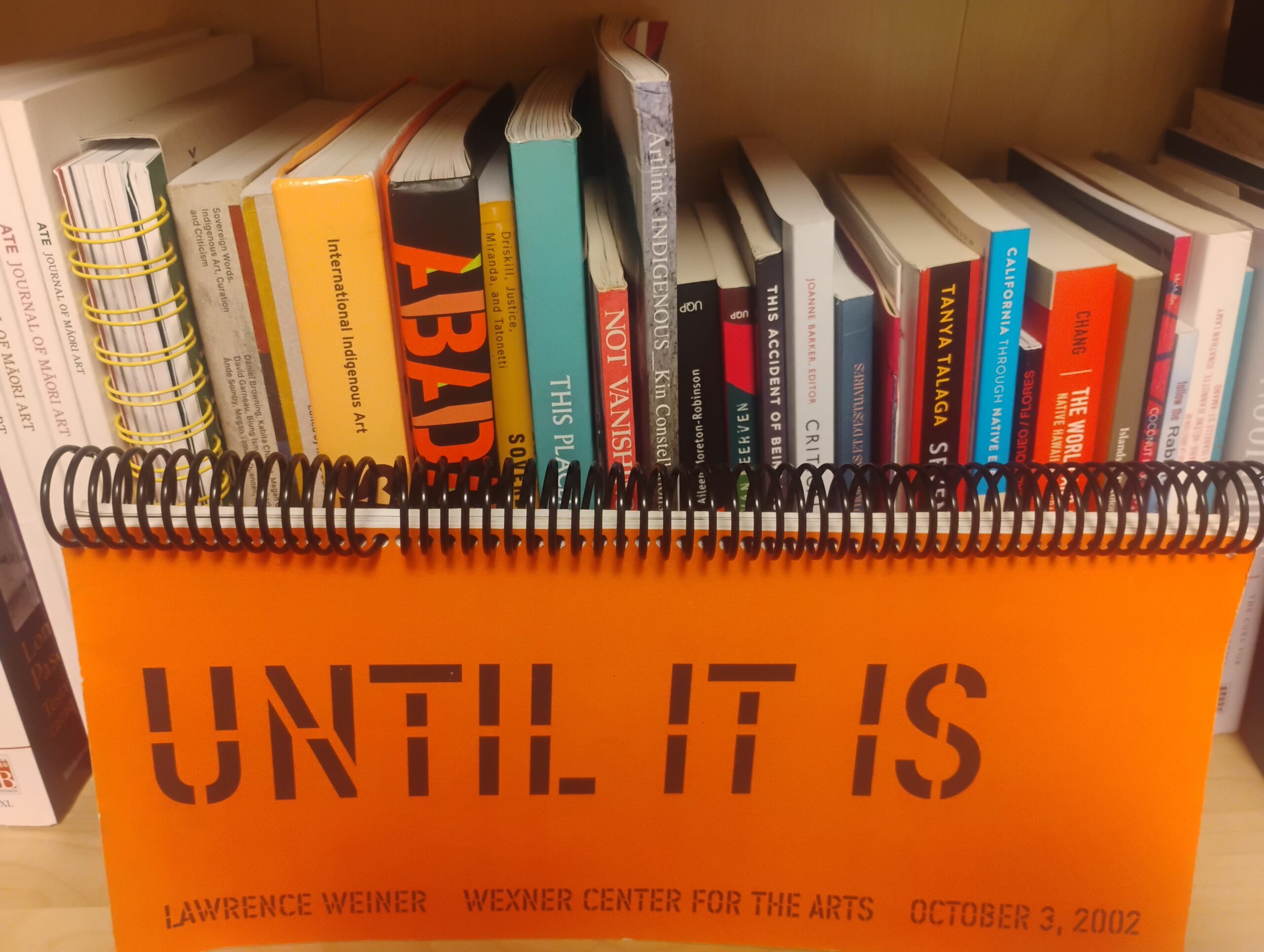
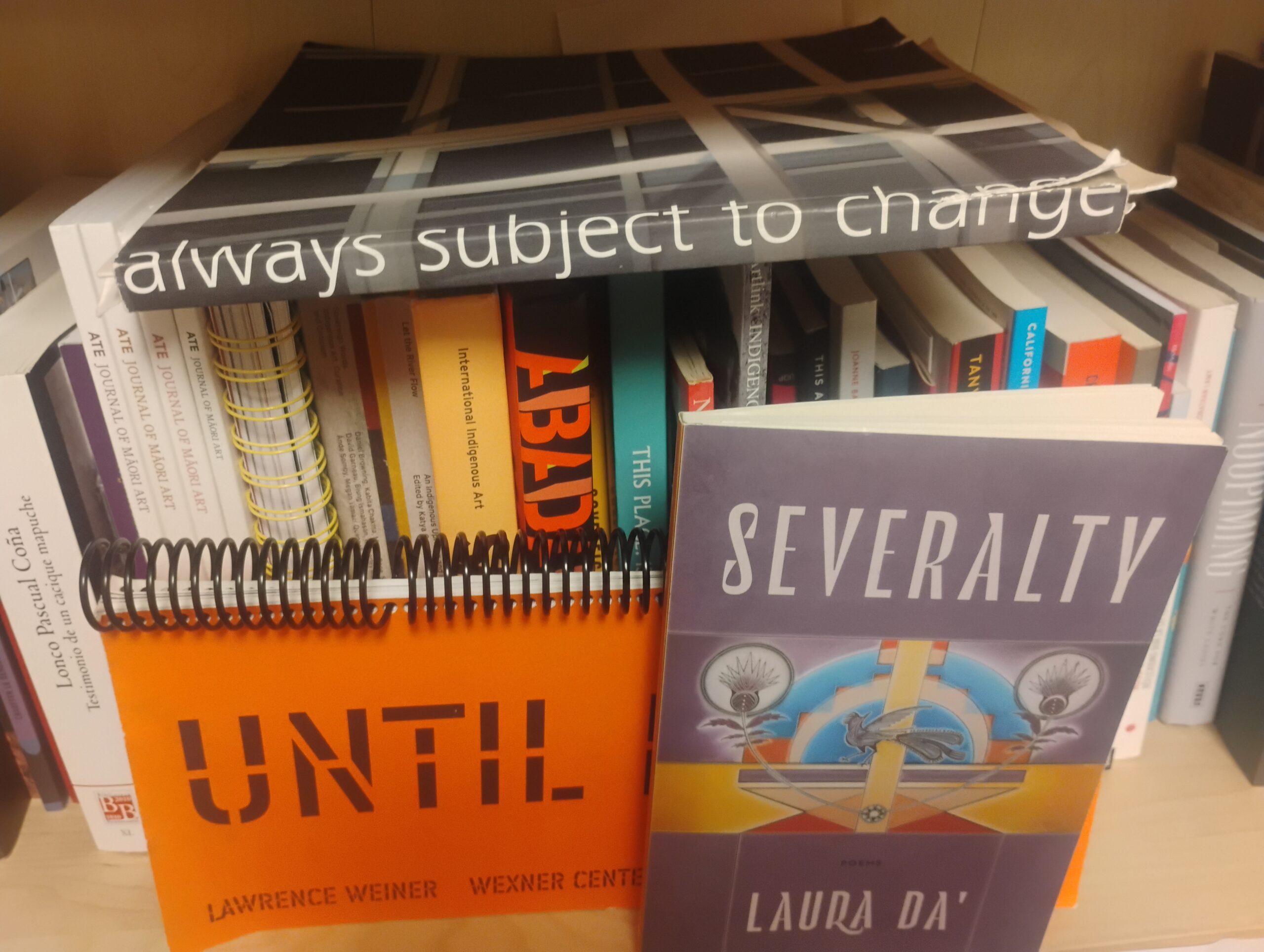
…a work of art made by Lawrence Weiner called UNTIL IT IS – a public art piece installed on the OSU Oval (behind the Wex from where I was sitting) in October 2002. The bright orange, ring-bound catalog – one of the first books I bought at the Wex store has photos, drawings and sketches of the text work and on one page you can read in Weiner’s signature all-caps:
THE SUBSTANCE OF THE GROUND PROVIDES IN ITSELF A MISE EN SCÈNE
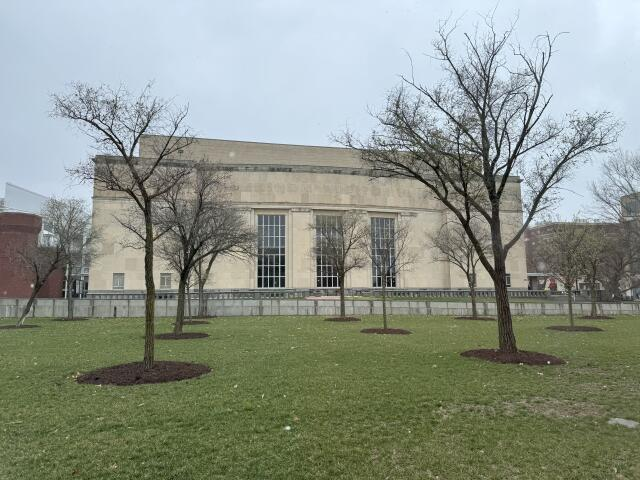
Weiner’s work is long gone now, although there have been some recent interventions in the ‘grounds’ of the Wex. For example, the cover photo of this post and the fragment of the radio show was taken from the new green space (is it a meadow?) alongside my building Sullivant Hall, with lush grass and young trees, but with a series of barriers, is a place where students and other pedestrians are encouraged not to cross. In fact, the university is now offering up this space to book for conferences and other events!
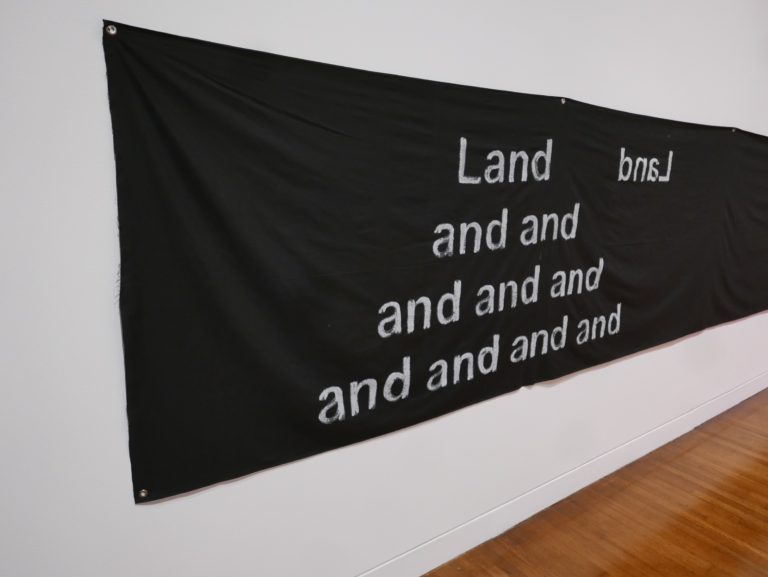
A more gentle encouragement that the guidelines that no chalking is allowed on campus or the restrictions on acknowledging the land.
As the Wexner Center for the Arts embarks on its next phase – marking again the statement used to celebrate its 10-year anniversary in 1999 with the title of the book always subject to change: the wexner center at ten – at what phase is the land? And who do we ask to know? For me, I listen to Elissa Washuta and Laura Da’, and the lines they draw that exceed imposed divisions, just as the curators at documenta 14 listened to Indigenous artists, to understand what the splitting of their exhibition between two cities (Athens and Kassel) meant at a more fundamental level – an integrity beyond colonial guidelines or markers.
ANYWAY, now more than ever, we need to follow the integrity of Indigenous artists as they create new desire lines through elk-defined meadows.
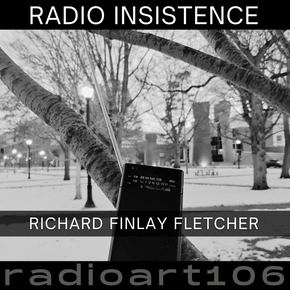
* I misspoke when I said ‘A Curriculum of Insistence’ when it should be ‘A Curriculum of Imposters’ and hearing this error offers a way to bring my earlier Radio Insistence show into dialogue with this show. I created Radio Insistence for the whole year of 2024 to engag with the concept and practice of Insistence developed and sustained by Alutiiq/Sugpiak artist Tanya Lukin Linklater for her exhibition at the Wex during the Summer of 2024. The show was incorporated into two classes – an undergrad class on visual culture in the Spring of 2024 and a mixed undgergrad/grad class on global Indigenous arts: education for settlers in the Fall 2024. Here is a compilation episode of Radio Insistence which I created for RadioArt106. I now to think further about the connections between insistence and imposters, and their respective curricula!