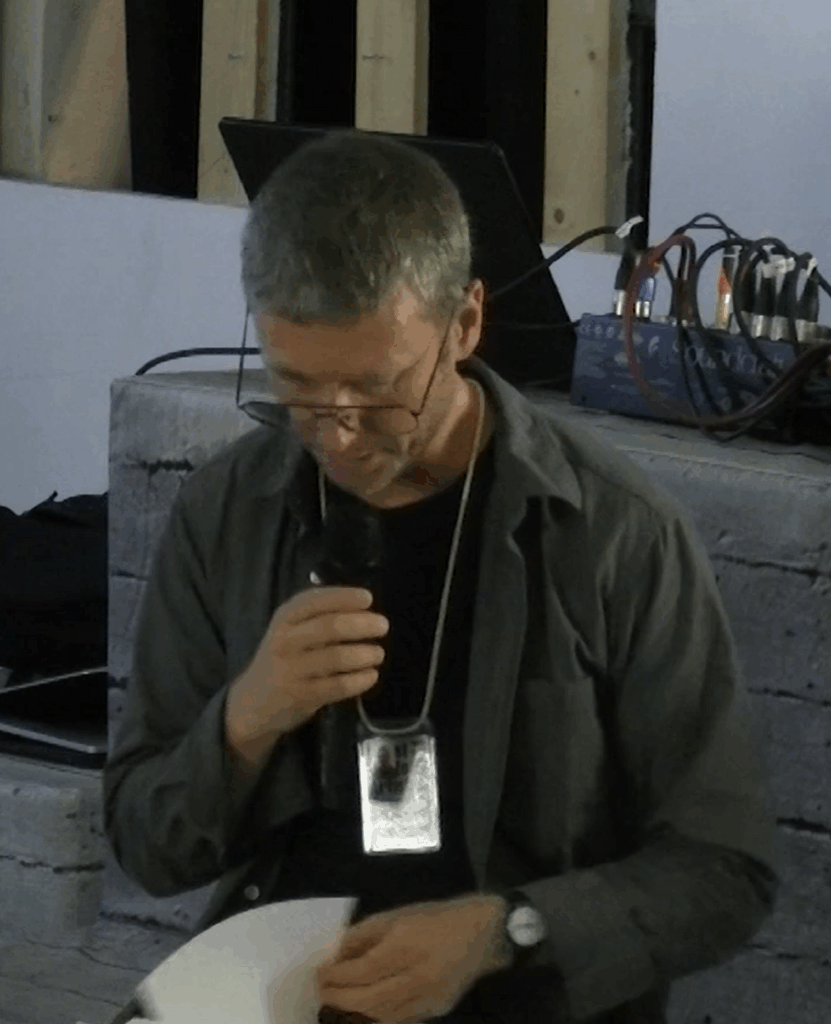
Welcome back to A Curriculum of Imposters (here and now, there and then, on and on). I’m your host, Richard Finlay Fletcher, and it is Friday, September 5th, 2025.
This radio show is part of a kind of third space for two classes that I’m teaching at this Ohio State University, which is a university that occupies the ancestral home of many Indigenous nations, including the Shawnee, the Wyandotte, the Delaware, the Potawatomi, the Peoria, the Ojibwe.
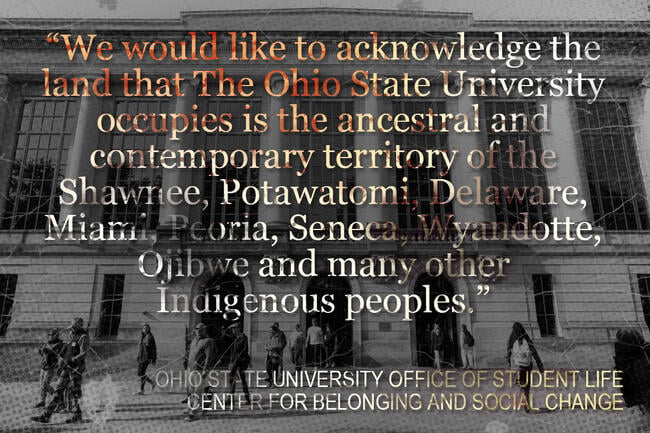
And this land has contemporary ties to those nations and one of those ties is demonstrated in the class itself because we are going to be engaging with the poetry of Laura Da’, who’s an enrolled member of the Eastern Shawnee Tribe of Oklahoma and her new book collection, Severalty.
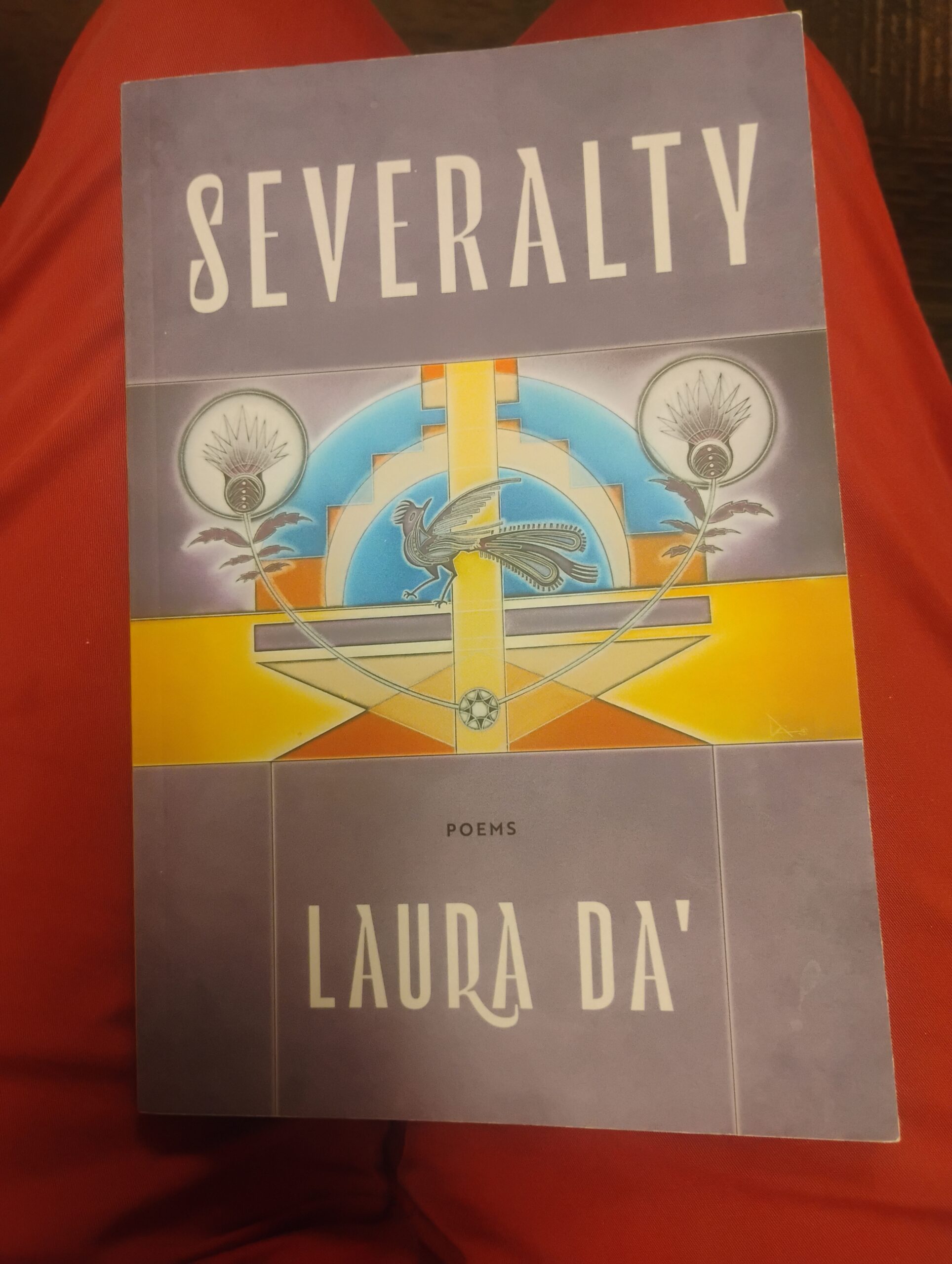
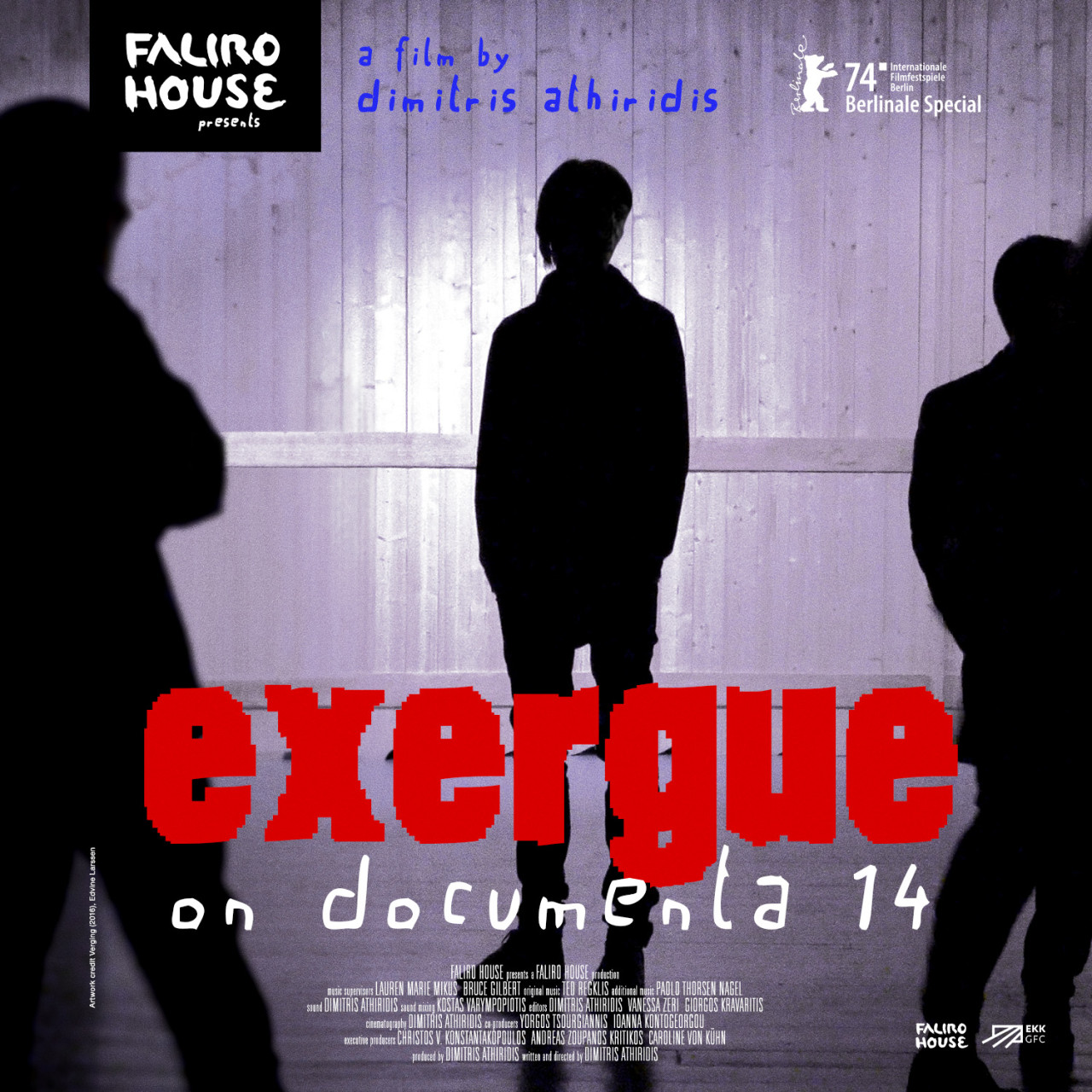
A bit later in this post, I’ll just tell you about another poem from an earlier collection by Laura Da’ that I’ve been thinking about because of the other thing that we’re doing in these two classes or across these two classes that this post and accompanying radio show are engaged with, which is the 14-hour film Exergue on documenta 14 from 2024, which is directed by the Greek director Dimitris Athiridis and produced by Kaliro House and distributed by Kino Lorber.
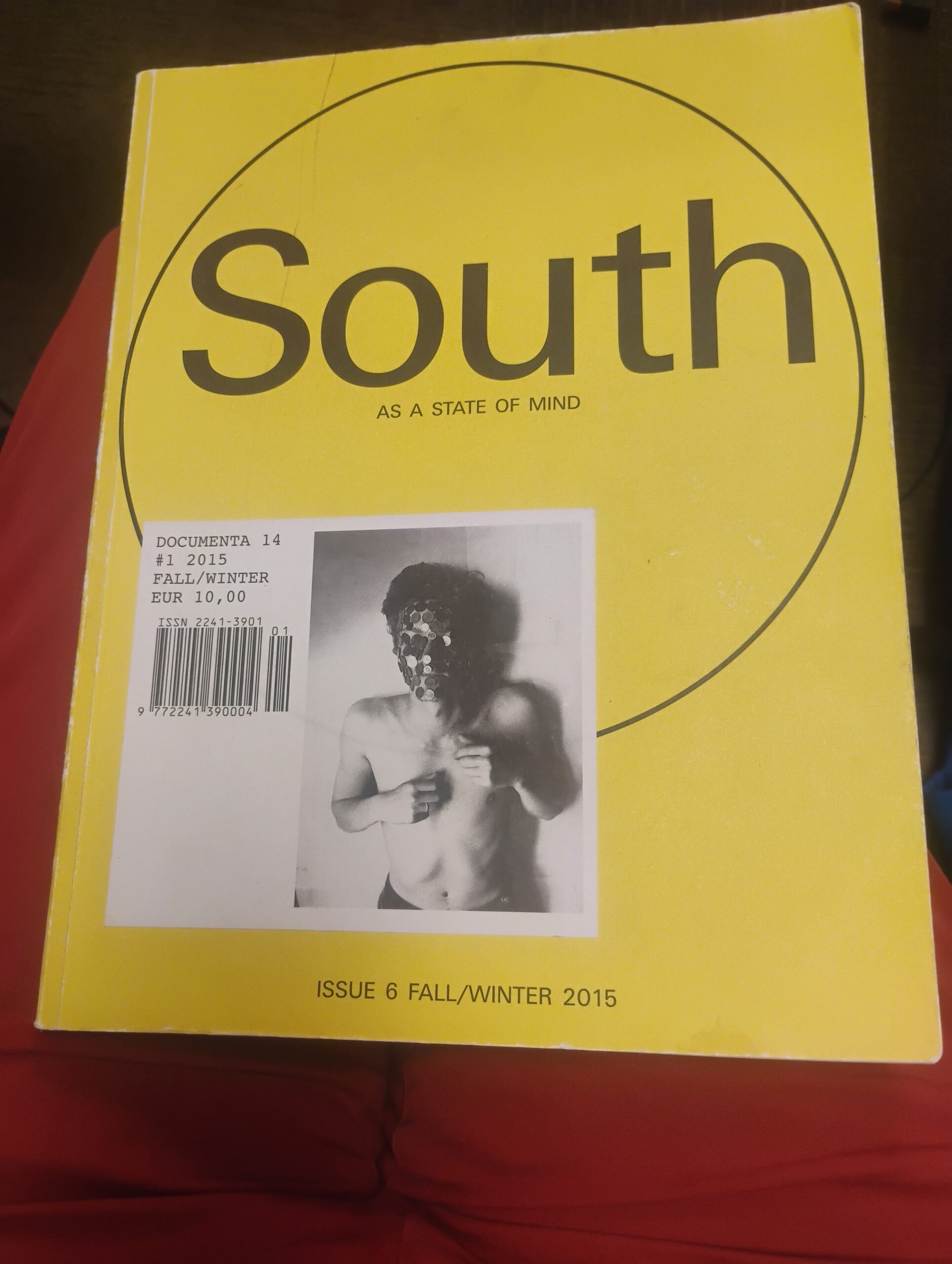
And so I want to use this space for the two classes, one on contemporary theory and art education and the other on the social world of the arts. And this week in the theory class, we were thinking about language and post-structuralism. We were reading ‘From Work to Text’ by Roland Barthes. We were reading eelections from The Truth in Painting by Jacques Derrida, and also an essay from The documenta 14 Reader by Quinn Latimer called ‘Signs, Sounds, Metals, Fires or an Economy of Her Reader’. The episode of Exergue that we watched, which is Chapter Two: Going South, ends with the launch party for the first issue of the magazine, South as a State of Mind, that’s originally a Greek art magazine that was created by Marina Fokidis. And then for the run of documenta 14, it was hosting the Documenta 14 project. The launch was in Berlin at Savvy Contemporary, the art space that was run at the time by curator Bonaventure Ndikung, who was also a curator at large at documenta 14 and so Quinn was part of that episode in the reading for South as a State of Mind and the launch for that publication.
In the other class, we were reading a kind of overview article about the sociology of culture, thinking about things like material and symbolic culture, thinking about high and low culture, thinking about ideas of the kind of social fields, habitus, you know, these kinds of ideas, cultural capital, that kind of thing. And when I was thinking about what I was going to say today, I was thinking about how to kind of talk to the students in the class about these kind of connecting points using Exergue and Laura Da”s poetry as a kind of point of connection. But also I was thinking about how to do it in a way that acknowledges the moment we are in and one way to do that is to speak of, speak directly to certain political situations, whether they are at the university or in the state of Ohio or in the US or in the world right now.
We can speak to some of the themes of documenta 14 through some of the ideas about language and difference and how to frame things and what goes beyond the frame in terms of the politics right now. But we can also talk about it in ways which kind of look at this situation through the eyes of the people who are living it, experiencing it, and how it’s so necessary when forms of oppression and of violence are inflicted on particular people that we also engage with their life-affirming activities and not only when engaging with them, always bring it back to the life-destroying components of their everyday reality. And so those moments of life, maybe fleeting moments of joy or frivolity, are really important as we think both about the social world of the arts but also about kind of how theoretical ideas are often kind of grounded in everyday activities and lived realities.
Related to this, one thing that I’ve been doing over the years in my engagement with document 14 is turning to their Daybook. It was a publication, so along with The documenta 14 Reader and South as a State of Mind, the Daybook is basically a guide to all the living artists who were part of documenta 14 back in 2017 and it’s a beautiful book.
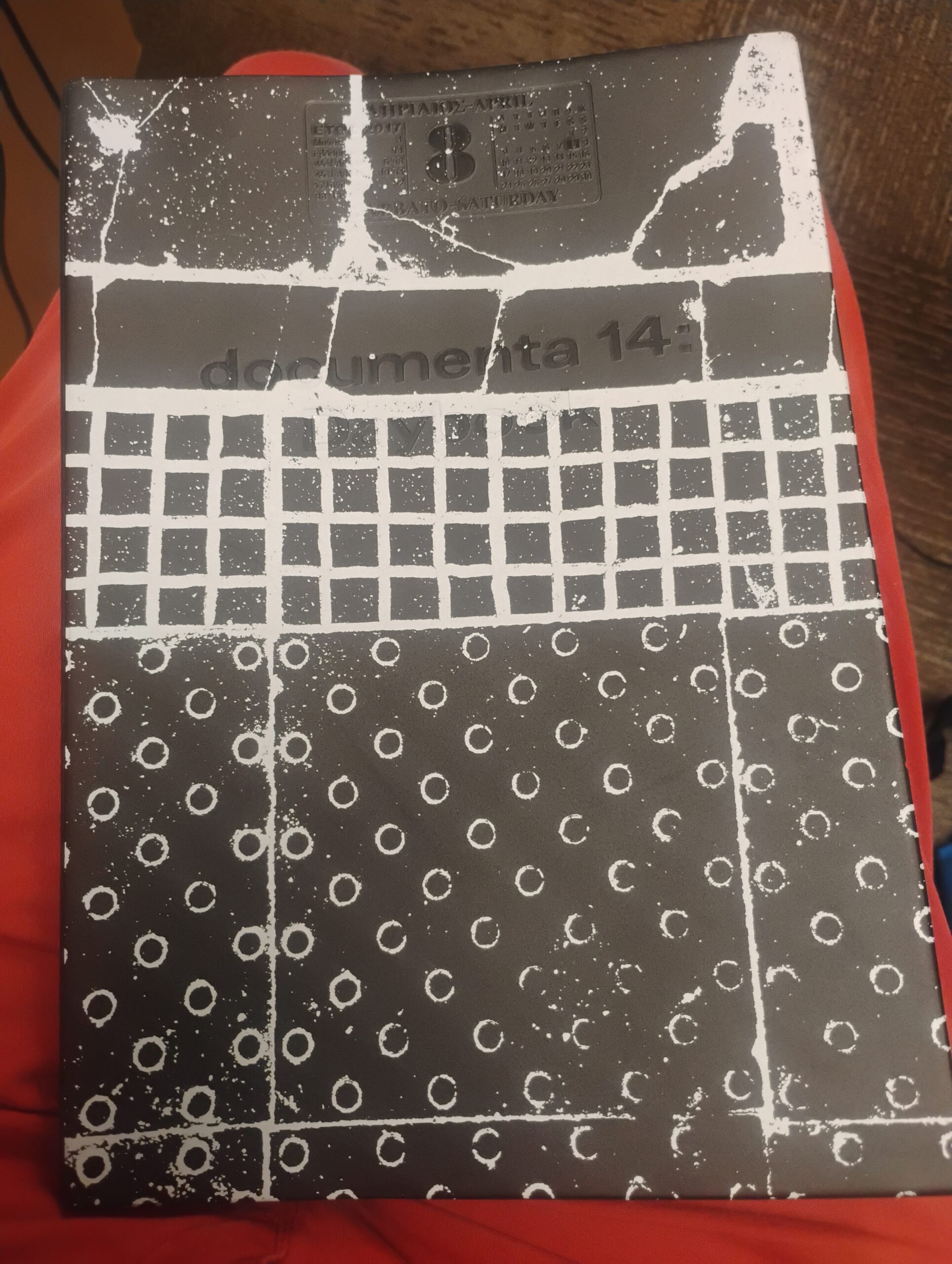
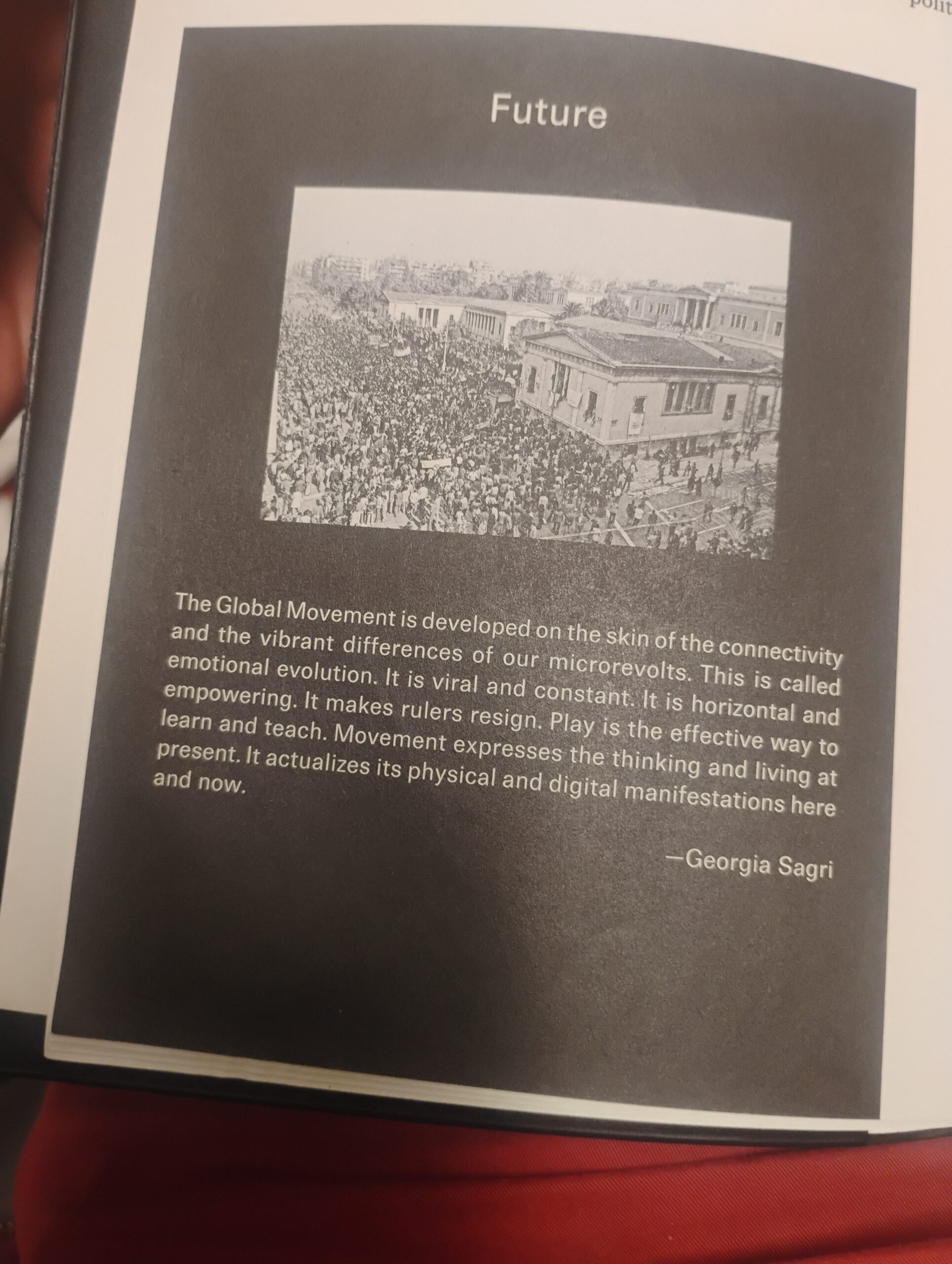
It has essays, commissioned essays and images for each artist. But it also has this really amazing feature, which in the corner bottom-left page of each spread, there is a little black box which includes a date and a text that was contributed by the artist who’s being referenced in each page. And this date actually decides the kind of order of the artist in the book. It’s not ordered by alphabetical order for the names of the artists but by these dates. So you start in the present. Actually, you start in the future, since the Greek artist Georgia Sagri chooses the ‘Future’ and here is her entry:
So we start from the future and then we go all the way back to the past. For example, I’m just turning to the page of Mounira Al Solh, who is an artist that we’re going to come back to later, a Lebanese artist with also Syrian parentage as well. Here is her Daybook spread:
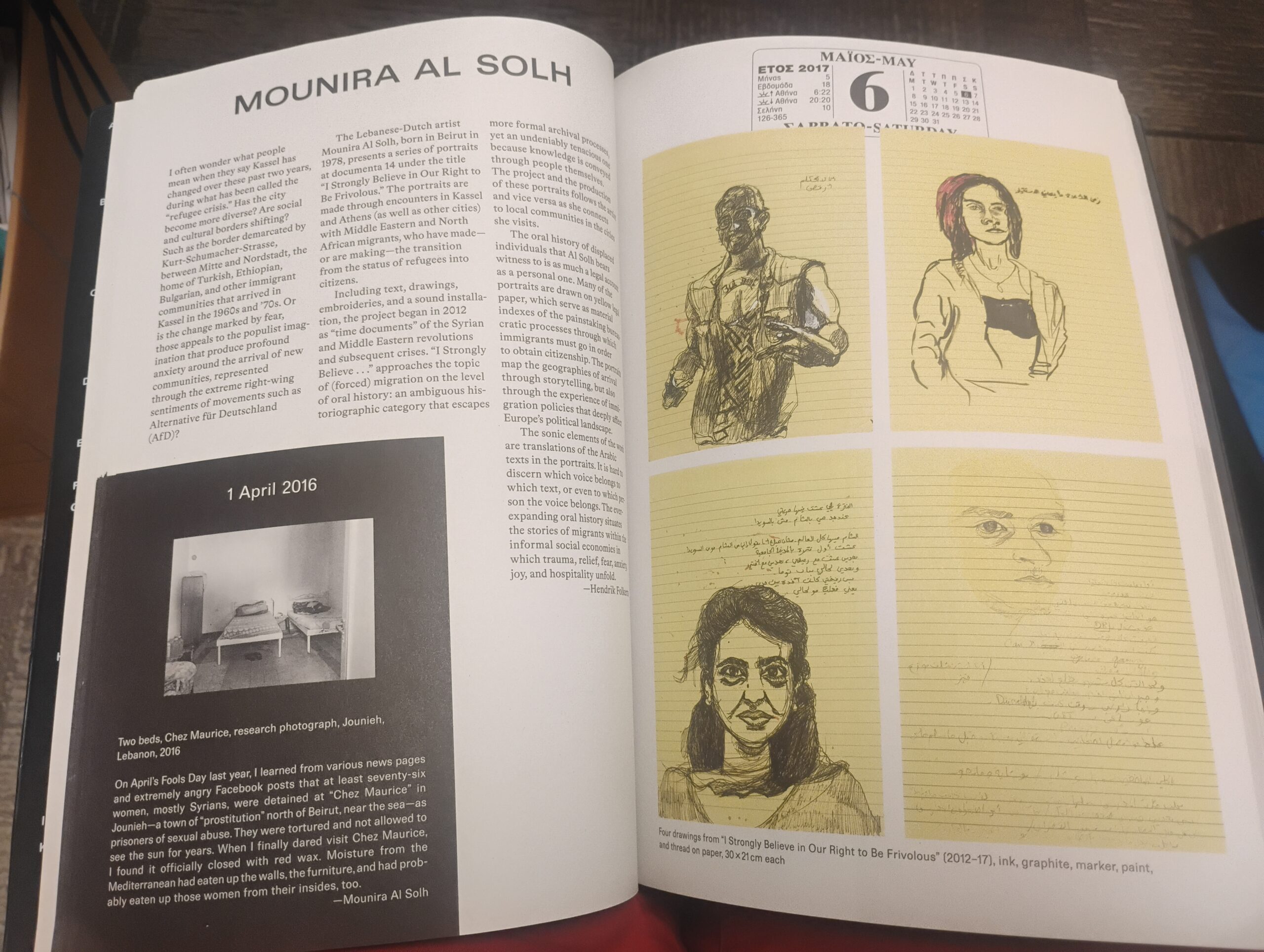
So the artists choose the text and at the top of the page, there’s also the date of the run of the exhibition, from April 8th to September 17th in 2017. And sometimes I’ve been using this Daybook as a kind of way to register the time passing. And sometimes I’ve had a project in the past on Minus Plato that is called the Empty Daybook. Here is my post from May 6th, 2019 on Mounira Al Solh (and if you click the image it will take you to other posts from the Empty Daybook series):
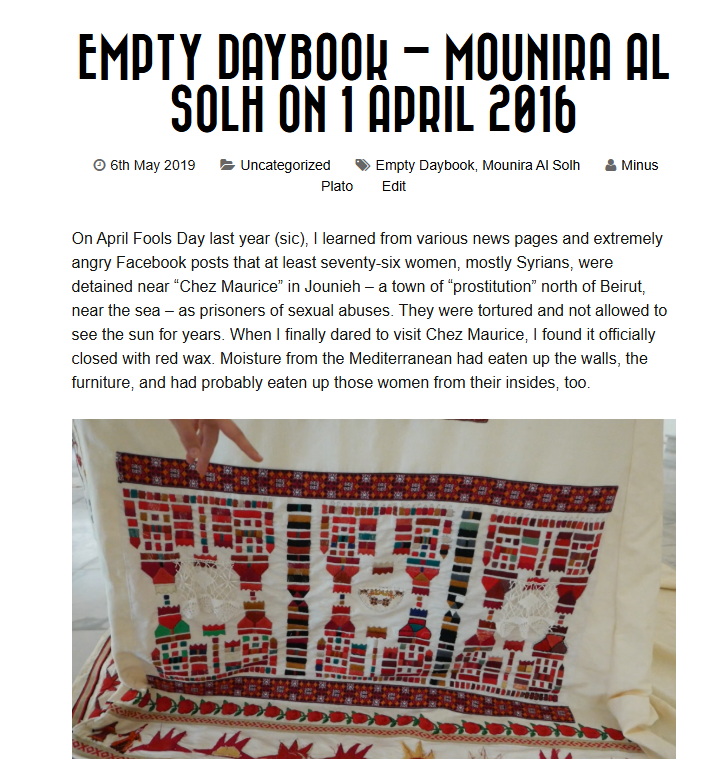
And I go back to the, you know, the text for the artists are reproduced online, but those little texts in the black boxes are not. So I bring those texts into an online space and then also show artwork that is either from documenta 14 or more recent by the artist.
And so while I did that a few years ago, sometimes during the run of the exhibition in the years since, I’ve gone back to the Daybook and so, for example, last week, our first episode of this third space show for the two classes, it was August 29th and if I turn to the Daybook, it’s really interesting because that is the work of Nevin Aladağ, a Turkish artist who created the Music Room in Athens and the Conservatoire, as well as these porcelain beautifully designed hexagons and this kind of wall of them in Kassel. Nevin Aladağ was the subject of an artist research presentation by one of the students in the theory class and also there’s a really beautiful text accompanying it by Quinn Latimer that is shaped like a drum and anyone who knows Quinn Latimer’s poetry will notice how she uses a refrain (in this case the word drum) really beautifully throughout her work.
So what’s happening in the Daybook today? So you turn to September 5th, and it’s actually in the pages of the book after the list of artists. So September 4th was the appendix. And then if you go to September 6th, which actually really interestingly appears after the sponsors, the pages of sponsors to include the team of documenta 14. Here is September 5th:
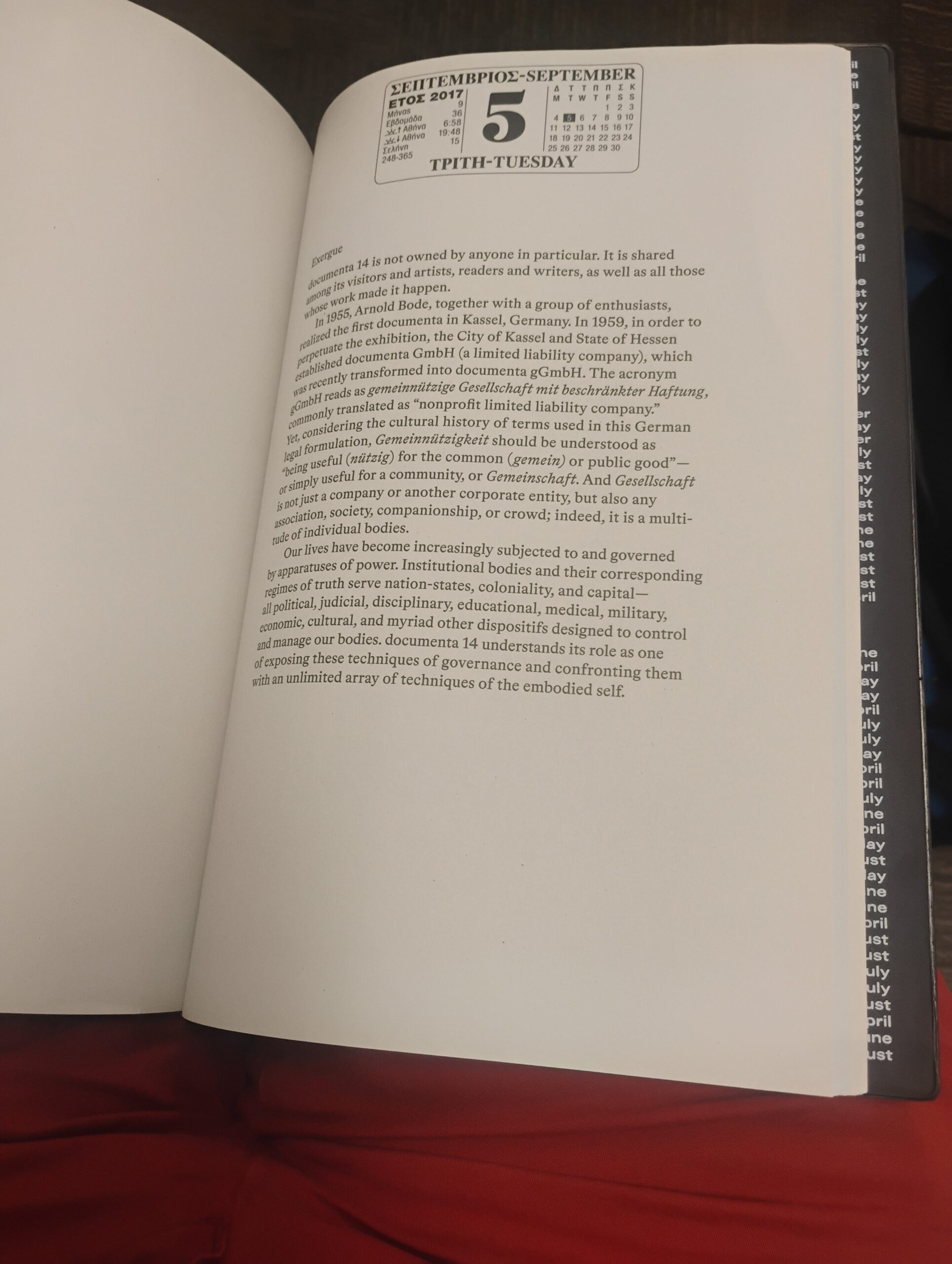
So ‘that ‘Exergue’ is our today in the Daybook and obviously the film by Dimitris Athiridis takes its title from this short text that was created by the documenta 14 team. And I think it’s really important to think of the exhibition kind of aligned with this kind of commitment to not being owned. But it’s also a commitment to bring institutions and frameworks and kind of impose structures and perspectives that try to control in line with another kind of perspective or other perspectives.
There’s a great moment in the second chapter of Exergue, Going South, where the curator of public programs, Paul Preciado, is responding to Adam Szymczyk, the artistic director, saying that the party is over. And this is a response, and we’ll come to this a little bit later, to them being in Beirut during not only explosions in a Palestinian refugee camp there, but also news of an ISIS attack in Paris, and just this kind of simmering violence in the world around them as they’re making this exhibition. This was back in 2015. And Szymczyk says the party’s over, in reference to the art world of artfairs and excess, and Preciado says, well, we’ve got to ask, maybe we can make another party. Maybe that party is over. But we kind of ask who was invited to that party, and we can make our own party. And I think that that kind of gesture is really, really important. And this will be kind of a theme running through this post today.
But this kind of dynamic really made me think of the poetry of Laura Da’, a poetry that engages with the whole kind of sweep of her Tribal history, specifically the removal from Ohio, first to Kansas and then to Oklahoma, and the other important ways in which the settler colonial state took away from Shawnee life, including boarding schools, including the Allotment Act, all of these ways. So Laura’s engaging with this large scope, and she includes this character called Lazarus Shale, who’s like a fictionalized but also kind of semi-real ancestor of hers, who was removed and who first settled in Kansas and then in Oklahoma, and then his family, his sister, as well as his children. By choosing this kind of family member, even if it’s fictionalized, Laura is able to kind of channel not only her experience as a contemporary Shawnee person and her context moving into her body and her words and her work, but also transposing that onto Lazarus himself. And I’m not going to read the whole poem, but I just want to share with you a poem that’s from her 2015 collection, Tributaries. All her three main poetry collections are published by the University of Arizona Press, and this poem is called ‘Bread Dancing in Indian Territory.’
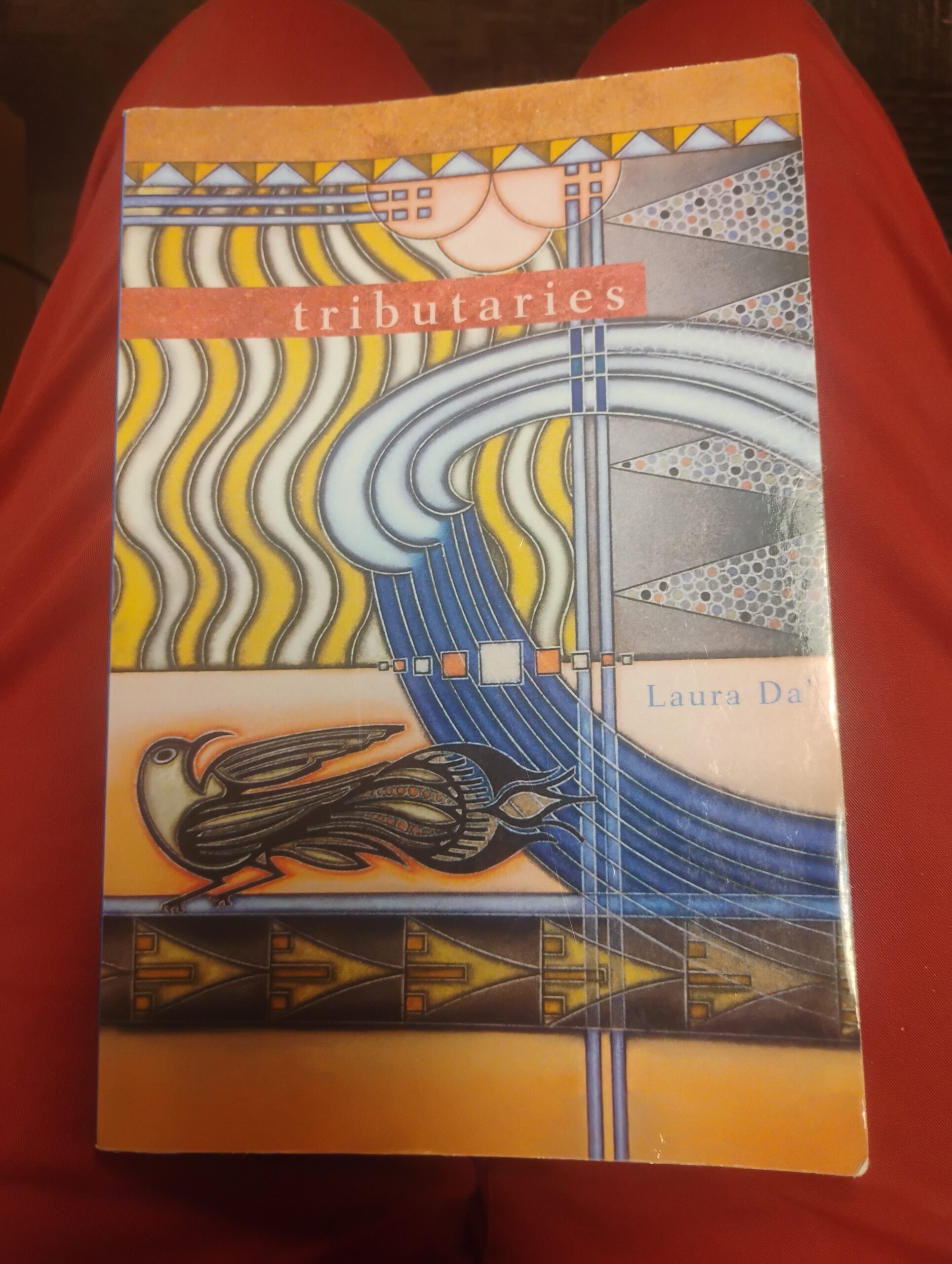
And it begins with Lazarus Shale making a bet with his uncle that he could make this horse ready to participate in festivities that were called the Bread Dance for the Shawnee. And so you have this scene of this, I think he’s a teenager at this time, making this horse, kind of riding the horse, kind of looking after the horse, massaging its “charred hooves”. And a few stanzas in, he says, “you owe me, uncle, pay up” because he has made the horse well. And then there’s also this moment after that where they play a ball game, without keeping score. In the next section, Lazarus is riding around on the horse, but then a kind of a sinister element kind of creeps in because he is interrupted by the Indian agent who says to him that there’s no record of a Shale child at the mission school, asking how old, Lazarus’ sister is. The implication here is that the sister needs to go to the mission and needs to be enrolled in the school there. And so Lazarus has to bring his sister to the mission, but the next section of the poem is all about the sister, Judy, going to visit her aunt and in that process, as she’s visiting her aunt with the with a car and a donkey, there are these nice moments where she’s kind of playing with the donkeys, twirling the donkeys ears and just this lazy visit to the aunt at this time. But the final section of the poem is them heading to the to the mission and Lazarus leaves without his sister but leaves with ration resources given out to the Shawnee. Finally, we learn that the Shawnee Sun newspaper, which is disseminated to benefactors on the East Coast and how “ladies of the tea societies murmur/over the visual cacophony of Shawnee”. And in that moment, we then have the last stanza where these ladies see a picture of a Shawnee teenager at the mission, wearing a cross, and we are to presume it is Judy, Lazarus’ sister.
This poem made me think in many different ways about the way in which there is a kind of play and frivolity in the brother and sister going about their lives, even in these positions of being removed here to Kansas and the Kaw River. But there’s also the serious political context of all this happening, manifested in the violence of the boarding school. But amid that, there’s another kind of frivolity or leisure and that is the ladies of the tea society. And the way in which Laura Da’ critiques that consumption of her people’s lives and experiences from this remove is really powerful.
And it reminds me of a moment in Exergue that we watched in chapter two, when the artistic director Adam Szymczyk is in Beirut and because of the news of the ISIS massacre in Paris and the bombings in the Palestinian camp in Beirut, he wants to write a statement as documenta 14. At the same time, he’s at the exhibition Homeworks and the journalist, writer, historian, Kaelen Wilson-Goldie, asks to take his photo for the art magazine, Artforum. And Szymczyk initially says no, because Artforum is part of the system he is against but eventually agrees, but refuses to smile for the photo saying: ‘No Artforum smile’.
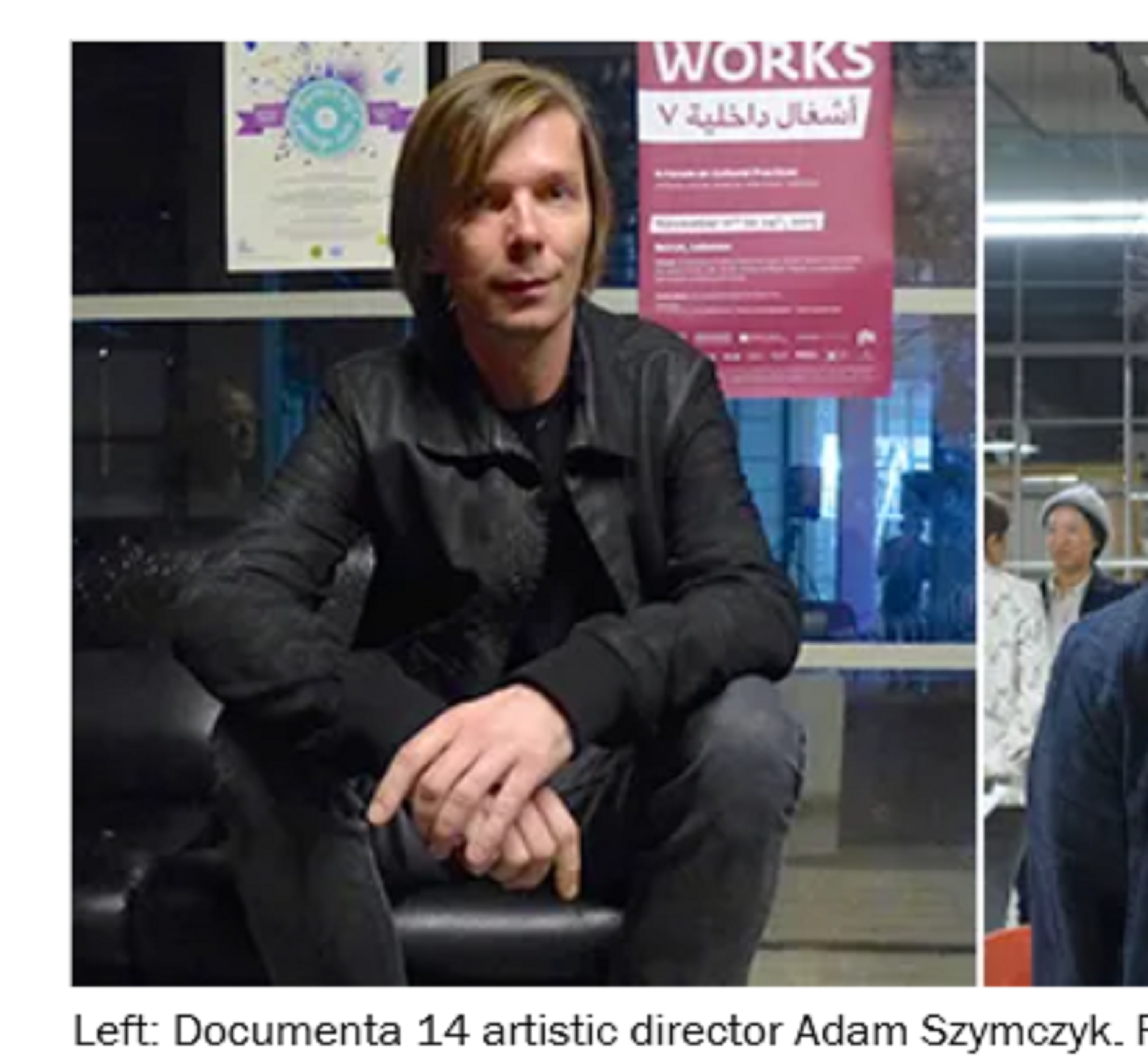
So there’s this interesting balance and I’m thinking about Lazarus Shale’s sister and the ladies reading about the Shawnee at the mission and seeing her photo.
But there’s also this other kind of relationship that includes Wilson-Goldie’s work as someone that knows so much about Beirut and the art scene there, as well as the political context there. And she actually begins her piece, which is called ‘Always Struggle with the Object, Always Rewrite the World’ which is accompanied by photos by Fouad ElKhoury with a quote by the Palestinian poet Mahmoud Darwish.
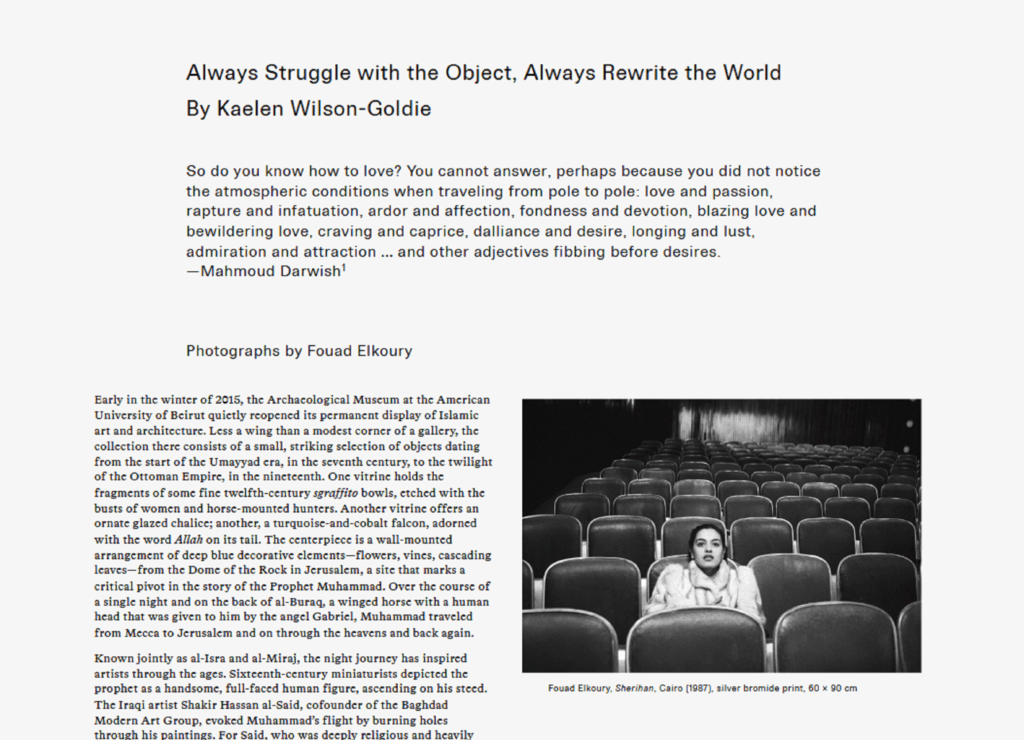
This is an amazing text about language and emotion and the limits of one and the exceeding overflow of the other and I wanted to get us round to Darwish, not only because we read his amazing poem ‘To the Reader’, which opens The Documenta 14 Reader that says “do not expect musical delight”, while, at the same time, we do expect musical delight from his poetry in spite of the anger and rage that is grounded in that poem.
The scenes that I wanted to share with you from Exergue (and I hope if you are reading this and not part of the class, you are able to watch the film for yourselves) from Chapter Two: Going South, is from the moment in the exhibition where the curators are going on trips around the world to try and find artists for their exhibition and it’s split between Beirut and Johannesburg, South Africa. We see artworks that ended up, an artist that ended up not being in the exhibition. For example, Rayyane Tabet, who is introduced to us in a gallery in Beirut, shown images and work and samples of work by the gallery owner and their assistants. And then there’s an amazing performance by the South African artist Albert Ibokwe Khoza. And Szymczyk seems especially excited by this artist and aligns it with his partner, Alexandra Bachzetsis’ work, picturing a performance in the Archaeological Museum in Athens. But that didn’t happen. And we don’t know the story of why Khoza was not included in documenta 14. Personally, I was happy to see his work in the Liverpool Biennial in 2023.
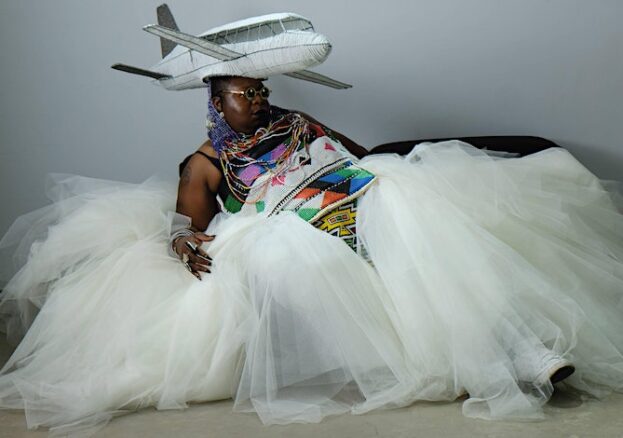
The scenes when the curatorial team go to the studio of Mounira Al Sol are really wonderful. Her studio is kind of a mess, the power keeps going out, and she’s talking about works splayed all over the floor, but the curatorial team get really interested by some works on the wall. They are drawings of people’s faces with writing by them on this yellow lined paper. And they’re from a series that would eventually be called I Strongly Believe in Our Right to be Frivolous, which would be shown in Kassel at documenta 14 and the title is actually a quotation from an interview that Darwish did for Bomb Magazine.
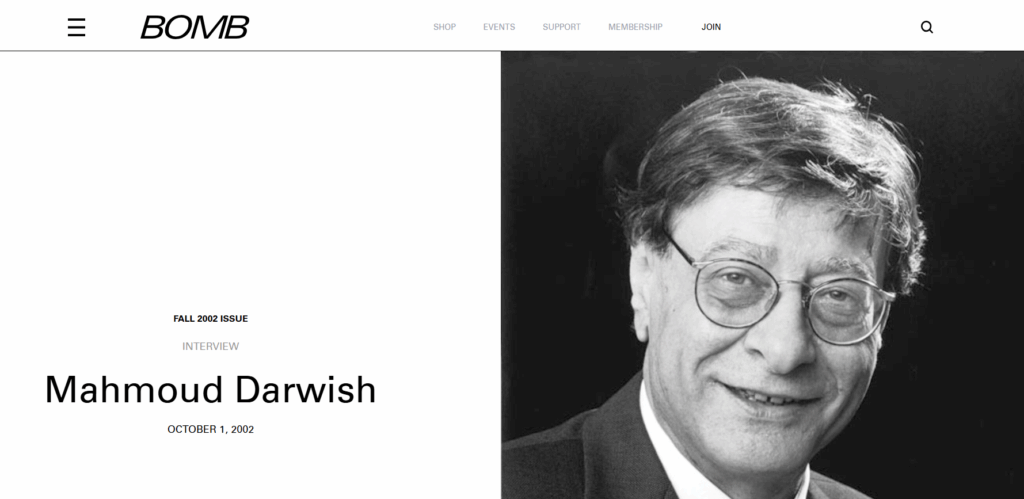
Darwish says:
The Palestinian cannot just be defined as terrorist or freedom fighter. Any trite, routine image ends up reducing and usurping the humanity of the Palestinian and renders him unable to be seen as merely human. He becomes either the hero or the victim—not just a human being. Therefore I very seriously advocate our right to be frivolous. I strongly believe in our right to be frivolous. The sad truth is that in order to reach that stage of being frivolous we would have to achieve victory over the impediments that stand in the way of our enjoying such a right.
But let’s tune into a video called At the Table with Mounira Al Solh, which is from Artes Mundi from a year ago and in partnership with the British Council of Wales, in which she discusses the work (go to 14 mins through).
These drawings were installed in Kassel in a long row. And the image on the cover for this post comes from a video that I took of the installation in Kassel.
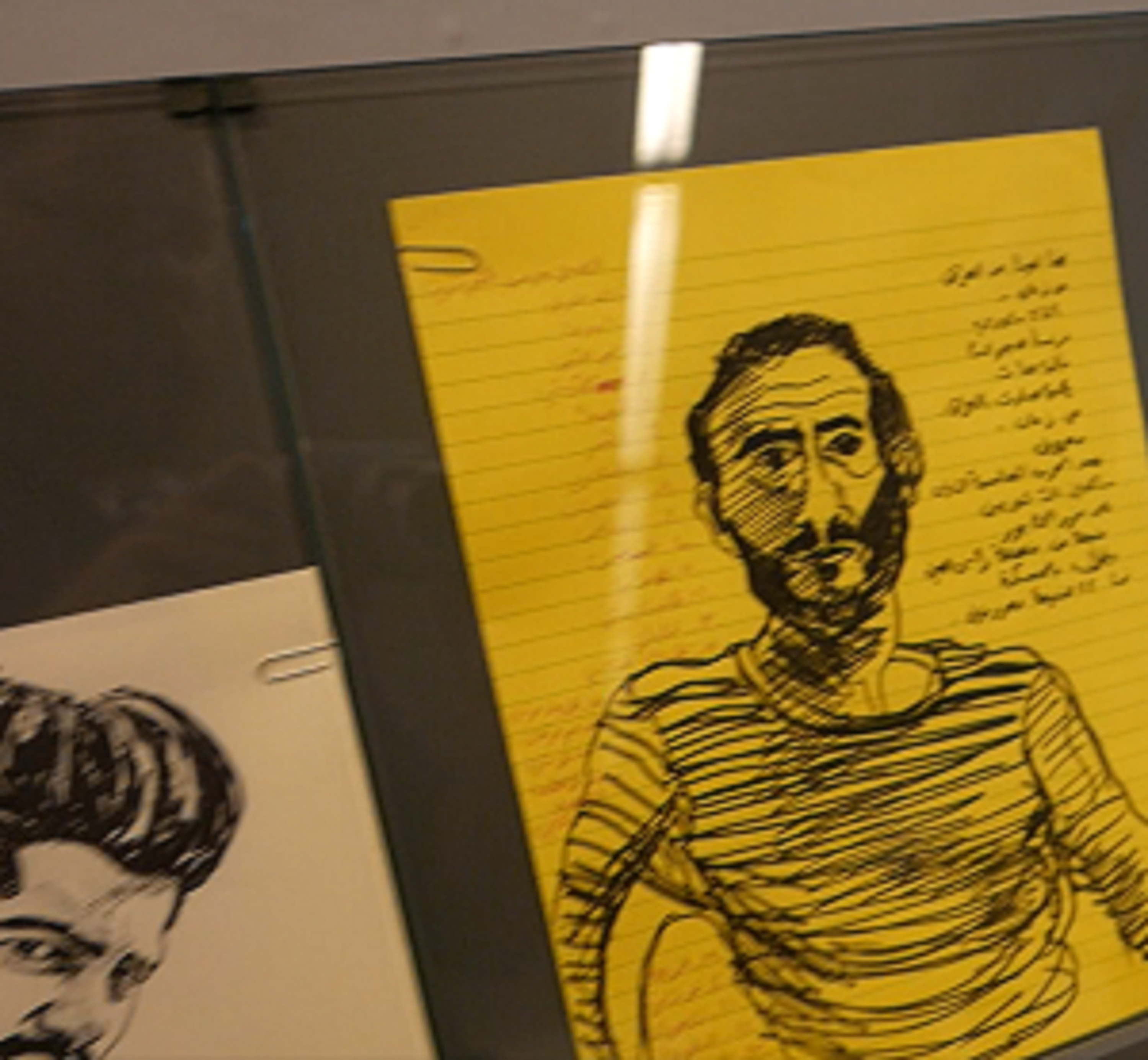
And I take this particular frozen, this particular still for my own video, because it is one of these drawings that Mounira Al Solh mentions in the film Exergue about this man who is Assyrian and so he speaks Aramaic and she wanted him to teach her songs in Aramaic. But then Mounira jokes with the curatorial team of documenta 14 that it seemed like he was more interested in her than the story. And Adam says, ah, he wants to marry you and teach you his songs. And Bonaventura Ndikung says, ah, you don’t just teach songs like that!
This idea of the marriage song brings us to the other work that Mounira Al Solh had at documenta 14, Sperveri. So this work is a tent, which has been embroidered with images and writing by the artist in collaborations with local women. In Rhodes, a sperveri is this bed tent, which was hand embroidered to cover the kind of nuptial bed. It’s also a dance that is danced in the dressing of the bridal bed. And there’s a song that accompanies it called έστολισαν το σπερβερι (let’s decorate the sperveri). Here are a couple of clips of the song – the second is by Olivia Papailou, who actually made a video singing it with Mounira Al Solh’s work behind it.
To end today’s post, the experience of reading, of seeing this work in Athens was accompanied by a long conversation I had with the worker for documenta 14, the guard in the space and the interpreter, Vicky Tsirou, about the different elements. We were reading the stories and then seeing the elements embroidered on the sperveri and I want to thank Vicky for that amazing conversation, all these years later.
To summarize, I wanted to engage in this post with the interplay between broader political questions, but also intimate, personal, day-by-day actions of resistance and hope, strongly believing in the right to frivolity, but a frivolity aligned with the ‘no Artforum smile! I really hope that Minus Plato is seen as a place of play and frivolity as much as a place of reminding us of the political implications and ongoing implications of documenta 14 and the issues it raises. You know, I am within an institution (the university), but I am not the institution and find this place and try to create this space, really asking whether documenta 14 in general, and Exergue on documenta 14, is truly not owned by anyone. And as I engage with the film, while I need to kind of navigate the situation of having an educational license to screen it in class, I also want to find responsible ways of bringing it into these posts too. And those in the class know that I’ve already been having these conversations with the production company for the film and the distributor and the educational rights that we have and what can be included on a Minus Plato post and what cannot be. So even if I can’t include audio in the future or clips from the film or transcripts from the film or stills from the film, I want to make sure that this is still an open space for me to find through my voice, through other mechanisms, a way to bring the film into dialogue with broader themes and ideas in documenta 14 and beyond, including the poetry of Laura Da’.
I’ll just end by mentioning Scottish artist, Ross Birrell’s text ‘What it is to Read?’ as a kind of shout out to the Tuesday’s class, the theory class, because we were having technical difficulties at the beginning of class, reading the text, passing the book around, each person reading it. Then we introduced Ross’s work, ‘The Parasite’, and then we brought Laura D”s poetry book, Severalty, into our reading round. So we had this amazing three books circling the room with sections being read and the sound of that was really beautiful to hear these works being read together in this way!