[The original post contained unauthorized stills and transcripts from the film Exergue on documenta 14, dir. Dimitris Athiridis, Faliro House Productions, 2024. They have been removed on request.]
Welcome to A Curriculum of Imposters (here and now, there and then, on and on). I’m your host Richard Finlay Fletcher, and it is Friday, August 29th, 2025. If you click on the Soundcloud link above, can listen to the artistic director of the documenta 14 exhibition of 2017, that was split between Athens, Greece and Kassel, Germany, the Polish curator Adam Szymczyk, reading a poem by the Polish romantic poet Cyprian Kamil Norwid.
It appears at the end of the first chapter, called ‘The Proposal’, of the 14-hour film by Dimitris Athiridis, called Exergue on documenta 14. And I’m beginning this post with this poem because it is a reminder to myself that there are paths that still need to be followed with this exhibition, even though I have dedicated a lot of my working life to continuing to engage with this exhibition, even nearly 10 years later. And actually, A Curriculum of Imposters is an attempt to register the 10 years, and prepare for the 10 years since documenta 14 in 2027. And so this will be a multi-year project, and it’s already started, here, on the minus plato website. You’ll see earlier posts and episodes of this kind of hybrid radio show that comprises of audio and a roughly edited transcript of the audio with images as well.
For our listeners, let me just tell you a little bit about what I’m looking around me. I think radio is great because it kind of is of the moment and not, you know, put together like podcasts. And I’ve done kind of editing before in the past where I’ve spliced together things I’ve said as well as clips. But what I’m doing for this show is something very different where I’m just speaking and I’ve kind of queued up some clips to play to you. And so I’m sitting in my campus office at this Ohio State University in Columbus, Ohio, which we should always remember is the ancestral lands of many indigenous groups, including the Shawnee, the Delaware, the Wyandotte, Potawatomi, the Ojibwe, the Peoria, the Miami, and other nations that also have a contemporary claim and position in this land as well. And that is where I teach in the Department of Arts Administration, Education, and Policy. But you already know this because my primary audience for this show are the students in my classes here at Ohio State, specifically two classes: one is on art education and contemporary theory and the other one is called The Social World of the Arts, which was a course that was created by my colleague, Dr. Rachel Skaggs. And what this radio show is doing is being a kind of third space between those two classes to think about ways in which I’ve made them kind of connect with each other, but also kind of serendipitous connections across those two classes. The basic parallelism of the classes are two kind of, I guess you could call them case studies in one class, but also kind of context for the other class. And that is the documenta 14 exhibition, specifically how it is mediated and communicated through the film Exergue on documenta 14, but also the poetry of the Shawnee poet, Laura Da’, specifically her new collection, Severalty, that was published by the University of Arizona Press in 2025.
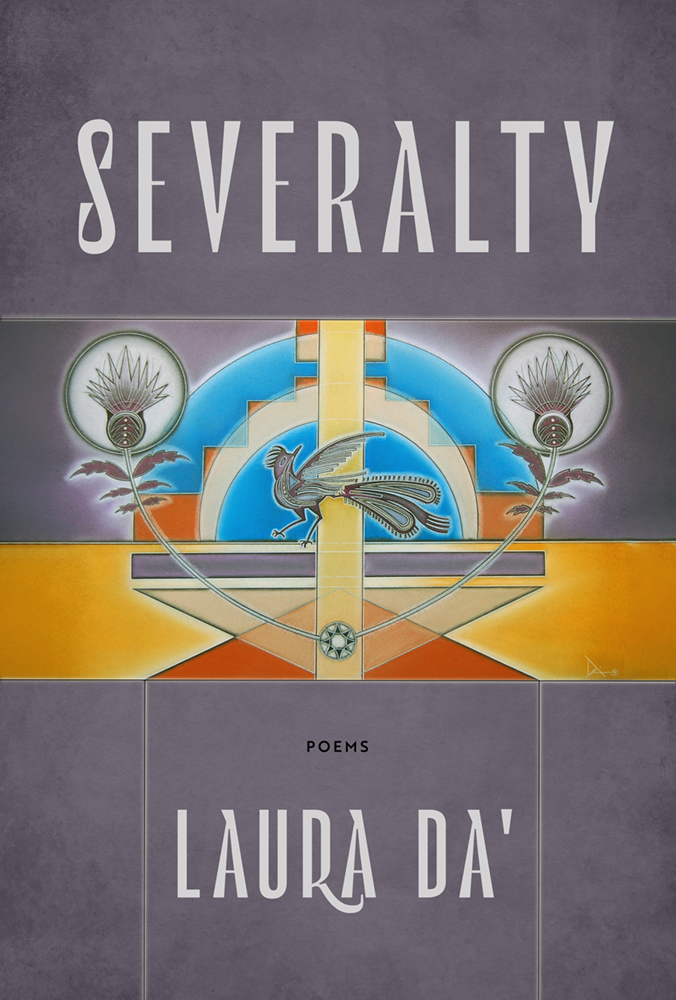
Laura Da’ is an enrolled member in the Eastern Shawnee Tribe of Oklahoma, and I’m really happy to say that she is coming to Columbus in early November as part of an exhibition that we’re working on together along with our collaborators, Elyssa Washuta and Marti Chaatsmith of the American Indian Studies Program and the Newark Earthworks Center. And that exhibition is called Laura Da’ Why Lazarus. And in these episodes of A Curriculum of Imposters, you will hear Laura’s poetry and us talk about that in a kind of framework and in dialogue with the documenta 14 exhibition and excerpt.
So sometimes when I do radio, this kind of has a curricular tie-in. I kind of ask students to directly engage with it. But this space is if the students in either class are interested in finding this space via a footnote I’ve added to the syllabus.
I should also note that the Land Acknowledgement on the syllabus and any land acknowledgement that is spoken in the context of the university, we’ve just received rules and guidelines thanks to the passage of the Senate Bill 1, which has various restrictive features on the teaching and our research at Ohio State and other Ohio universities, saying that we can’t have land acknowledgements unless there’s a direct tie to the class. So in these two classes, there is a direct tie, but also any class that’s taught at a land-grant, land-grab university like Ohio State, or within the settler-colonial context of the U.S., of Canada, of other contexts like that. The Land Acknowledgement, and there’s a lot of debate within Indigenous communities about how useful they are or that they just kind of moves to innocence. But at least there is a kind of freedom of speech situation of being able to make at least the motion towards this past and the present commitment to the tribes as well.
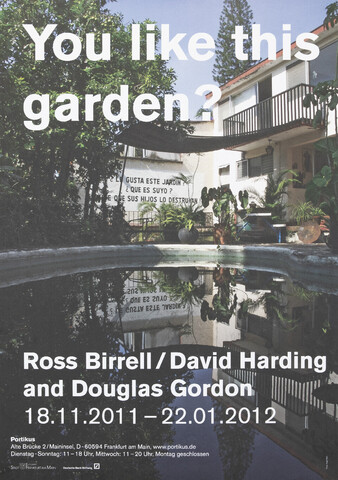
Okay, so let’s just return to Exergue on documenta 14 Chapter 1: The Proposal. I didn’t know who this poet was that Szymczyk was reading, so I had look for it and in doing so, I came across a text called ‘The Profession of Strangers’ (which you can read by clicking here) from 2010 that Szymczyk wrote about a short story by the British author Malcolm Lowry, who wrote Under the Volcano, which has had a big influence on Szymczyk. He had an exhibition that was engaged with this. And two of my Scottish artist friends, also documenta 14 artists, Ross Birrell and David Harding, had work inspired by Malcolm Lowry’s novel.
Malcolm Lowry had a short story that Szymczyk was really taken with called ‘Strange Comfort Afforded by the Profession’, and he describes in this 2010 text that he translated it into Polish because he wanted to get closer to the text. And while he was trying to get closer, he said he was, and I quote:
“I suddenly found myself stranded, doubting, on the crossroads, faced with many forking paths that led me to other writers and texts.”
And he’s thinking about writers who became exiles in strange countries. And he’s speaking about Poe, Gogol, Dostoyevsky, Nabokov, as well as Keats and Shelley and Byron in Rome. But he’s also speaking about Cyprian Kamil Norwid, the Polish late Romantic poet who lived near the Spanish steps in Rome, but spent also most of his life in Paris as well.
So, and the whole of chapter one of Exergue is about the kind of tension between, or setting up the tension between Kassel, the home of Documenta, since 1955, where it doesn’t need to be explained what this exhibition is. It’s kind of part of the culture of that place. And then Athens and the kind of fraught political context of, and this is all going back to 2015, so 10 years ago. And, you know, how to think about those two places in relation. And one of the amazing gestures that Szymczyk does is at a conference, which is called Documenta 1997 to 2017, Expanding Thought Collectives in July 18th, 2015.
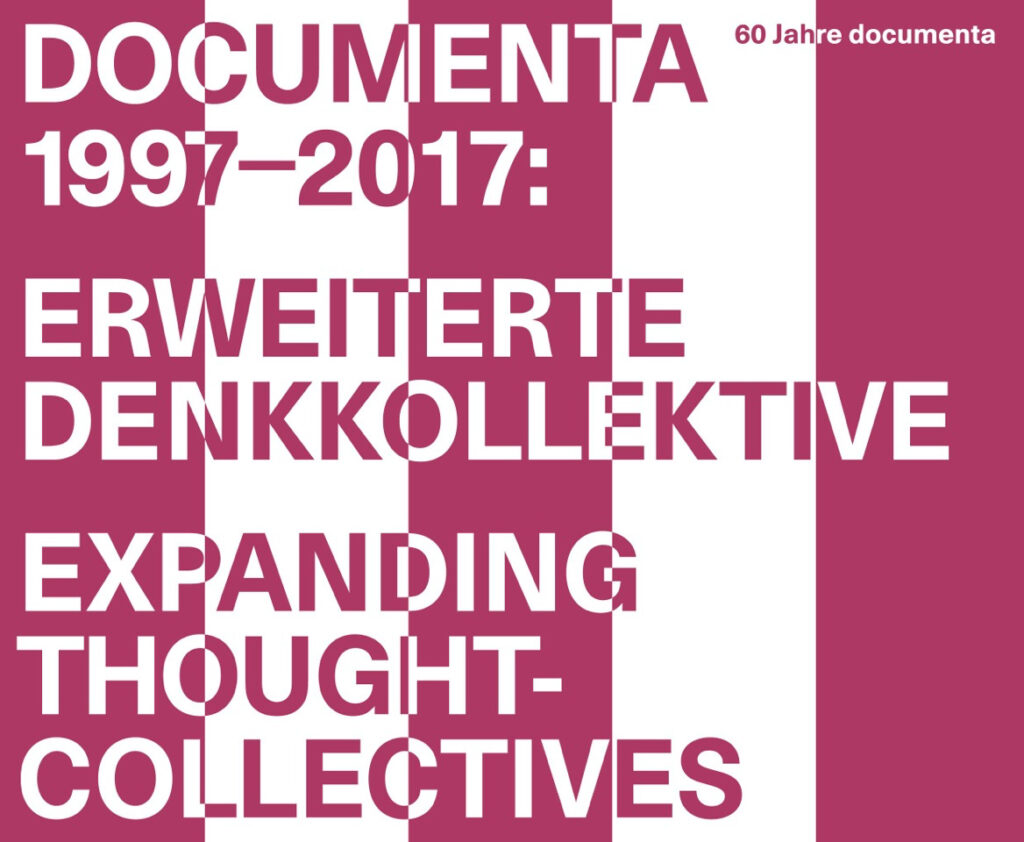
He doesn’t do like a presentation on documenta 14 about the exhibition to come, but actually has a performance by the Kurdish (Iraqi) artist, Hiwa K and the flamenco singer Carmen Amor from Sevilla. And, if you are listening, you will hear a little a clip of that performance, which included film works by Hiwa K as well as the performance.
But first I just want to go back to my own story with documenta 14. I arrived in Athens and the first, this was in April 2017, early April. No, that’s not true. It was in June. The exhibition opened in April. I actually timed my visit to documenta 14 in Athens at the opening in Kassel! So it was in early June. So the art world was in Kassel and I was there in Athens. And the first venue I went to was the Odeion or the Athens Conservatoire, so the music school. And I remember sitting in the kind of basement area of that, watching the film Pre-Image (Blind as the Mother Tongue) (2017) by Hiwa K.
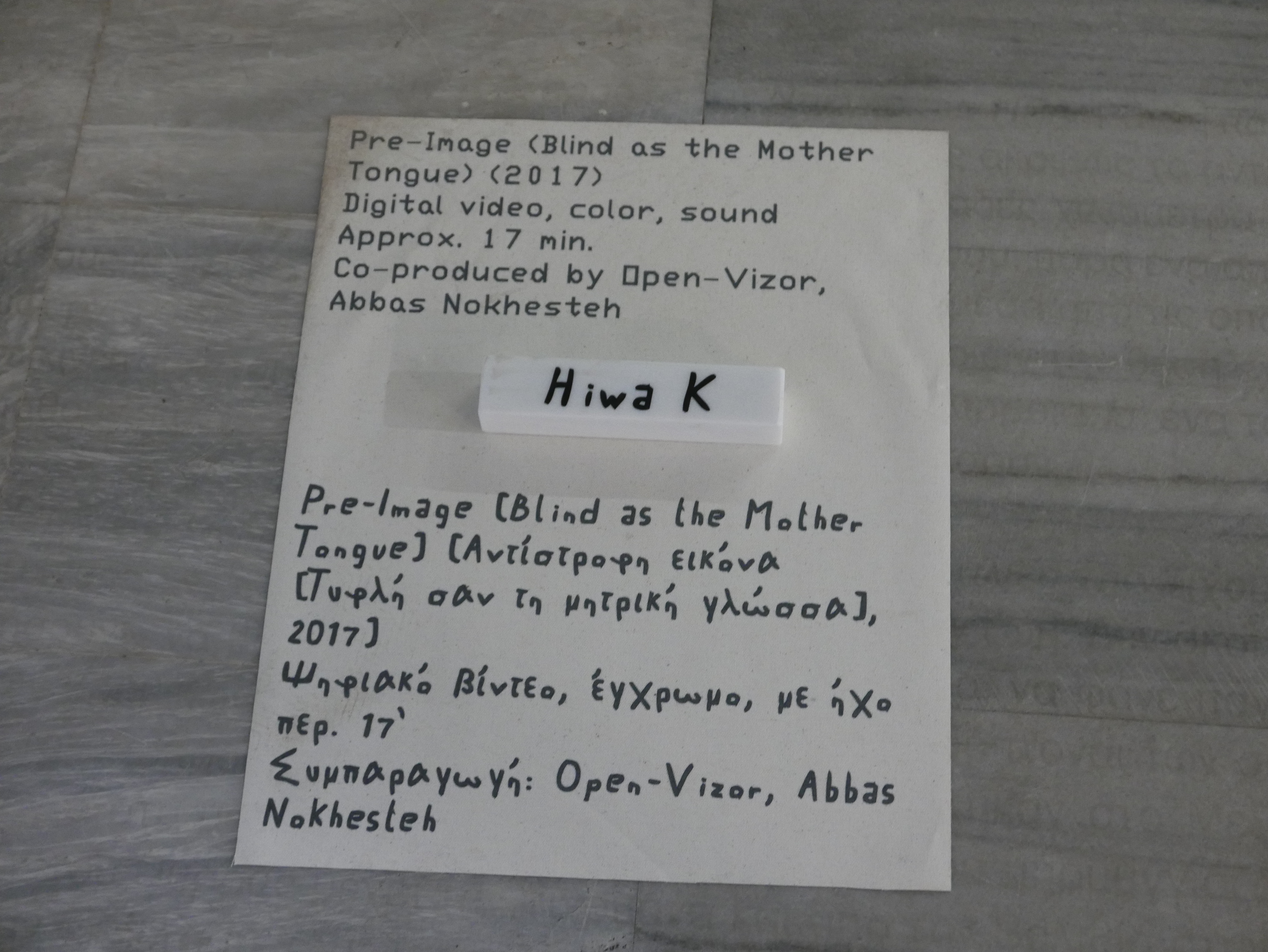
In the event with Adam Szymczyk and Carmen Amor, we learn in Exergue that Szymczyk is reading the narration of Hiwa K to create a slippage between what you’re seeing on the screen and the words that you’re hearing on the stage. So this is a clip (from 4:10-10:30mins) from Hiwa K’s short film (click the image to watch the whole film):
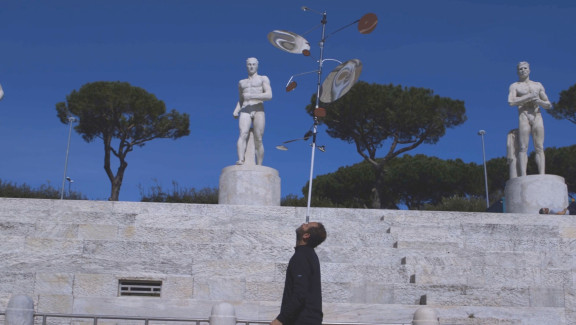
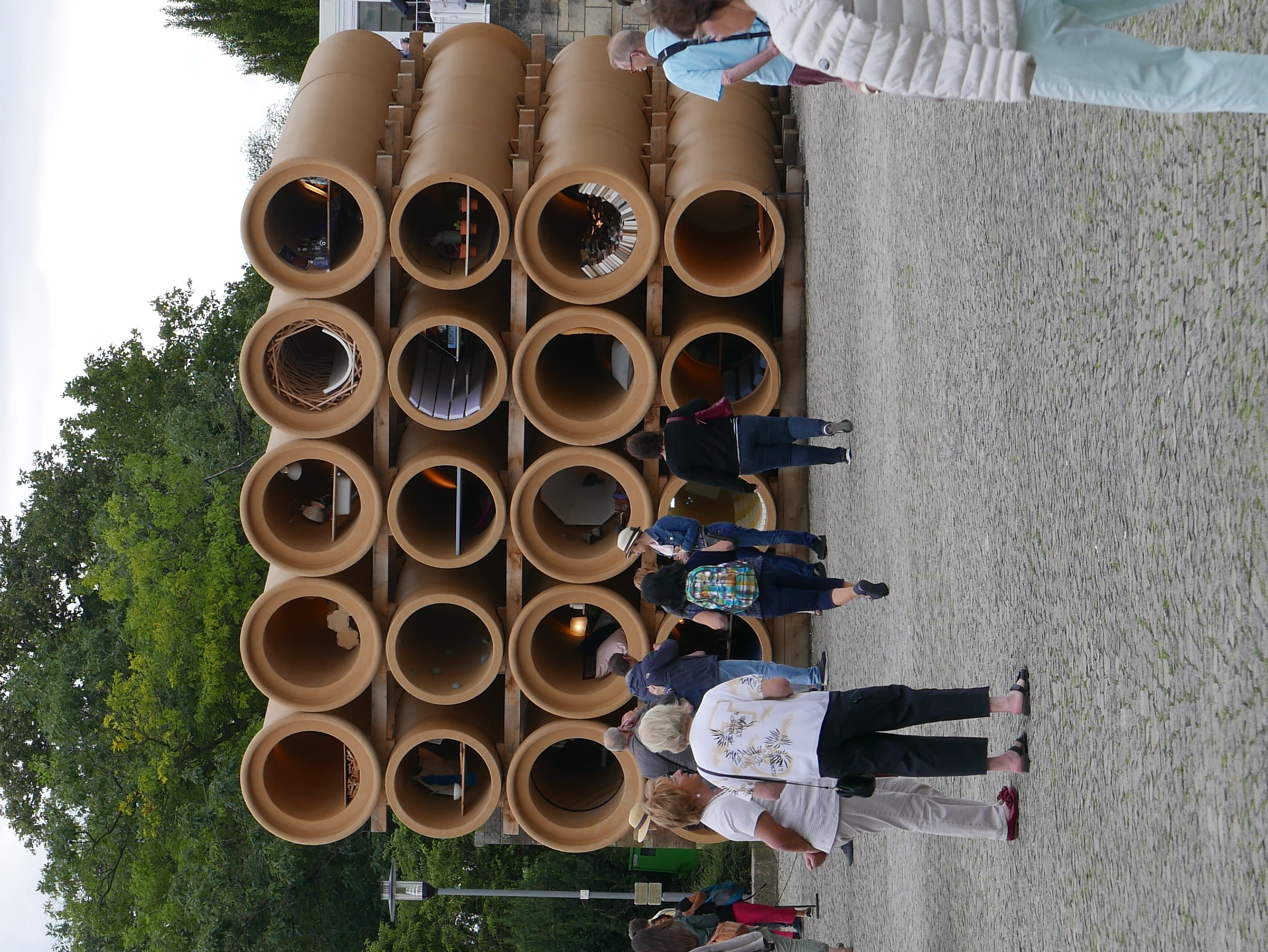
So Hiwa K is very interested in the tension between the vertical and horizontal perspective, the lived versus the surveilled life, especially in relation to the question of the refugee in his own context. And so this was one of the first works I saw at documenta 14. And he also makes reference to his work in Kassel, When We Were Exhaling Images (2017). And it is of the pipes that he references, that they slept in. And there are these large kind of beige pipes, which have kind of people’s beds in, their books, their personal items in each of the tubes of these pipes piled up on top of each other.
And I think I wanted to bring this film, this soundtrack into the conversation with Exergue because this film, while it’s amazing and 14 hours long, kind of should be a kind of starting point in many ways for a conversation about the artists and other people involved in documenta 14 and their impact and their legacies since the exhibition and what it might mean for them today. So we’ll now kind of go back to Exergue, but before then, I just want to read a couple of texts.
One of them is freestanding and the other one, I’ll read the first part and then Adam Szymczyk will take over reading it in the middle. And then you’ll hear the soundtrack of one of Hiwa K’s films and then the Martinete, the kind of solo flamenco singing of Carmen Amor after it, from Exergue. These texts that were read by Szymczyk at this 2015 event in Kassel were called ‘A Few Notes from an Extellectual’, published in the e-flux Journal. And one of them is called ‘A View from Above’ and I’ll read that one second.
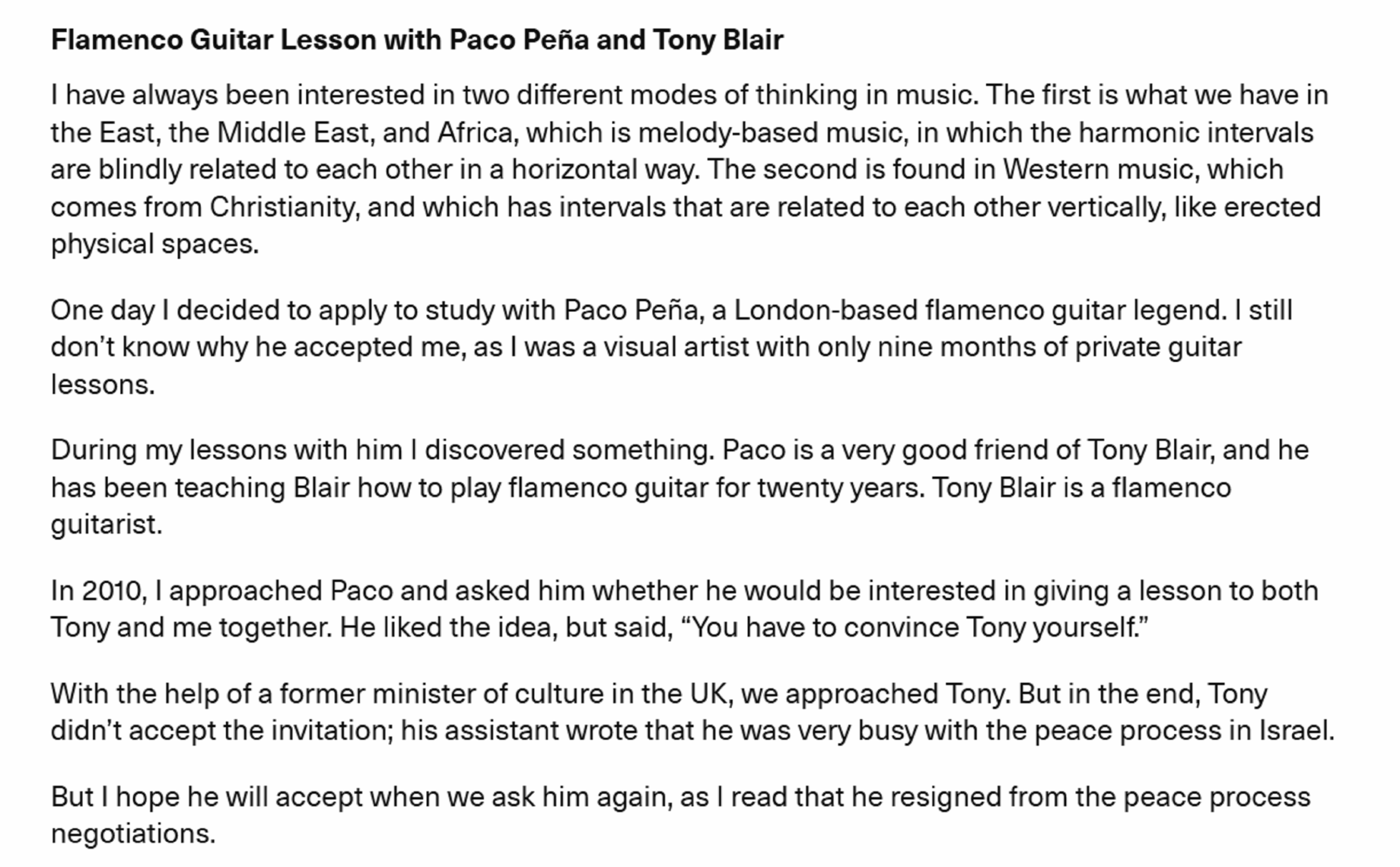
But let me just read the first one, which is called ‘Flamenco Guitar Lesson with Paco Peña and Tony Blair’.
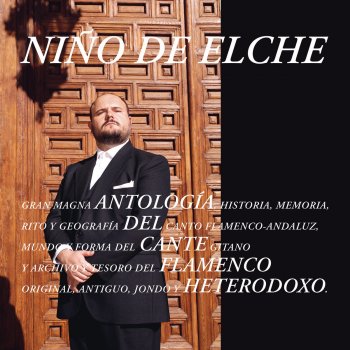
(If you are listening, you’ll hear a track by ex-flamenco artist and documenta 14 participating artist Niño de Elche called Martinete y Debla de Vicente Escudero (Con Baile al Sonido de Dos Motores) – click to image below to hear).
Just in case you want to experience Hiwa K playing flamenco guitar, here is a video of him and Carmen Amor from 2009.
Before I get to the other text by Hiwa K, I mentioned that Niño de Elche was a documenta 14 artist, well, he was part of a collective project with another ex-flamenco dancer, Israel Galván, as well as the scholar and artist Pedro G. Romero. They had a work called La Farsa Monea (2017) (Counterfeit Money), that I remember seeing in Kassel, in Gottschalk-Halle in the University of Kassel Here’s a taste:
What’s really interesting about this turn to flamenco is a, and actually, let me just use the words of the curator of public programs, Paul Preciado, in the daybook for document 14 to describe it. He writes,
So notice the reference to the Roma people, which sometimes have been described offesnively as Gypsies, but which is a term now being reclaimed word of the Roma people. There’s this really important issue of this kind of cultural formation that has been denigrated as people that move from place to place within the Roma context and Roma culture, which aligns with a lot of the themes of document 14 as well. So when we think about Adam Szymczyk’s decision to introduce documenta 14 in Kassel with a flamenco performance by a Kurdish artist playing the guitar and a flamenco singer, there is a reference point to a kind of alternative thinking of cultural canons in Europe in terms of the Roma, but also questions of shifting between the Middle East and Europe as well.
So I’m going to share the text ‘A View from Above by Hiwa K.
A View from Above
In the last four decades, many people have come from Iraq as refugees. In 1991, a division was created between northern Iraq (Kurdistan) and the rest of Iraq. The UN considers Kurdistan a safe zone. As a refugee you have to come from the unsafe zone, or at least prove that you do, in order to qualify as a refugee.
During the interview for refugee status, an official checks to see whether you really come from the unsafe zone. He asks about small details of the city you claim to come from, and compares your answers to a map to confirm that your answers correspond to it. If you cannot prove that you come from the unsafe zone, you are sent back to your country.
Many people have difficulty proving that they come from the unsafe zone, even if they really come from there.
Here is a story about someone who we can call M.
M tried to apply for asylum in one of the Schengen countries—let’s call the country “X.” He was not aware that the city he came from was in the safe zone, according to the UN. He waited five years for a positive answer from country X, but unfortunately he got one negative answer after another, until he received the final rejection from X and was set to be deported back to his country. Back then, his country was still ruled by a dictator. As a deserter from the army, returning to his country was the worst ending he could imagine. After a while he managed to cross the border of X without legal papers and enter another country—let’s call it XX—to apply for refugee status again. From that moment he was a new person.
Before going for the interview, he spent weeks with people from a town in the unsafe zone. Let’s call that town J. During this period he started to draw a map of J, which he had never visited before. He wanted to know every corner of it—the names of all the streets, the schools, the major buildings, and even the minor buildings. The people from J taught him everything and helped him draw the map of their town, all the while asking him questions to confirm that he had mastered everything about J.
When M finally had his refugee interview, the official was quite surprised, even impressed. He asked M questions about the geography of the town, and compared M’s answers to a map. M’s answers demonstrated knowledge of J as it was seen from above.
It took only twenty minutes for the official to grant M refugee status. Meanwhile, thousands of people who were actually from J and other cities in the unsafe zone waited as long as ten to fifteen years for the same thing, because their answers only demonstrated knowledge of their towns from the ground.
In the last four decades when many people have come from Iraq as refugees, in 1991 a division was created between northern Iraq, Kurdistan and the rest of Iraq. The UN considers Kurdistan a safe zone. As a refugee you have to come from the unsafe zone or at least prove that you do in order to qualify as a refugee.
During the interview for refugee status an official checks to see whether you really come from the unsafe zone. He asks you about small details of the city you claim to come from and compares your answers to a map to confirm that your answers correspond to it. If you cannot prove that you come from the unsafe zone you are sent back to your country.
Many people have difficulty proving that they come from the unsafe zone even if they really come from there. Here is a story about someone let’s call him M. Mr. M tried to apply for asylum in one of the Schengen countries. He was not aware that he is from a city that is considered by the UN as one of the cities in the safe zone.
He had to wait five years for a positive answer. Unfortunately he got one negative answer after another and he spent weeks with people coming from a town that was considered as one of the towns in the unsafe zone. Let’s call that town J. The people from J taught him all and drew with him the map of their town J. He would know now every corner of it all street names schools main buildings and unimportant ones as well basically everything.
The judge was asking M. questions and was trying to check on the map what he was answering matched to what he saw on his map. M’s answers also came from a perspective that was from above. It took M only 20 minutes to get accepted by the judge this time while there are thousands of people who were originally from J and other unsafe zones and were waiting for many years sometimes 10 to 15 years to get accepted because they simply were describing their cities from a horizontal perspective.
With this text and with the 2015 performance and the Exergue film itself, we follow the view from the ground, the horizontal perspective, of the parth, versus the vertical perspective of of institutional control and surveillance.
To end, I want to listen into a poem read by Laura Da’ that extends these contrasting perspectives by digging down, into her garden, but also into the ground of her Shawnee cultural memory, both here in Ohio and beyond. I will not reproduce the poem here, but if you go to 7:18 mins in on the below video, you can hear it for yourself):
Thanks!
It’s Cyprian Kamil Norwid (check your spelling). Another great poem of his is sung here https://m.youtube.com/watch?v=CgkWs5p6Nk0
Corrected! Thank you reading, for the recommendation &, well, for everything, really!