[The original post contained unauthorized stills and transcripts from the film Exergue on documenta 14, dir. Dimitris Athiridis, Faliro House Productions, 2024. They have been removed on request.]
In a world which is controlled and owned by nations and corporations, only limited access to educational objects will ever be possible. But increased access to those objects which can be shared for educational purposes may enlighten us enough to help us to break through these ultimate political barriers. Public schools transfer control over the educational uses of objects from private to professional hands. The institutional inversion of schools could empower the individual to reclaim the right to use them for education. A truly public kind of ownership might begin to emerge if private or coporate control over the educational aspect of “things” were brought to the vanishing point. A guitar teacher, unlike a guitar, can be neither classified in a museum nor owned by the public nor rented from an educational warehouse. Teachers of skills belong to a different class of resources from objects needed to learn a skill.
- Ivan Illich Deschooling Society (1970), pp. 86-87.
The word ‘duodji’ is rooted in the Sámi life and difficult to translate, but can be explained as the Sámi artistic way of being. Duodji is fun and wonderful, since the concept varies with the variations in its practice. Duodji has been included and discluded in turn from the discussions of art, both generally in the art world and in the Sámi context. It has nevertheless maintained its intrinsic value, which has kept its practicse stable, although it has evolved. What is the intrinsic value of duodji, an independent artistic expression that is still practised today and that can give the story of art an additional narrative?
- Gunvor Guttorm ‘Duodji and its Stories’, in Let the Rivers Flow: An Indigenous Uprising and its Legacy in Art, Ecology and Politics (2020), edited by Katya García-Antón, Harald Gaski and Gunvor Guttorm, p. 255.
Joar Nango
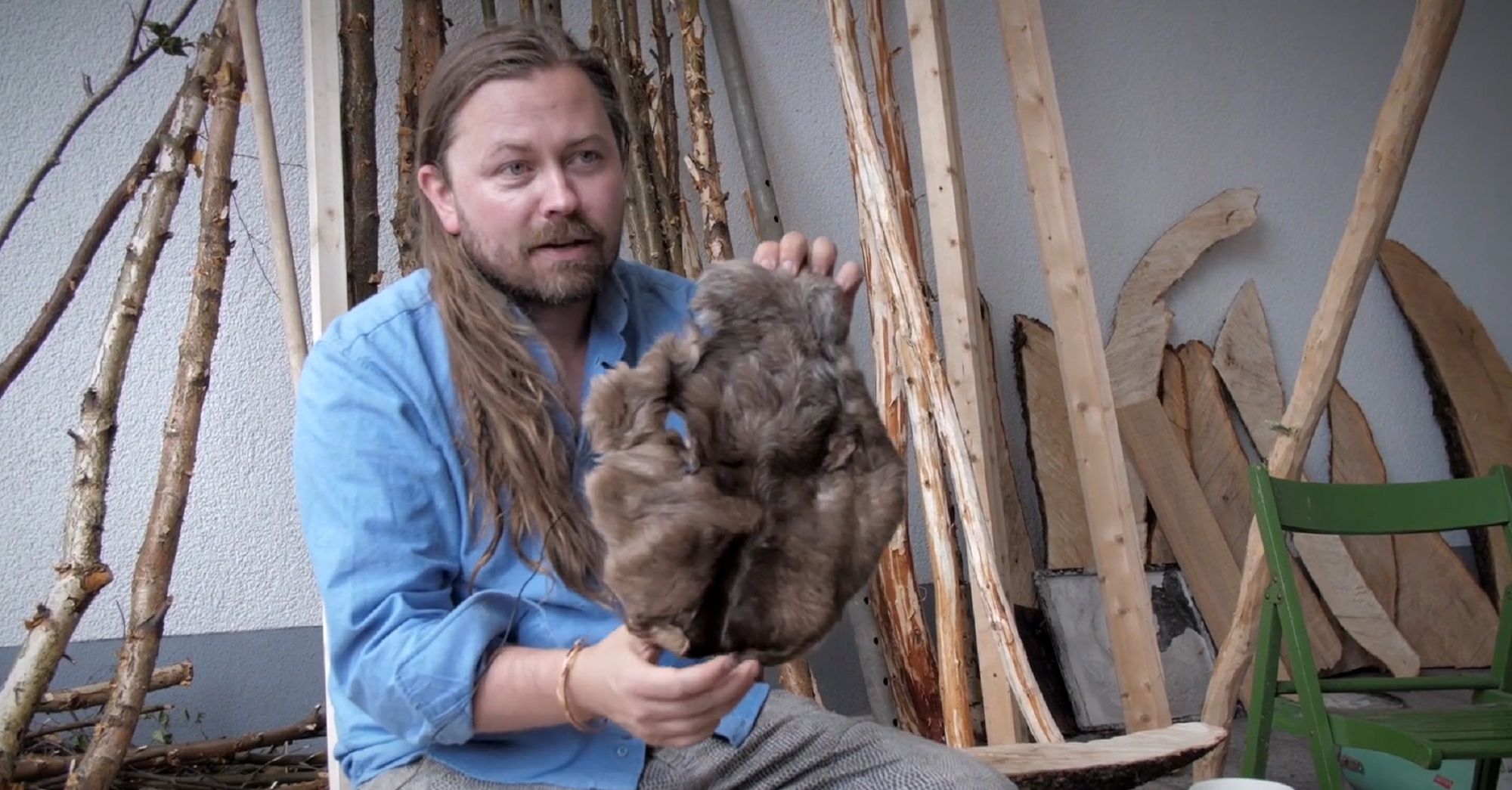
Hi, I’m Joar Nango. For your library, I have donated a reindeer fur, a piece of reindeer fur. It’s the face of a reindeer, and it’s quite spectacular. It looks like a mask, as you say. But it’s, for me, very interesting because it has quite a pragmatic use, traditionally. It’s actually used as the bottom sole of a shoe. It’s called the ***** in Sámi. This is the heel, which you fold up. The nose becomes the very characteristic tip of the shoe, and these are the sides of the shoe. You can see it shaping. I find it somehow a little bit poetic also, that we step on a face. These are called *****, and they are the legs, the leggings of the reindeer. The four leggings of a reindeer is enough to make one shoe. There’s another kind of shoe called *****. There’s the shoe which is used where the face is used, and then there’s the shoe which uses the leg fur. I’m trying to get it out. Both of these furs, they come from a very exposed part of the animal’s body, so it means that they have very short hair, but it means that it’s also very, very sturdy. So it means that, of course, shoes need to last long, so this fur is ideal for that. I’m trained as an architect, and as an artist, I work a lot with context. I’m very interested in the way we, as people or humans, relate to the material around us. So in that sense, I think I would have to say everything. That would be the answer. For me, it’s very interesting to learn from the northern culture’s way of improvising with materials around us, this makeshift, DIY kind of aesthetics or architectural installation of structures. For me, not only interesting as aesthetical objects, but they’re also interesting in the sense of it actually representing a way of thinking, attitude towards life, attitude toward land resources. For me, it’s some kind of humbleness that exists within it that is something I think that our contemporary world needs to… Yeah, it’s something we can learn from. The project that I’ve done for documenta, I started the whole project by driving a car from northern Norway to Athens, and the car, when it started, was filled with nearly two tons of material and tools also. And one of the more basic components of what I brought to Athens was four birch trees, big birch trees with a bent shape that I brought from my grandfather’s summer grazing land in northern Norway. And the other component was skins, a lot of furs. And so the face was sort of a part of the furs that was donated to me by my aunt. My aunt is a traditional shoemaker, one of the best ones, and she has for years been actually also making a living from selling these furs. So bringing materials from the north to the south, and vice versa, bringing material from the south to the north. When I’m in Kassel here, I have also been working a lot with materials from Athens, the materials I brought from Athens. I brought a lot of marble, and I also, let me think, quite a lot of small peculiar stuff. But I also brought a huge E, steel E, which is a part of a sign of a closed-down factory in the north of Athens called Eskimo. It’s a refrigerator company. So I brought that E, and I brought a lot of the neons, the neon lamps that were in the sign, that I prepared and used in the installation, the spatial composition. I think being a representative for a minority culture like the Sámi culture somehow always force you to be some kind of an educator in situations. It’s like, I can’t count the times when I had to sort of explain to people what a Sámi person is, how many people we are, our history, what we’re known for, in short terms. And that sort of educative position is something you as an Indigenous artist always have to deal with. I also like the fact that it can have some kind of a bit of a playful sort of approach in using it as a mask. And of course, that’s also a little bit why I gave it, because me and my nephews, nieces, we’ve been, of course, playing around with this, running around, putting some rubber bands around us, making theater play, of course. And I like that part of it. I think it’s also important that the discourse around indigenous cultures and our continuous presence in the world isn’t too dramatic either. And I’m very interested in normalizing ourselves as well. And what better way to do that than to play around with something as mysterious as this, right?
Keviselie/Hans Ragnar Mathisen
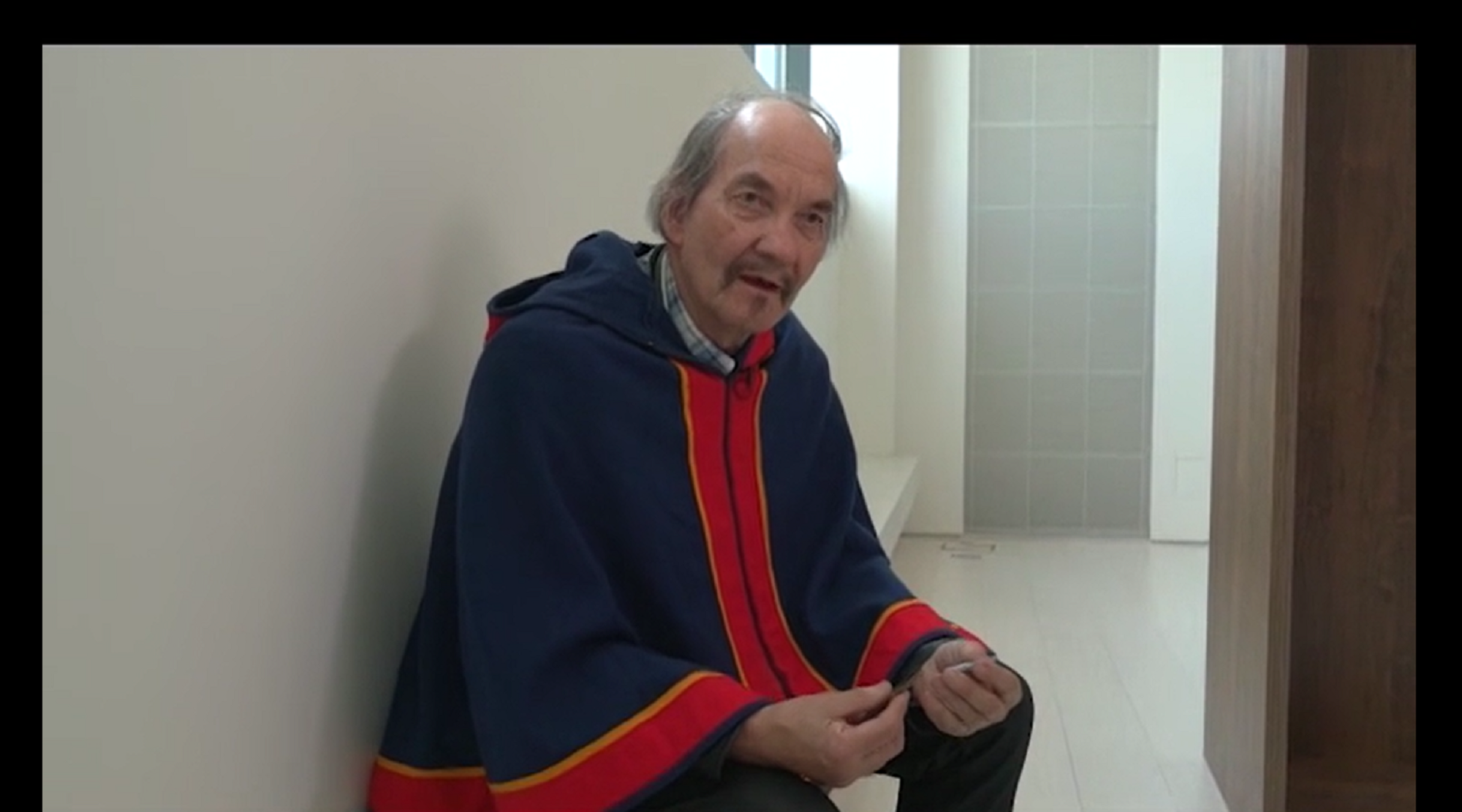
My name is officially Hans Ragnar Mathisen. That’s when I sign documents. But when I sign my art, I sign Keviselie, which is my artist name. It is a pencil holder, because in my artwork I use both ink, pencil and also color pencils. So all artists have to be very careful not to waste material because at least in my youth artists were poor people. So we have to take care of the resources. So when the pencil was so small that it’s kind of difficult to use it, I have this extension here, which makes it longer. Then it is more easy to use. So you can use it almost till the end. I have worked in a quite wide specter of techniques. But here I have exhibited maps, handmade maps, of the areas in the Sámi homeland with the Sámi place names.
Because they are different, unique and they have a lot more content than most other names in the same areas. Yes, I could pick one example that often is used. You have a valley not very far from where I live, which has been kind of translated or orally translated from Sami to Norwegian. In Norwegian it is on the map Signaldalen. ‘Dalen’ means valley and ‘Signal’ means a signal. But it has no meaning in that context at all. Because it is an oral translation of the Sámi word *****, which means deep. It’s a deep valley, that means it’s a quite flat valley and it has almost like a canyon shape. But it is not a canyon because we have words for that too. So it’s a deep valley. It goes far inside the country and it has quite steep hills on both sides. And it’s a very beautiful valley. If you ever come there you will agree. You have one mountain there called *****, means ‘The Otter Mountain’. And from a certain perspective it reminds you of Matterhorn. And in fact it’s called the Matterhorn of the North. The maps are drawn with ink, pencil and colour crayons like this one. This is a light blue or grey. So I use it to colour the maps. And they are very expensive because they are the first top quality crayons. So I need to be careful not to throw it away as long as I can use it.
[This post is part of the experimental radio show called A Curriculum of Imposters: Here & Now, There & Then, On & On that reflects on the creation, production & reception of the exhibition documenta 14 within ongoing learning contexts at a public land-grab university]