I have already seen Christopher Nolan’s The Odyssey twice and I enjoyed the experience both times, including talking about it afterwards, both for its merits as a film (especially its timely commentary on the devastation of war, male arrogance and violent deception), and also in how it relates to Homer’s poem (e.g. its incorporation of Virgil’s Sinon). However, as a former classicist, who both read and studied the whole poem in Greek during my undergraduate degree in Classics at Cambridge (1998-2001) and who has taught it in translation in large-scale classes during my 12 years in the Classics department at Ohio State University (2006-2012), the open debate swirling around Nolan’s film that brings classicists their moment in the limelight has reminded my why I had to leave the field in the first place. Of course, classicists and Homerists, especially brilliant translators such as Emily Wilson, are perfectly placed to debate the relationship between Homer’s poem and Nolan’s film, finding flaws in the latter and under-appreciated nuance in the former. Yet, while they have been invited to weigh in on this particular film, their perspective is intrinsically blinkered because, as classicists, their expertise in film studies, let alone filmmaking, are necessarily wanting. This reminds me of the years of frustration with the way classics as a field engages with contemporary artists that led me to writing about ancient Mediterranean cultures and contemporary art on this blog in it’s first, pre-documenta 14, phase (2012-2017). Invariably, attention would be limited to when the artist (and it is usually a single artist like Cy Twombly or Jean-Michel Basquiat, in isolation) used classical themes in their work, and the classicist’s role would be to show how the artist had a deeply serious engagement with the text or topic, akin to their own, that not only shone a new light on the artist’s work, but also some arcane corner of the (still?) popular field of classical reception studies. Nowhere to be seen would be moments in the artist’s work that veered away from the classical theme and, worse of all, there would be next to no engagement with the wealth of scholarship and broader art writing about the artist. I see this happening again with Nolan’s The Odyssey. While we are in the early phases of its reception by classicists – no doubt conferences are in the works and book contracts are being signed – where are the analyses that include his other films (e.g. Memento)? Or how his films have been discussed in terms of his engagement with other directors? While I no longer concern myself with the self-obsessions of classicists, who, not remarkably always feel like they are invited and are loudly platformed in no small part due to the ongoing ‘save Western culture’ moment of racist and xenophobic white nationalism, I did feel a twinge of compulsion to share some old Minus Plato posts about the Odyssey to offer a modest alternative to this mainstream moment.
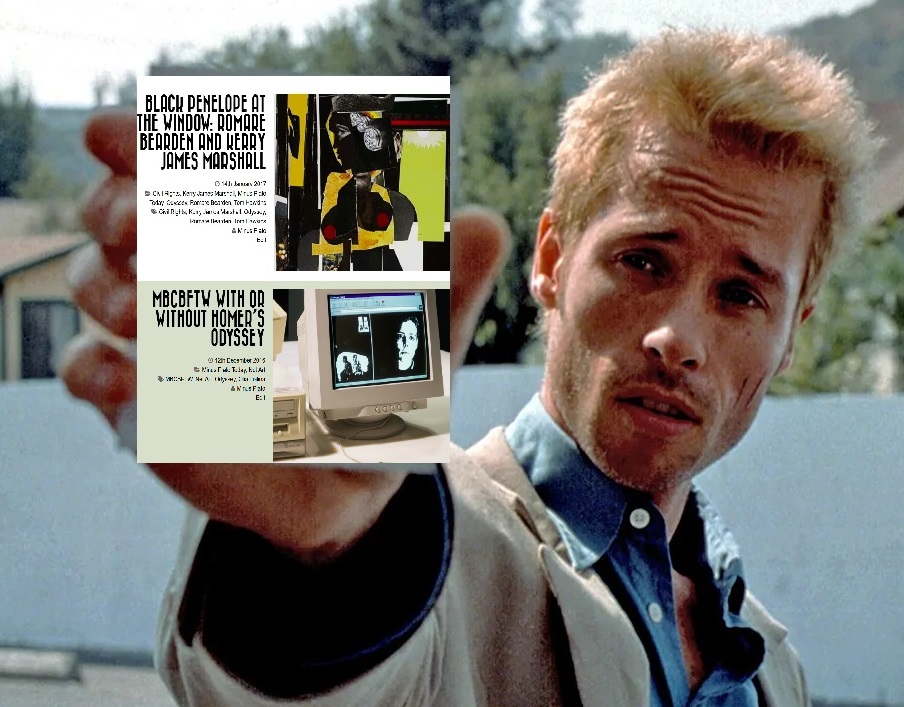
Here they are, held up like the polaroid by Guy Pearce’s character in Nolan’s Memento, in reverse chronological order. And along with Cavafy’s Ithaka, as quoted by Adam Szymczyk in The documenta 14 Daybook, I hope the road back in time reading them is a long one, full of adventure, full of discovery and remember don’t hurry the journey at all.