No president has ever been subjected to the incessant slander leveled at him, the relentless daily assault that would drive most mortals to a permanent fetal position. Much of it has been outright lies. But he shrugs it off and spends every waking moment addressing the nagging problems we face and combating the forces who are determined to divide us on race, gender and economic status, and to burn the nation down to make way for their quixotic socialist utopia. So many of the attacks leveled against him have been orchestrated by a monolithic liberal media that has abandoned any pretense of fairness and objectivity. The media is not only a hell-born hydra for the Democratic Party; it is outright dishonest and censorious. Even if you disagree with every conservative policy, you surely can’t be comfortable with the liberal media and social media conspiring to suppress conservative speech — not if you still love America and what has always made it unique. If you think this country can long survive with such tyrannical behavior, if you think Donald Trump represents a greater threat to this nation than people who facilitate such despotism, then we’re on different planets.
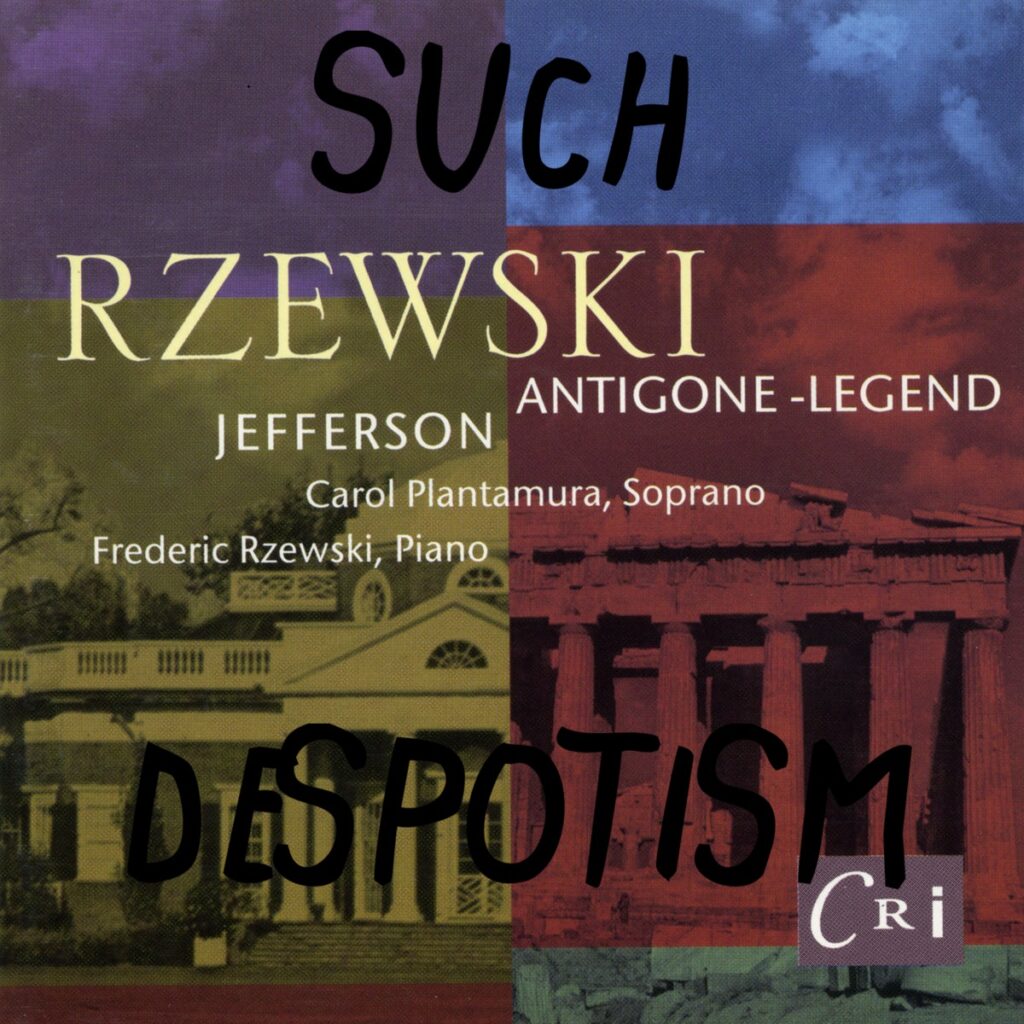
I wrote Jefferson in the summer of 1970 in Rome, after coming back from a U.S. tour with the improvising collective MEV—a tour cut short by the massacre at Kent State University in the spring of that year. The bloody confrontation, the government’s increasing tyranny, and its readiness to use violence against its own people convinced many that a potentially revolutionary situation existed in the United States, and indeed in the world. A vision existed of a nascent revolutionary culture, both peaceful and beautiful, that would replace the old, patriarchal, acquisitive, and warlike culture that had dominated the century.
[…]
I chose the opening sentences of the Declaration of Independence, a text I had read in school but hadn’t paid much attention to since. Suddenly it seemed relevant. It spoke of the legitimacy of revolution: “Whenever any form of government becomes destructive of these ends, it is the right of the people to alter or abolish it.” Its lofty rhetoric was clearly the source of much of the current political jargon, and in fact provided a cloak of respectability for the antiwar movement. Governments, according to the Declaration, are not to be overthrown for “light and transient causes”; on the contrary: “all experience hath shown, that mankind are more disposed to suffer, while evils are sufferable, than to right themselves by abolishing the forms to which they are accustomed.” Just as the French and English revolutions wore the Roman toga or spoke the language of the Bible, the revolution of today could invoke the words of the Founding Fathers.
[…]
We performed Jefferson in a number of venues, and made a few radio recordings. The reception was generally less than enthusiastic. The tonal language was unacceptable in contemporary music circles, and in the milieu of the political left—in many ways equally orthodox—the piece was denounced as “capitalist realism.” It was put in a drawer and was not performed at all for twenty-five years (partly also because of the extreme difficulty of the piano part). Looking at it again now, however, as the world shifts into the Age of Globalitarianism, I do not find it old or dated. Could it be, as some have suggested, that the time has come around again when it may become necessary to call, with music as well as words, for “a new social contract on a planetary scale”?