Parko Eleftherias, Athens Municipality Arts Center Museum of Anti-dictatorial and Democratic Resistance
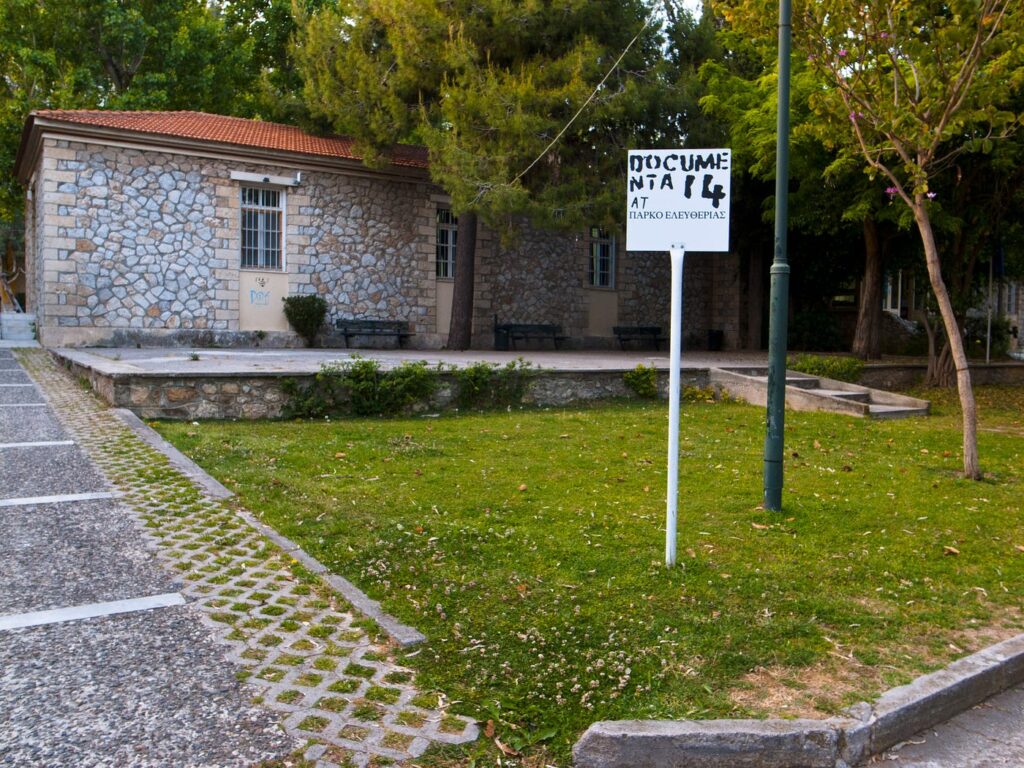
The Athens Municipality Arts Center in Parko Eleftherias (Freedom Park) and the Museum of Anti-dictatorial and Democratic Resistance belong to a nineteenth-century complex of military barracks whose recent history is linked to the repressive military junta that ruled Greece from 1967 to 1974, sometimes called the Regime of the Colonels. The building of the Arts Center, currently occupied by documenta 14, was used to house the military police headquarters; the museum building just behind it was a detention and torture facility. Both buildings still belong to the Greek Ministry of Defense.
These two sites represent divergent approaches to history, memory, and collective trauma. The Museum of Anti-dictatorial and Democratic Resistance is operated by the Association of Imprisoned and Exiled Resistance Fighters. Lacking funding, it is run on a nonprofit basis by some of the victims, who personally relate their experiences. The interior spaces have been preserved as they were during the 1960s and 1970s and include archival and documentary material.
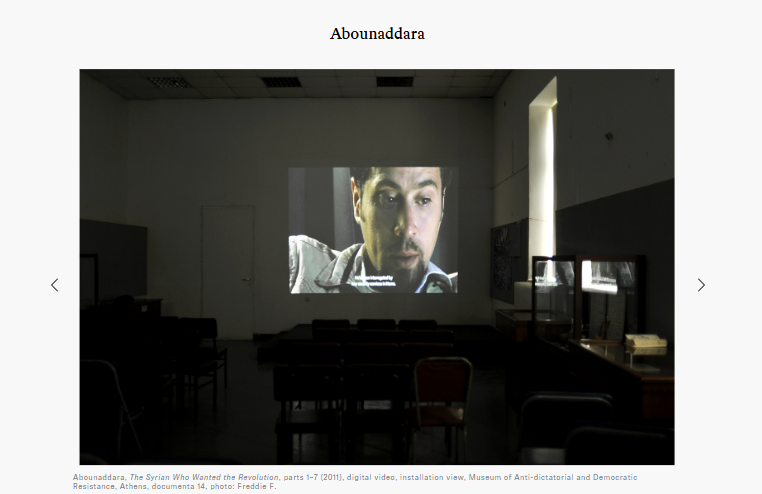
In contrast, the building of the Athens Municipality Arts Center was transformed into a public art gallery and traditional “white cube” in the 1980s, effectively imposing a “de-historization” of the space. documenta 14 invited Greek architect Andreas Angelidakis to transform the architecture of the Athens Municipality Arts Center into the site of the Parliament of Bodies (the name given to the Public Programs of documenta 14), which subsequently serves as an exhibition venue. In an act of “investigative restoration” Angelidakis carried out a series of minor yet crucial interventions. First, paneled walls were partially cut away, allowing the stone walls and the material history of the building to emerge. Second, a direct connection to the museum behind has been created by reopening the back door of the building. Third, Angelidakis has covered the windows with black curtains, which suggest mourning “widows” or shrouds between the buildings. Finally, Angelidakis designed Demos, a soft architecture consisting of sixty-nine blocks of fake concrete “ruins” that can be assembled and reassembled in multiple ways to reorganize the inner structure of the space. For eight months, the building has been the site of the Parliament of Bodies, a space for public debate and collective performance, and it continues to have this function throughout the exhibition. In this context, we ask what does it mean to be public? Who can narrate history? Who is allowed to speak? Can the museum be used against its own colonial and patriarchal regimes of visibility? The Museum of Anti-Dictatorial and Democratic Resistance also serves as one of the sites of the exhibition by hosting a film by the Syrian collective Abounaddara.