
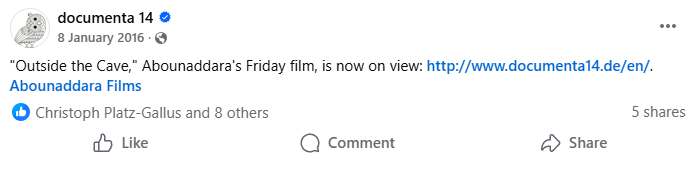
Outside the Cave, film still ©Abounaddara
The audience
La Vie des Idées: For whom do you make your films? How are they perceived by the various audiences you have encountered?
Abounaddara: We make films because it is the most useful thing we can do for the revolution. However, we do not subscribe to activist cinema that wallows in self-segregation by preaching to the converted. Instead we speak to the audience on the basis of a shared humanity, regardless of any political or national concerns. In fact, the Arabic-speaking public can access our work more easily. The foreign public also seems to have taken an interest, however, especially in Europe where festivals often request films from us even before we have released their subtitled versions.
Having said that, we have always taken great delight in confusing the issue by playing on the real or imagined differences that characterise our public here and elsewhere. One of the rare films whose title makes reference to the name of our country, Syria Today, shows a steam train similar to that which has haunted people’s collective memory since the Second World War. Another, dedicated to The Syrian Street shows an old taxi driver straight out of neorealist Italian cinema, who is looking for the way to Damascus while we hear a national opera singer commemorate the moment with a tango song. In each case we are trying to show a humanity that is the same everywhere, whatever the views of those who defend “the complicated Middle East” and “the Syrian exception”, who are the same everywhere. However, this approach bothers a certain left-wing Syrian and European elite that takes pleasure in seeing Syrians as nothing more than victims. For those compassionate souls, our films “do not really represent reality”, for which we have been reproached on more than one occasion.
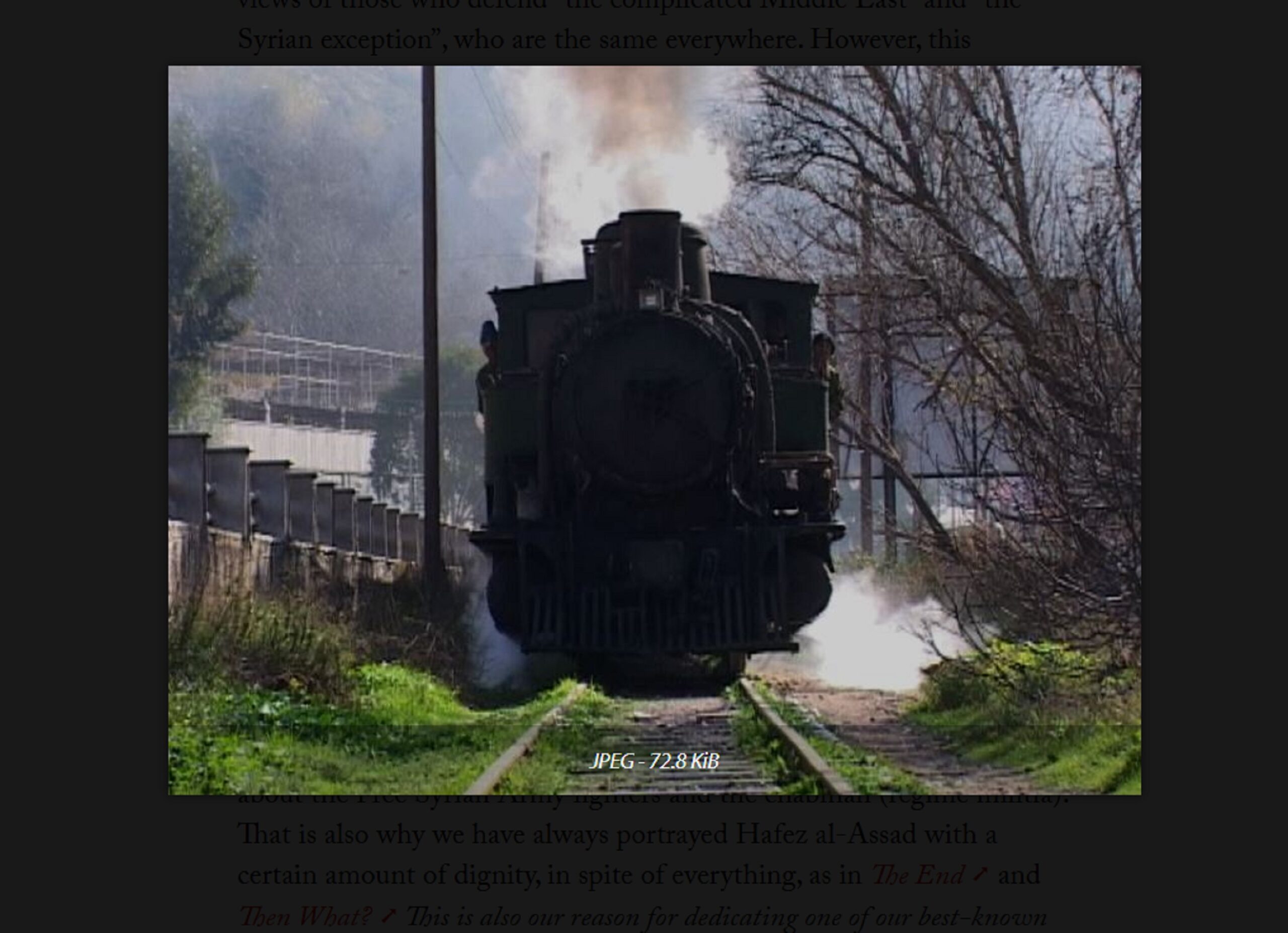
Syria Today, film still ©Abounaddara
However, the public we usually have in mind when making our films is the sector that supports the regime. We try to involve those people who are distrustful or hostile by bringing them back to the sphere of pure humanity, especially now, at a time when we are hoping to make films about the Free Syrian Army fighters and the chabihah (regime militia). That is also why we have always portrayed Hafez al-Assad with a certain amount of dignity, in spite of everything, as in The End and Then What? This is also our reason for dedicating one of our best-known films, I Will Cross Tomorrow, to the sniper that killed our friend Bassel Shehadeh, the filmmaker who returned to the besieged town of Homs to film and train citizen-journalists [3].
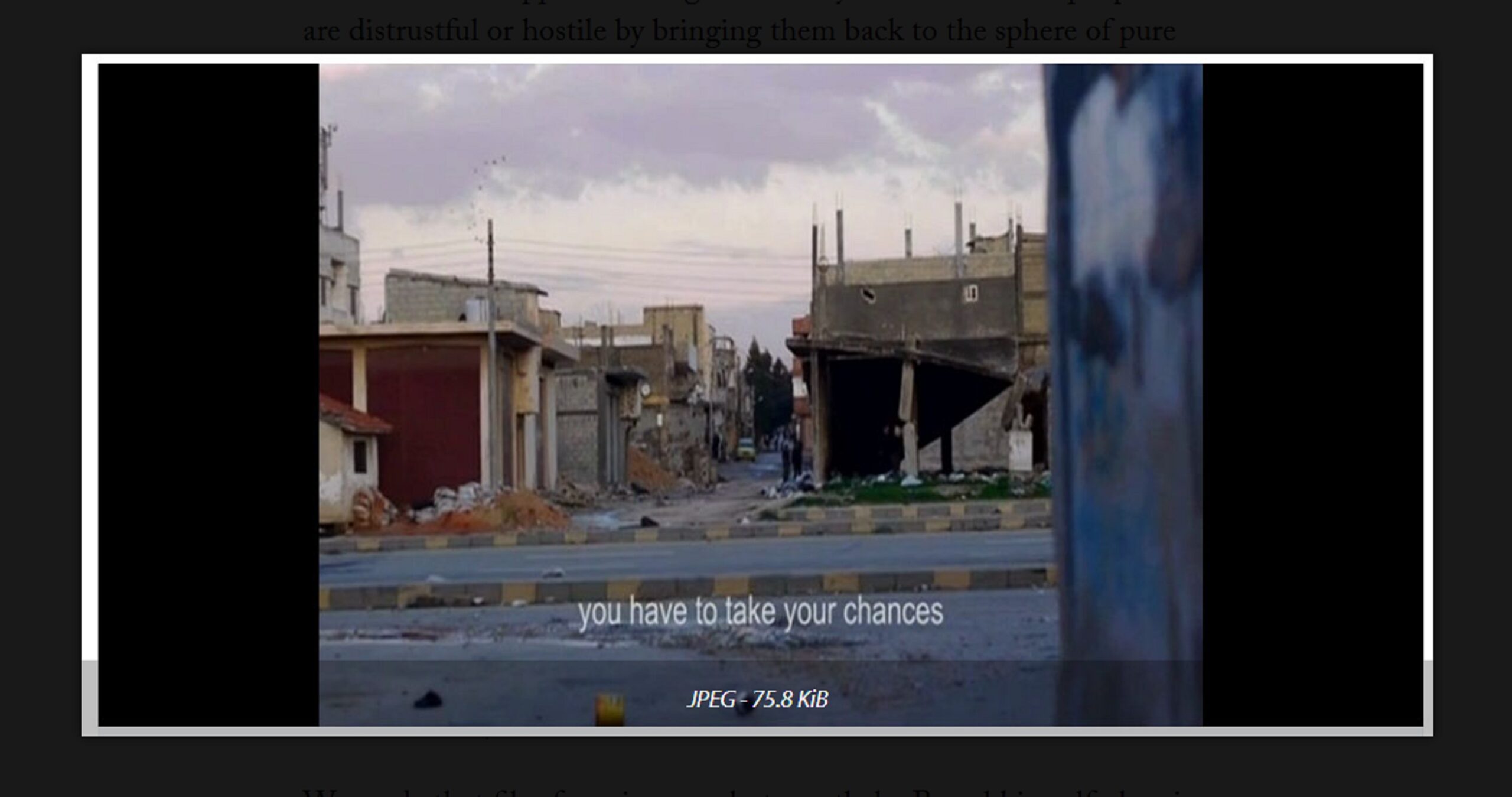
I will cross tomorrow, film still ©Abounaddara
We made that film from images shot mostly by Bassel himself, showing him crossing an area guarded by a sniper. It is presented as a posthumous letter from the filmmaker to his killer, its substance saying the words, “You can kill me, but my images will always be there as a witness”. For the end of the film we invited a religious man committed to the revolution to sing a song as a Requiem. However, the religious man chose to sing a profane song that says, “Our martyr is dearer than the Almighty”! In other words, a man of religion showed ferocious iconoclasm by suggesting that the concept of God should be revised after Assad. And our public both at home and elsewhere has had nothing further to say because the film was a tremendous success. This shows us that cinema can allow itself to aim high. It even has a duty to do so, to protect the revolution from snipers and from television, which both share a tendency to aim low.
3. Bassel Shahadeh (1984-2012) was a self-taught filmmaker who made several short films from 2006 on (see in particular
He played a very active role in the Syrian revolution when it began in March 2011, before leaving for the United States to study cinema as part of a Fulbright scolarship he received at the University of Syracuse. Three months after arriving in New York, however, he returned with a film he made on pacifist commitment
He was then active in the Syrian pacifist movement and settled in Homs to film, inform international media and train citizen-journalists in filming and editing. He died on 28 May, the victim of a bomb attack by the Syrian army in the neighbourhood of Homs where he was at the time. In accordance with his wishes, he was buried in Homs and not in Damascus, his home city.
Bonjour Bassel Shahadeh
Bonjour Fatima Hassouna
Bonjour Awdah Hathaleen
Bonjour Renee Nicole Good