
Greetings all my relatives. We are all one. It’s an ancient insight from the indigenous cultures that seems to have been lost along the way.
And so when I speak to people I want to acknowledge you as relatives. I’m really moved by the presentations this evening and the other ones I’ve heard. I’ve not been in an environment like this before.
I’ve been so grateful for the opportunity to listen, to learn some of the things that I’ve learned here. And one of the most important things that I’ve latched on to is that your world is really important in helping us to find a way to make this divine place a better place. There’s far, far too much harm and brokenness, savagery, brutality, murder.
We hardly find the time to build monuments when some other atrocity happens. And so in the knowledge that you carry, in the professions that you embrace, I can see the power of harnessing that energy, of harnessing that knowledge, of harnessing that spirit and a desire to create something good. Much more than art form or symphony or dance or a song, but a symphony of the human spirit that says we’re all worth something, we’re all valuable.
And that we need to learn how to hold each other up, how to embrace each other, to care for each other, to love each other. That should be the way. And yet we see little evidence of it.
Next year, in a few short months, Canada is going to celebrate its 150th birthday. Among the population there are about 30 and maybe a million of people like me, indigenous people. And we have this monumental diversity in Canada.
Every race, every color, every creed, everybody lives in Canada now. At the same time, this country that we call Canada, our country, boasts of its freedoms. It boasts about its fairness and its equality and its justice and inclusivity.
But until now, Canada has had its own shameful little secret, which is the inhumane treatment that its own aboriginal people have gone through for the last 150 years. The attempt at absolute assimilation, doing away with the culture, doing away with the rituals, doing away with the real stories, doing away with getting the meaning, the indigenous meaning behind these ideas and masks and rituals that we hold, that’s a really profound form of genocide. And this has been going on for a generation, after generation, after decade, after decade, and no one cared.
No one cared. Nobody raised a hand and said, we shouldn’t be doing that to these people after all of their human beings. No one, no one raised their hand.
I didn’t hear a voice. I didn’t hear the art world. Instead, they were profiting on the things that we treasured so much and loved so much, that defined our place in the universe.
I ask myself, how could this have happened? How could it be happening now? Where you’re sitting right now, think about all the atrocities that you know of. Ask yourself, how could those atrocities have happened, and how can it be happening now? And when you ask that, you’ve got to ask the converse question. Who are we in this room? Who are we? I don’t mean your title or your profession, but who are you? Why are you here? And I don’t mean just in this room, but why are we here? What is the essence of our existence? What do we really want? Do we really care about others? And if we don’t, shouldn’t we be? Shouldn’t we have a duty to all others, so that no one suffers and no one gets left behind? So there were some tools that the colonizers in Canada used in putting down the Aboriginal people, and one of them was mentioned earlier, the Indian Act.
And I remember the first Indian Act I ever picked up, and it had a definition of an Indian, and it read in part, an Indian is other than a person, which meant that the colonizers were deeming us Indigenous people to be not human. And in the creation of the Indian Act, of course, they created a whole number of laws, and they established reservations. By the way, the first people who went to our lands that we’d owned for millennia, the first people who went to them were really only wanting access to the resources and exploiting all of those resources.
So they set aside lands for, it said, use and benefit of Indians, and we were set up in barren places that had no potential for productivity, and soon we were so marginalized economically and in every which way that our whole nation of people became spiritually bankrupt. I think you’re fortunate that you’re all in this room. I’m making assumption that you’re all creative, you’re all artists, you dance and you sing, and you have this spirit that’s alive and it gives expression to your soul and who you are and want to be, but imagine if that was stripped from all of you.
The reserve system was the first form of apartheid. When South Africa was thinking about setting up its apartheid framework, they sent a representative to Canada to study the apartheid in Canada because it was working so well. So they removed us from all of our territories, of course.
Sometimes we had to get passes to get off the reserve to go somewhere else. It’s interesting to note that Canada has been always considered a country of freedom, yet we were the only country in the Western world that had a separate act for its indigenous people. So that gives you some idea about the attitudes in those days, and when you set up those reserves, of course, that gave the federal government and the newcomers the license simply to exploit the lands at their will.
The other one that was just mentioned relates to culture again, and it was included as part of the Indian Act, the anti-potlatch law. In one fell swoop, the authorities destroyed our central constitution. At the stroke of a pen, they torched our worldview, our entire worldview.
At the stroke of a pen, they said it has no value, and from now on you will have to embrace our worldview. And in that same stroke of the pen, they condemned our spiritual ways of being. Anything that’s of value to us as individuals, that we love and cherish and caress and believe in and uphold, we should be able to hold on to those continually.
And at the stroke of the pen, they took that away. One of the other things that we all, North American Indians, Canadian Indians, we really believed with all of our hearts and minds and soul that our relationship with the land and the territories, the seas and water, the sky, was inextricably linked. As a matter of fact, our genesis, all of our tribes have at least four genesis, four stories, origin stories.
All of those sacred places in which a genesis manifested came from supernatural manifestation. And so it became a part of our mindset to know and think and feel and believe that we were the land. I know people get confused.
We’ve been busy trying to get our lands back in Canada, and we talk about Aboriginal rights and title. But the other day, I was at a funeral for a young relative of mine, and I invited this young, wise, middle-aged guy to say a few words. And he said, my ancestors said, we don’t own the land.
We don’t own the land. We are the land. And when you think about that custom and that belief and that perspective, you begin to understand why the Aboriginal people, the indigenous people, had such a reverence for creation.
And when you have that kind of atmosphere, you learn to develop a deep respect for all that is. And you become willing to take on what you consider to be your role, a responsible role, in protecting the environment and making sure that everything you do is sustainable, that species will thrive forever, that our waters will be clean for the next generation. So when they had that anti-pollution law, it was pretty destructive.
And I was a little boy then, during the height of that. I saw the old people weeping, and I didn’t understand it then. And they knew that they were sliding from the very foundational context in which they lived their lives out, and that there was nobody on their side that the church and the state and everybody else were happy enough to condemn us to our savagery and our heathenism, and that we should all be conformed to be like those new Canadians who came to Canada.
So the potlatch was our encyclopedia of historic knowledge. And it was, like I said, the utter foundation of who we were. It was critically necessary as a practice.
I’m sure there are many people here who belong to different faiths, some Christian, others religious, others faith-based groups. And you know, if you’re true to what you believe, that the deep impact and relevance and meaning of what you do in the name of that religion or belief has to match what you practice. You practice it every day.
And in our ancient, in a small part of the world that I come from, the ancient beliefs that we had and the little practices that we had allowed us to every day seek some sense of belonging to this magical, divine creation and to feel that we were a part of it, and that all of this was intended to be in harmony and connectedness, and everybody belonging to it. And I don’t see that anymore, and it’s so sad in our time, your time, and mine. When I watch television at home, I see the slaughter.
I see death and dying. I see hatred, and I can’t, I can’t understand that, even as one who’s growing old. I’m still trying to comprehend how we can be so inhumane to each other.
And so when I came to Documenta 14, I have to admit, I really wasn’t sure about what I was getting into. But after these four days of confusion, and then learning some things, and I called everybody, you got to be a little crazy, right? But learning what I’ve learned, that there are people in the world who care, that there are people with different skill sets that are so important and critical to the idea that we rebuild a new world that’s filled with love, not hatred. In the potlatch, there are many, many, many dances, many secret societies, and when we hold these potlatches, there’s intensive preparation, just like the preparation I imagine that all of you had here, in bringing everybody together for this gathering.
And there were names given, rites of passage, exercised, dances passed on, but it was always an act of giving, an act of sharing the wealth. I know this next comment, I just wanted to mention it. If you’re a Kwakwaka’wakw, you can potlatch, but if you’re a Greek or somebody else, and you can’t trace your ancestry to the first ancestor of our clans, you can’t potlatch, no matter what you do.
I just wanted to throw that up. But I think I wanted to talk a little bit about the most debilitating instrument of colonization Canada perpetrated on its Aboriginal people. And it’s about talking about the Indian residential school system that existed there for well over a hundred years.
They initiated these residential schools, and they built a hundred and thirty of them, and over the term of those schools, a hundred and fifty thousand little children like me. I was six years old in that picture, and I was to go to that school right after that picture was taken. And they took us away to these strange places, never seen the people who were now in charge of our lives.
They didn’t speak our language, and pretty soon we couldn’t speak, we were forbidden to speak our language. And they set these schools up, this regime up, and the expressed intention was to remove the child from the influence of his traditional surroundings, to kill the Indian in the child. And they’re all documented, these notions that they had.
And these schools were always underfunded, overcrowded, there was much malnutrition, there were nutritional experiments, and because they were underfunded, rampant for sickness and disease, children as young as three years old were often taken from their families and homes, and they never got to go home. Many of them died in these institutions. We’re discovering now some of the unmarked graves, we’ve been doing some research on them, and here are these little children that somebody loved.
They belonged somewhere, ending up in these institutions to die, and their parents never knowing what happened to them. In those schools, there were physical, sexual, emotional, spiritual abuse of every kind. Can you imagine a little six-year-old being sexually abused? Those things haunt you all your life until you somehow figure it out.
And so there were generations of little children like me, who grew out into adulthood, had our own families, who lived with this experience. Extremely, extremely traumatized. And we didn’t know that, we didn’t know we were traumatized.
We just closed up, we just shut up, we didn’t talk about it. We were just trying to bury it, and as we grew into adults, we acted out and behaved in ways that tried to drown out the torment of those experiences. Imagine that, generation after generation after generation.
Huge consequence and fallout. I’ve been working in Canada a lot on what we call reconciliation, talked to all of the aggrieved groups in Canada, became really good friends with some Jewish people who were concerned about the Holocaust and the continuing story about that. And we never, with those people, compared traumas.
We never compared pain. It didn’t matter to them that there were no guns in the instance of my experience. It didn’t matter.
What mattered to them was that we were hurt. And all the while this was going on, everybody could see these big schools. There are 130 of them, with 300 students on each of them every year.
And nobody raised a hand again. Nobody said, wait, we can’t be doing this to our offspring. It’s not right.
Nobody said anything. And just by complicity, it went on forever. There were some experiments in electrical shock.
In the school that I went, we had a little chicken coop that was probably the size of one of those seats with chicken coop wire. And if you misbehaved, they’d throw you in there for a day and fed you bread and water. There were all kinds of strappings and ways of harming little kids.
Standing in the corner until you blacked out. Or you’d run a gauntlet. If you wet your bed, they’d line up all the boys in the dorm, and everybody would be hitting you as you went.
It was so brutal and cruel. Imagine growing up as a six-year-old to a little later. Growing up in an environment where nobody once has said, I love you.
You’re valuable. I care about you. Nobody ever hugged you.
So when I left that school, I was so angry. I learned to hate. I was out of control.
I couldn’t imagine thinking about all those other little 150 kids. I always thought I was tough. It’s okay.
I’m okay. But I used to think about those other ones and say, my God, what have they gone through? I think the idea is not about the sad story about residential schools. The good idea is just emerging in Canada.
We had a truth commission that just concluded its work last June. I remember being at the presentation of the final report. There were at least 7,000 of us sitting in this room.
The chairman of the Truth and Reconciliation Commission pronounced, Canada, you did all this to your Aboriginal people. For that, you committed cultural genocide. The whole room erupted.
Everybody agreed. Everybody somehow in that moment, if you had gone to those schools, felt vindicated. My God, somebody had finally acknowledged my trauma, my loss, my hopelessness, my despair.
Here it is. It’s out there now. Except for one man.
He’s sort of a friend of mine. He’s the Indian agent. I can’t remember.
But he’s a big wheel in government, responsible for Indians. While everybody was stomping and hooting and hollering and screaming in joy and weeping with joy, he was a lone guy sitting there. He still wouldn’t stand.
I felt so bad. I got a really big heart. I felt so bad for him.
At that moment, I should have rejoiced in his discomfort. But I didn’t. I felt that, no, no, I can’t be that.
I can’t do that. After all, he’s only a human being, too. There was euphoria.
I went home and I suddenly became saddened. My God, somebody had just said that my country had committed a cultural genocide upon its Indigenous people. There was a sadness swept over me.
I truly cared about all the Canadians. I truly cared about Canada. I walked around for a couple of days trying to figure it out.
But then there was a subsequent poll released, which said that seven out of ten Canadians wanted to reconcile with Aboriginal people. That seven out of ten Canadians agreed with the characterization of cultural genocide. So what that said to me was that there was a whole country out there that cares.
And we, those of you who seek peace and love and joy, fellowship, relationship, what it says to you, that there are many, many good people in this world. We’re not all bad, nor are we all evil. So if you decide this evening that you as an artist and a profession or whatever it is that you do in your life, that you’re going to dedicate some of your time and energy creating peace and reconciliation, you can find the people out there.
As a matter of fact, most of them are waiting, waiting for you. I know in Canada, most of the people I speak to and I crisscross the country, most of the people I speak to say, well, yeah, we want to reconcile, but we just don’t know how. How do we, where do we start? How do we do it? Invite us.
And that’s the setting that now exists in Canada. So all I’m saying really is that in making this place a better place, this divine place, this creation, all of us in this room can have a part to play if we choose to. There’s so much chaos around the world.
We’ve got to find a new way forward, like we’re always saying. We’ve got to begin to have a new kind of dialogue between all of us that creates meaning, deeper meaning. And you’ll be surprised how that transforms relationships.
At a fundamental level, all of us in this room can do something about seeking peace and reconciliation. And I just visualized the power of your intellect in this room, the power of your spirit, and unleashing that out into the world where people need your talent and your commitment, your dedication. I still think there’s time for us to do all of this work to create a place we could leave to our grandkids, a better place, one where walks in equality, dignity, caring for each other.
I’ve been so honored to be here in Athens, in Greece, but here as well. I have heard the desires of your hearts, the intention, and I’ve seen good people. And all we’ve got to do is figure out how we carry that forward.
When I talk to kids, little kids, I end with the whole world is waiting for you. And in some way, in this room, the whole world is waiting for you. Thank you.
Sorry, it’s not over yet. I want to sing a song for you. It’s an ancient, traditional song.
That’s what they call us at home. And it’s a song about the Thunderbird. And it’s really a song about freedom.
And as I sing, and I’m a bad singer, by the way, as I sing this song, I want you to visualize the flight of the Thunderbird in freedom. And may it symbolize the desire that you have to bring peace and love to the world. And don’t forget, I warned you, I’m not a singer.
This is funny. If my people at home saw this, they’d be chuckling too, I think. So I’m going to look this way.
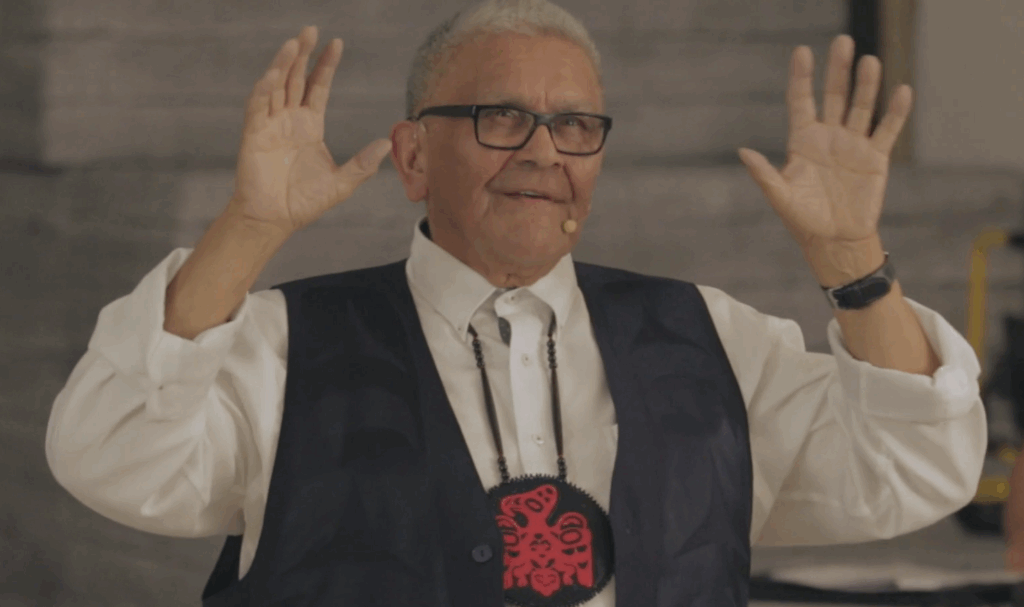
– Transcript of Chief Robert Joseph, hereditary chief of the Gwawaenuk First Nation, ambassador for Reconciliation Canada, and a member of the Assembly of First Nations Elders Council, speaking at the first ‘act of giving’ series I Owe You Everything, at documenta 14 on September 20, 2016, along with writer and curator Clémentine Deliss. The video is no longer available on the documenta 14 website, but information about the event can be found here.
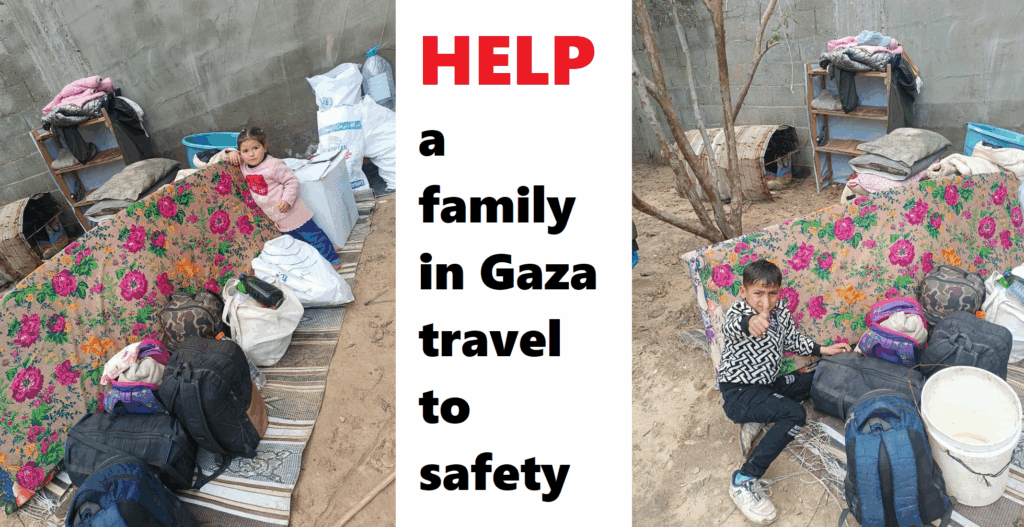
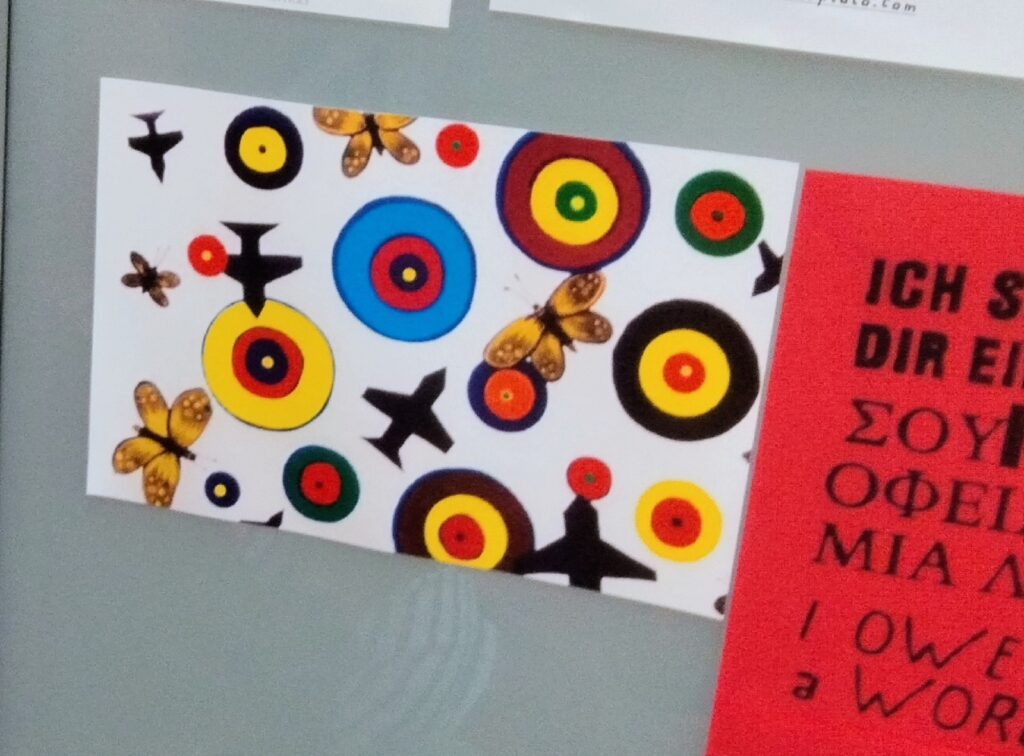
This post is dedicated to Saja Matar, sister of artist Dina Matar, whose painting (which you can see outside my campus office) inspired the project Bombers into Butterflies. Saja and her young family are currently being forcably displaced from Gaza City and she needs all the support we can give her to find safety. Please donate to the GoFundMe here, if you can.