I
‘To the Reader’
Black irises in my heart
and on my lips . . . flame.
From what forest did you come to me
O crosses of anger?
I have allied myself to sorrows.
I have shaken hands with banishment and hunger.
My hands are anger,
my mouth is anger
the blood of my arteries a juice of anger.
O my reader
do not ask me to whisper
do not expect musical delight
This is my suffering,
a wild shot in the sand
and another to the clouds.
My fate is my anger
And all fire starts out in anger.
This poem by Palestinian poet Mahmoud Darwish, first published in the 1964 collection Leaves of the Olive Tree when the poet was 18 years old, appears at the beginning of The documenta 14 Reader, the main publication for the 2017 exhibition split between Athens, Greece and Kassel, Germany. It is reprinted from Khaled Mattawa’s 2014 book Mahmoud Darwish: The Poet’s Art and His Nation, and it is no surprise given this title that the main line of interpretation that Mattawa will offer of this poem is in terms of the poet/speaker’s identity as both a Palestinian and as a poet. Mattawa registers the irony of Darwish’s refused expectation of “musical delight” for a poem written in elegant Arabic as a way to explain that, of course, the poet is both politically and aesthetically engaged from the beginning. But what draws me back again and again to this poem – and why I think it was used to welcome readers into The documenta 14 Reader – is less a statement of Darwish’s politics and poetics, is its atmosphere of hospitality and intimacy operating both within and beyond the poet’s emotional frenzy.
For all the poem’s insights into the sources, expressions and nature of the poet’s anger, bubbling through the poet’s body and striking out in shots of flame and fire, as a reader I feel carefully invited into his world, albeit with two caveats regarding what I can ask for and expect once inside. Of these two requests, while expectation feels appropriate for a reader’s response, asking the enraged poet to whisper evokes something more disconcerting for the role of reader. Sure, the obvious interpretation is Darwish imagining his reader requesting him to tone it down, to quieten his anger when writing his poetry, borrowing a reference to the sweet whispers of love poetry as a tool. Yet I understand the imagined request by the reader for the poet to whisper emerging through a quieter symbolism in the poem, pivotally placed before the explosion of anger and established by the opening words: “Black irises in my heart”. I first read this reference to these flowers as leading directly towards the images of anger spurting forth from the fiery words and then the body of the poet. However, when I learned that the black iris is a national flower of Palestine, the imagery took on another meaning. The poet’s heart in contrast to the unknown ‘forest’ where his anger came to him, establishes a relation to the land, before the body’s eruption into words of rage, from flame to fire, as well as the gunshots. If the ‘black irises’ of his heart evoke the Palestinian land, the ‘forest’, the source of his anger, could reference the Israeli afforestation program, initiated before 1948. Both symbols are taken up by later Palestinian poets, for example, in Fady Joudah’s ‘The Onion Poem’, lilies have rights, while the iris only has amendments, and in the title poem of Mosab Abu Toha’s collection Forest of Noise the pot-holed streets of Gaza City contrast with the smooth asphalt of settler roads.
Turning back to Darwish’s reader, a reason to ask the poet to whisper could be to temper not (only) the emotional violence of the poem, but also its source beyond the poet and in the land. In other words, a reader – and maybe it is just this reader – is calling for a supplanting of the romantic poet’s individualism with collective practices of Indigenous communing. My reading of ‘To the Reader’ emerges from the context of the form of the Reader – a gathering of texts on a particular topic, rather than one authority holding forth, in the spirit of the exhibition as a whole that enacts multiple forms of decolonial methods grounded in a global range of Indigenous artists and their practices. For example, the interplay of essays, poems and folios of artworks are interspersed with ‘Documents of Empire/Documents of Decoloniality’. While at the end of the Reader, an exergue announces that ‘documenta 14 is not owned by anyone in particular. It is shared among its visitors and artists, readers and writers, as well as all those whose work made it happen.’ But this reading also comes to me from and is carried through by a recent experience at another exhibition: Um al Einein by the Palestinian collective Sakiya (Nida Sinnokrot and Sahar Qawasmi) that I recently experienced at the 16th Sharjah Biennial. There I learned another way to listen out for the land amid the colonial noise.
II
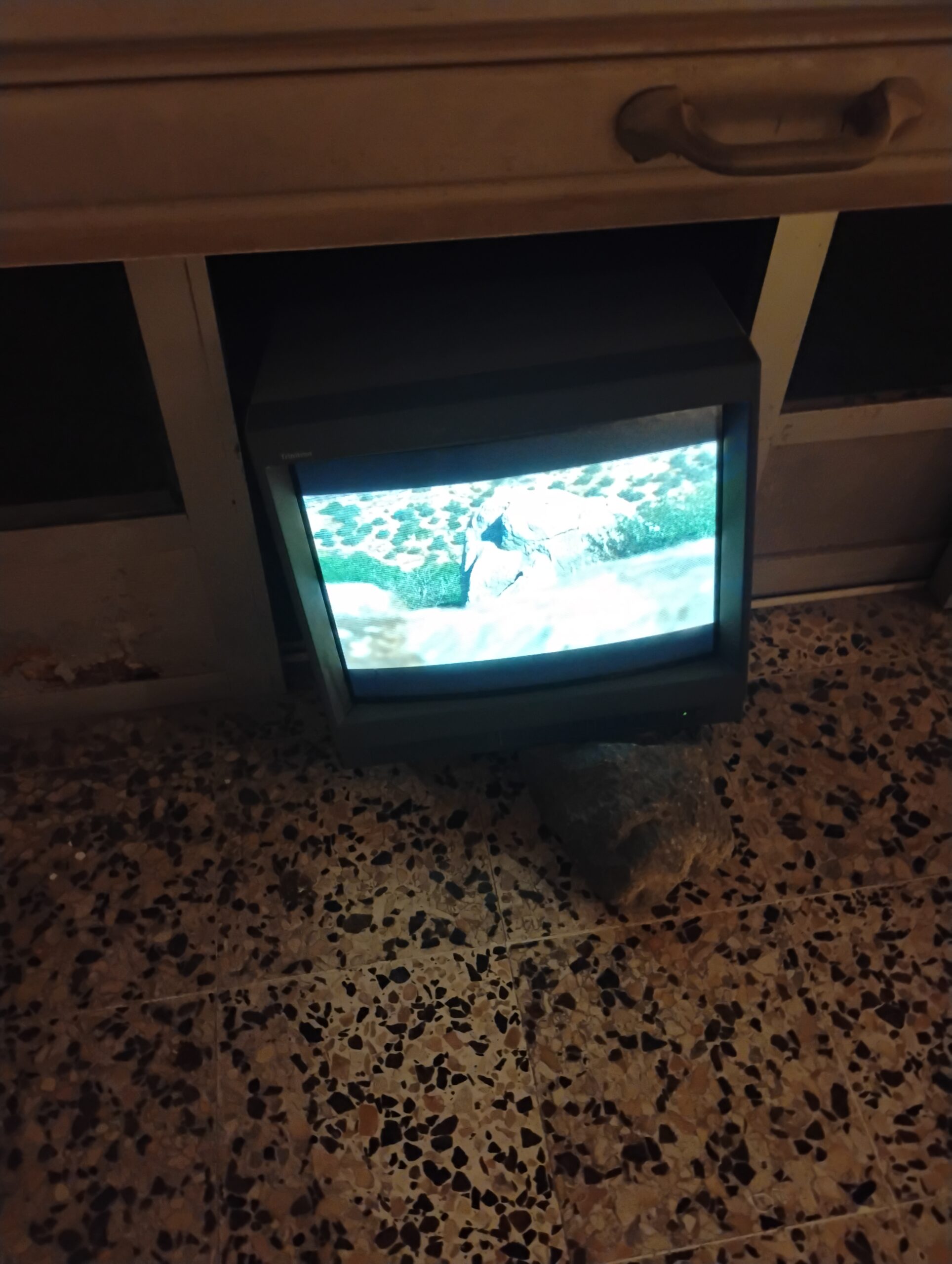
I am standing in the Old Al Jubail Vegetable Market in Sharjah watching a small television monitor, lodged beneath a half-opened metal shutter door and the ground, and propped up by a rock.
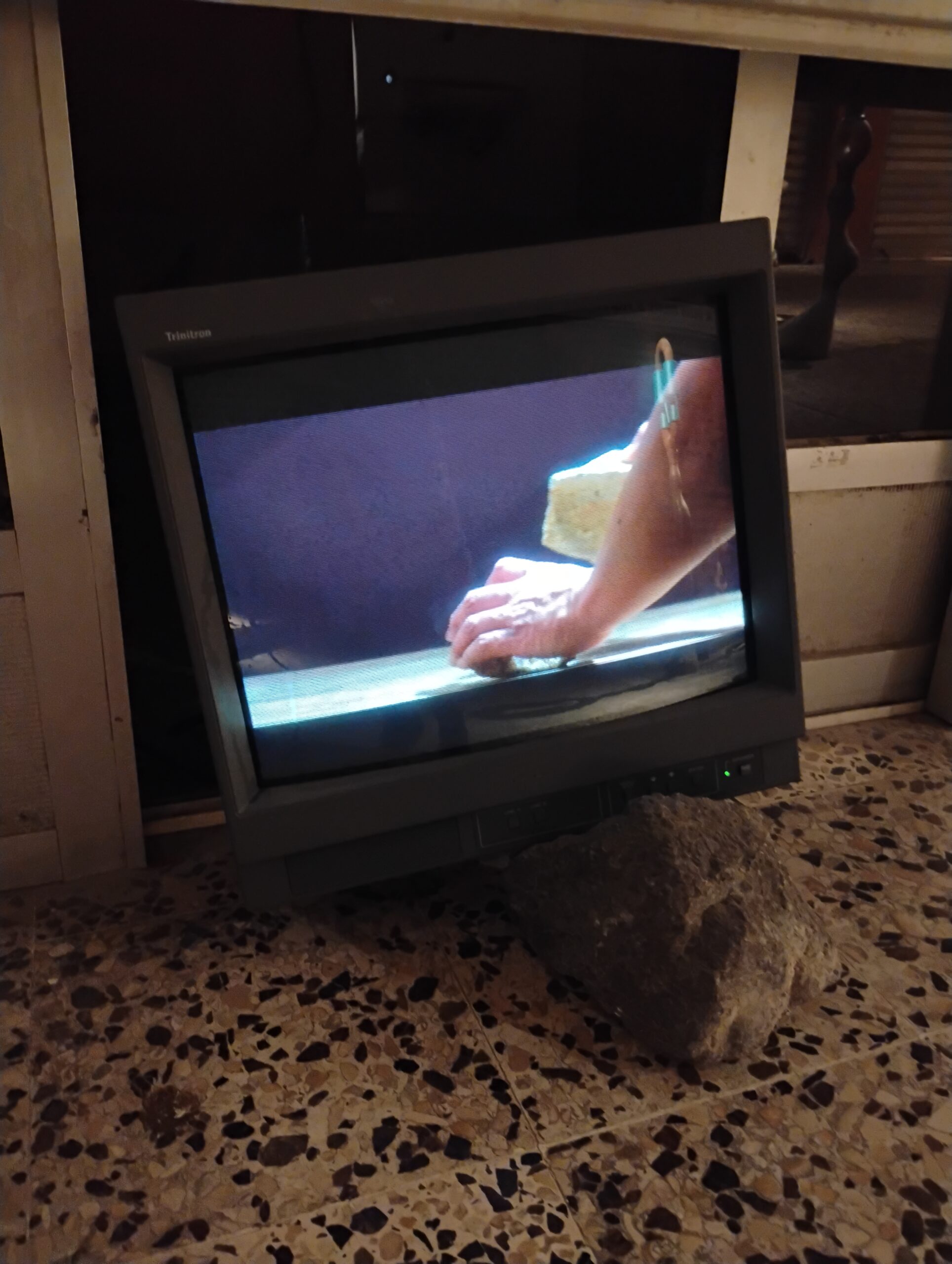
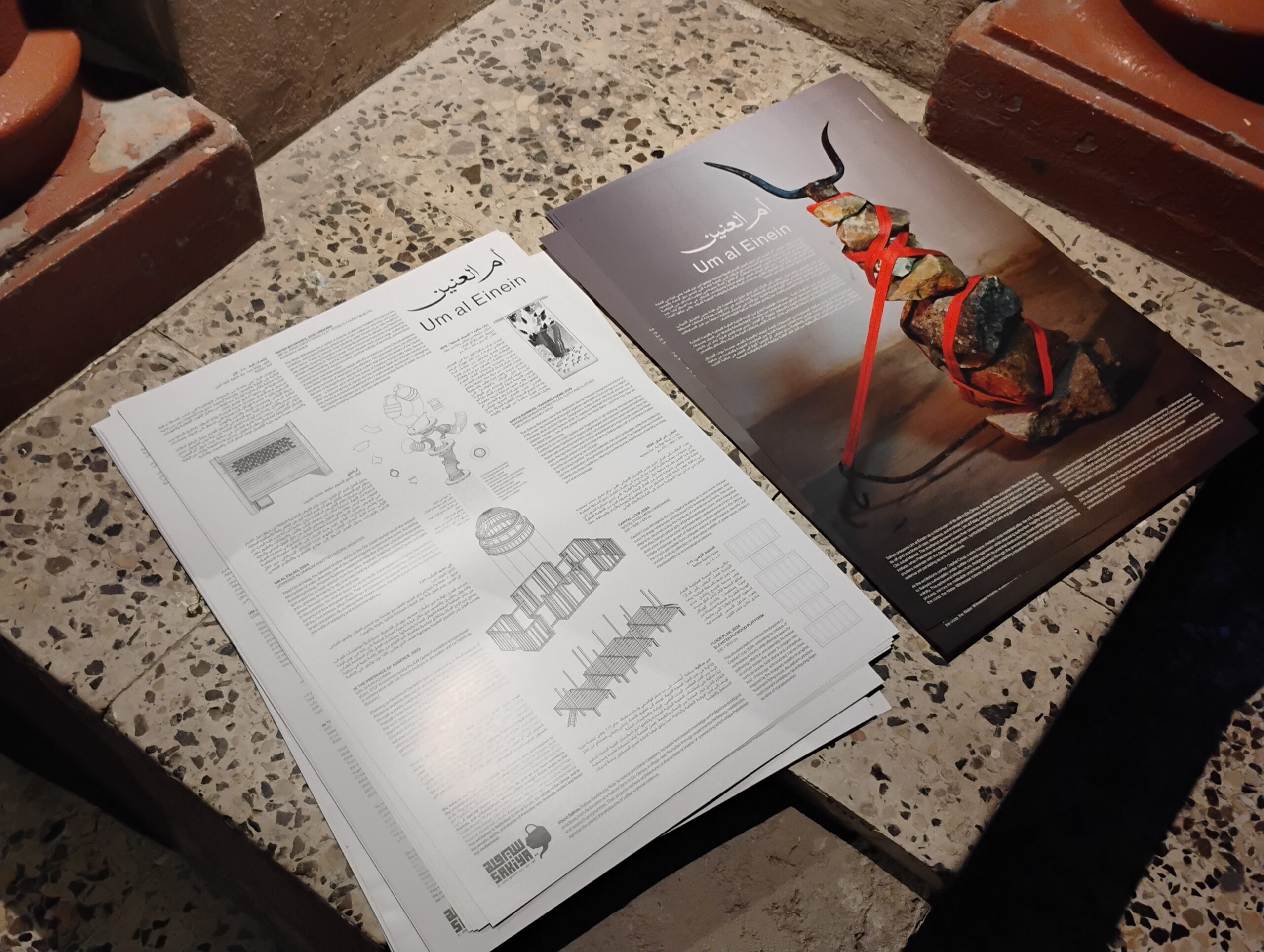
I have been taking my time this morning moving through the exhibition Um al Einein by Sakiya, an artist collective and arts-based research residency based near Ramallah, created by Nida Sinnokrot and Sahar Qawasmi. The soundtrack of the twelve-minute video I am now pausing to watch comprises a juddering pulse of music, accompanied by intermittent voices and laughter, a donkey’s bray and a rooster’s crow. It is only when I stop to watch, and listen, do I realize that the sound in this space is dominated by the noisy conversations of birds flitting through the wooden beams of the building’s ceiling above me. The video ends and before it loops back to the beginning, I take out my phone, open up a voice recorder app, and place it on the ground, leaving it there recording the video’s audio while I revisit the other works in the exhibition (click play in the SoundCloud link above to listen to what I recorded) – carrying the poster about the exhibition for supporting information, without the crutch of my phone to take pictures and videos of what I am experiencing.
The site of the exhibition has a completely distinct atmosphere compared with other venues at the 16th Sharjah Biennial, curated by Alia Swastika, Amal Khalaf, Natasha Ginwala, Megan Tamati-Quennell and Zeynap Öz. Built in the 1980s and closed down in 2015, the Old Al Jubail Vegetable Market was reopened to host the first edition of the Sharjah Architectural Triennial and has been used by both the Triennial and the Sharjah Biennial as a venue since. The gentle curve of the arcades, with the punctuation of the glass-fronted shop cubicles, still with their names written above them, creates a calming atmosphere, no doubt in contrast with the bustle and noise of a functioning market. Sakiya’s exhibition, curated by Natasha Ginwala as part of The Ancestral Well: Pulse to Terrain – her project within the biennial’s overall title and theme to carry – is one of five exhibitions that share the space, some in the central naturally-lit area (Heman Chong, Aziz Hazara), while others employed artificial lighting and projection in darkened space (Anga Art Collective, Ellen Pau). Each exhibition makes use of the interplay between the expansive central space and the individual shop units, however, only Sinnokrot and Qawasmi adjusted the found architecture of the old market by lowering the aluminum shutter doors, some completely and others partially, as with the one with the stone-supported television.
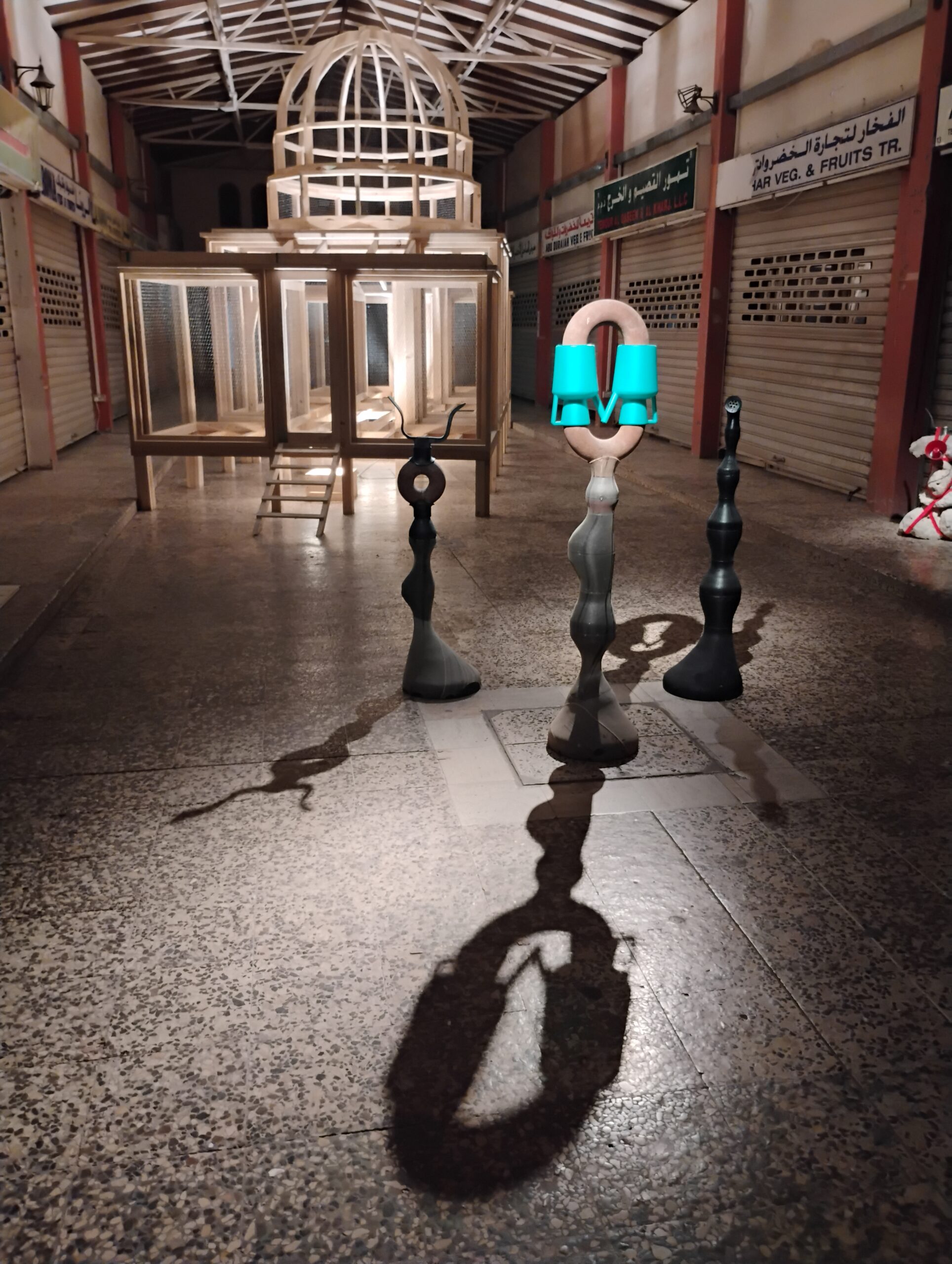
Walking back through Um al Einein, I immediately register the presence of a dense population of Water Witnesses (2020-ongoing), sculptural forms positioned on the market floor, or on a low-wooden platform or huddled together behind the glass in the only other shop space where the shutter door is slightly open.
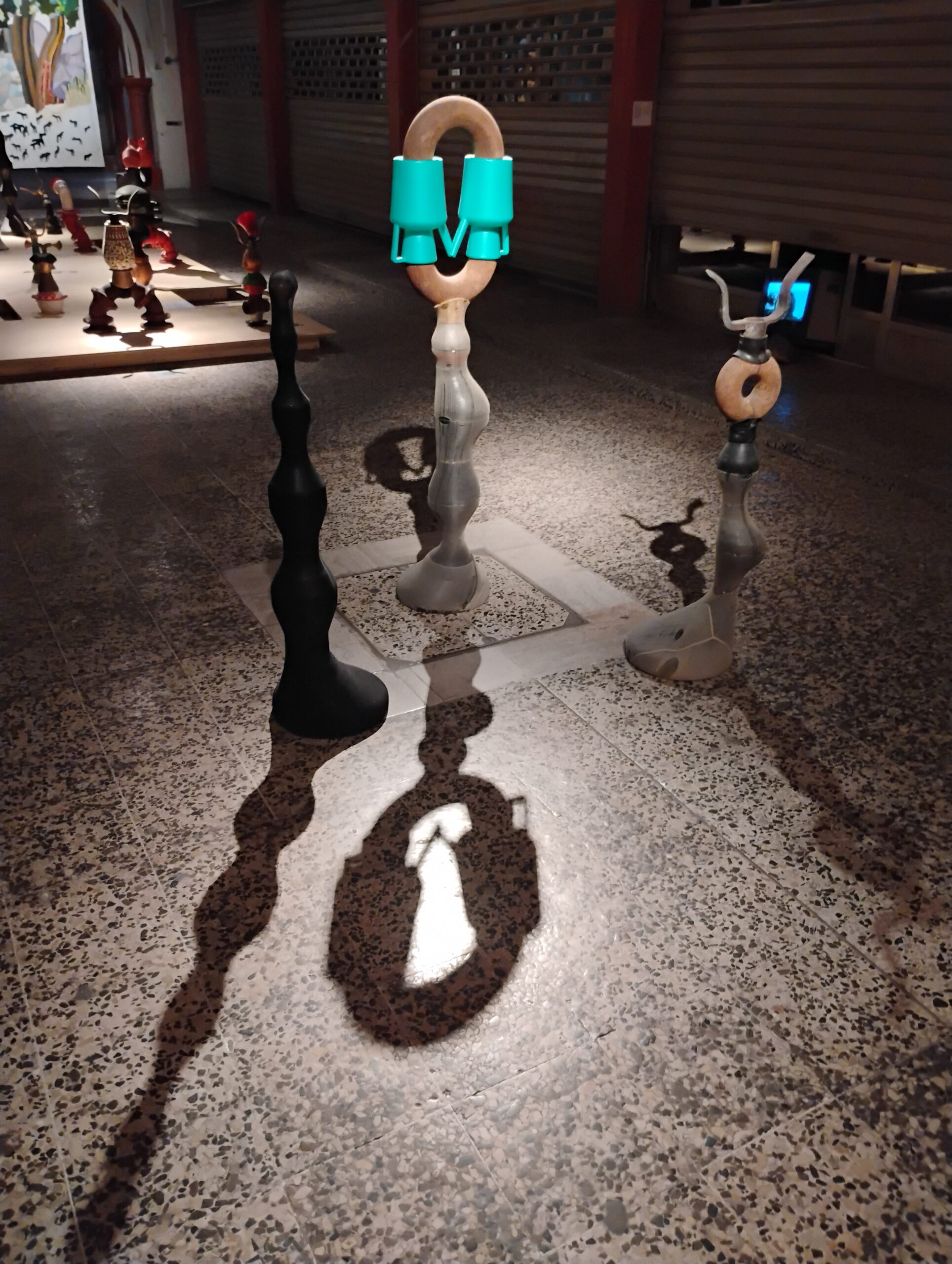
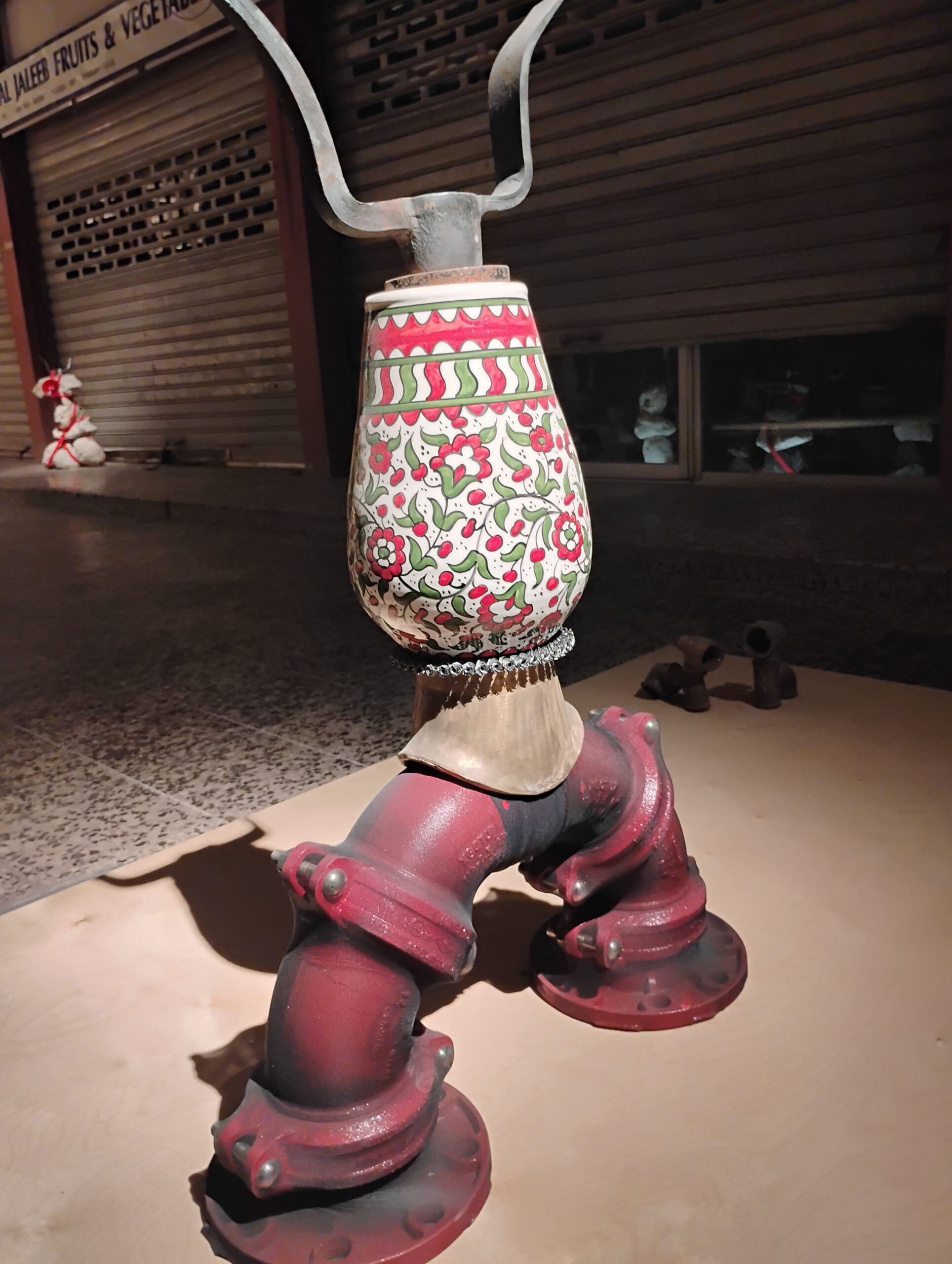
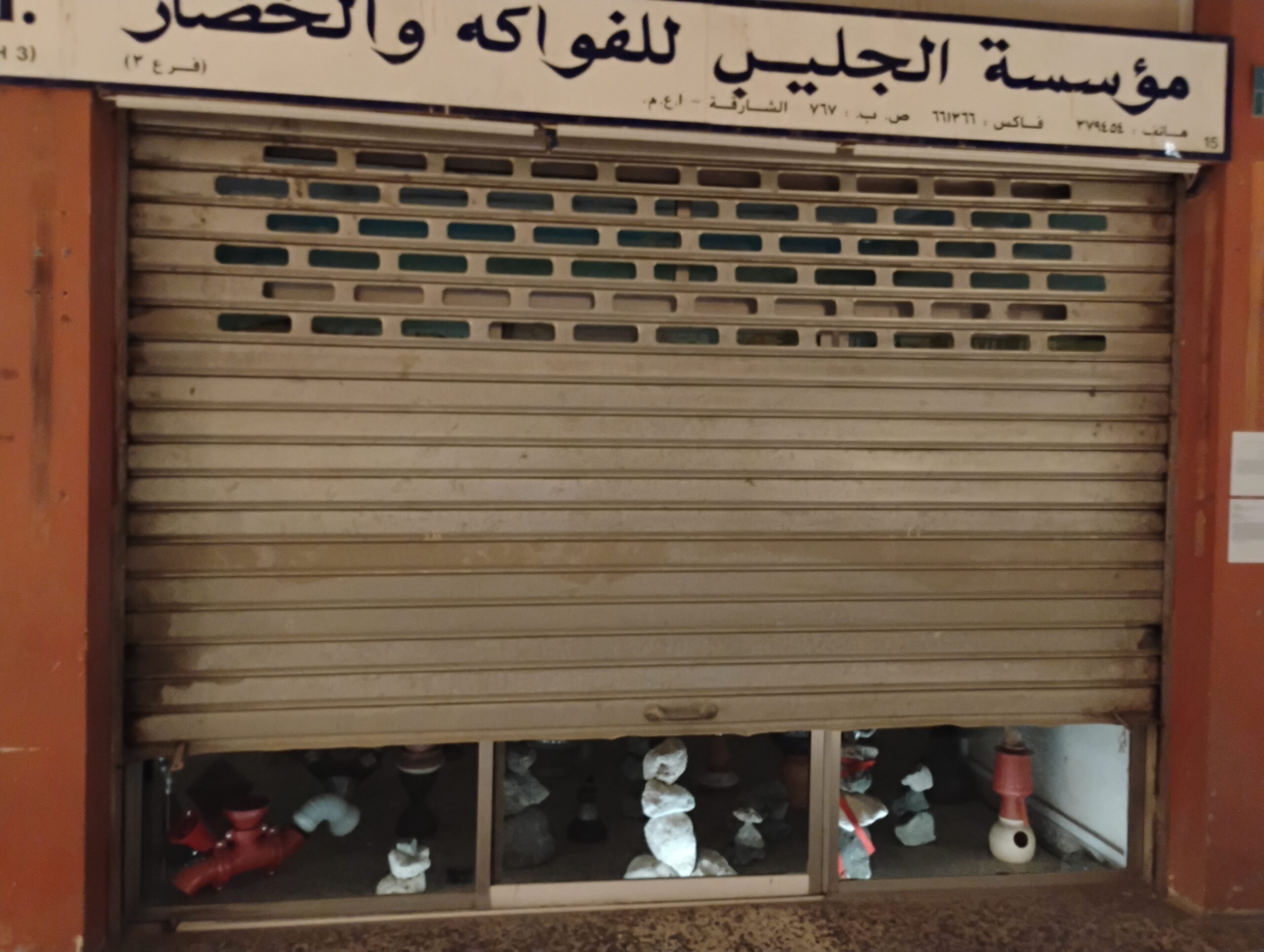
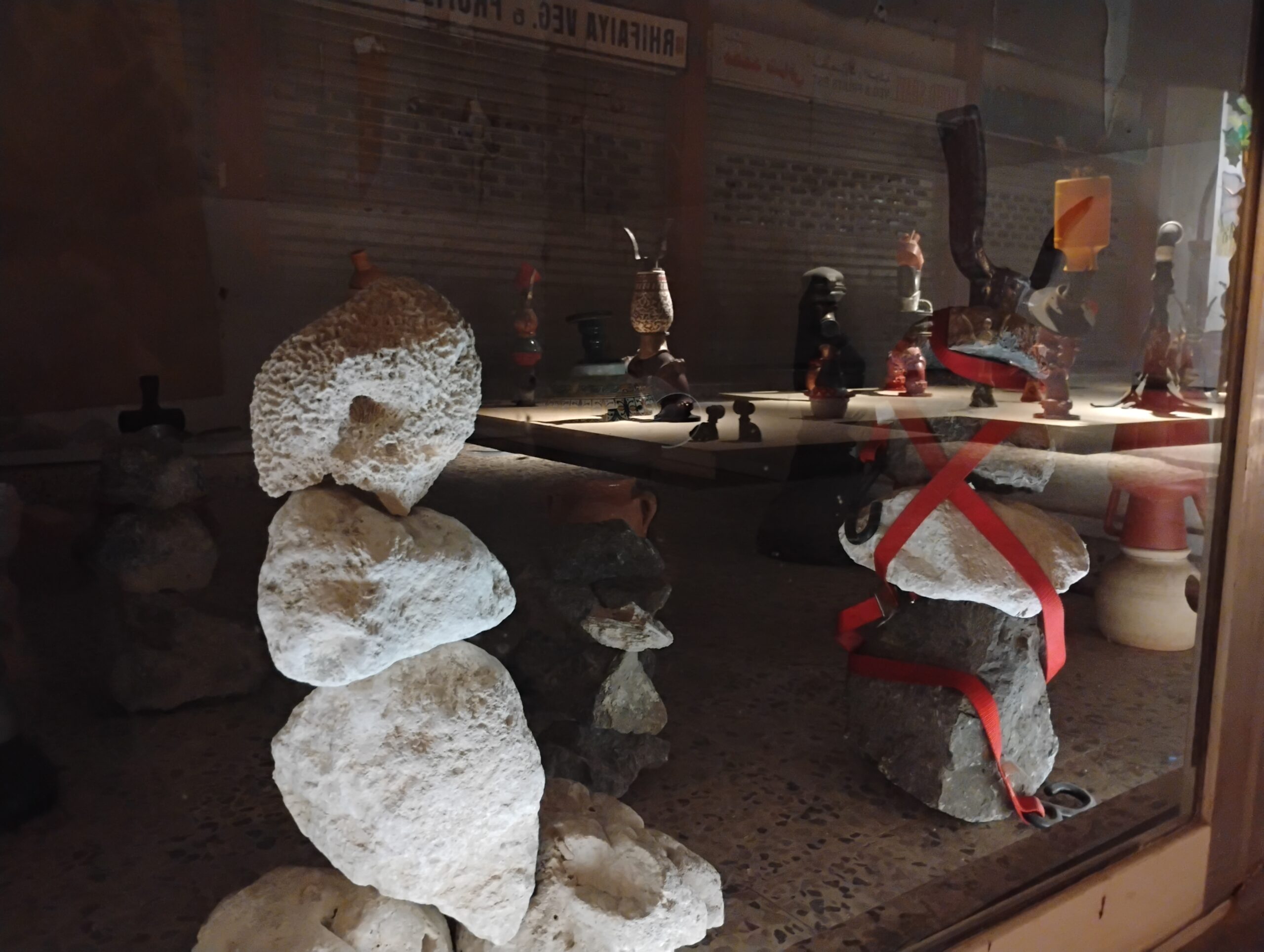
Each witness is uniquely composed of materials for industrial water infrastructure as well as traditional clay vessels, stones and other objects. Depending on their positioning within the marker, the harsh lighting from above casts shadows that meld their disparate materials into organic wholes. I am drawn to one of the Water Witnesses who stands apart and spotlit, comprising a body of piled rocks, with a head of a horn-like valve mechanism, and a clothing of red strapping. She closely resembles a sister chosen by Sinnokrot and Qawasmi to illustrate the beautifully designed poster to accompany the exhibition, although one difference is her accessory: a red megaphone.
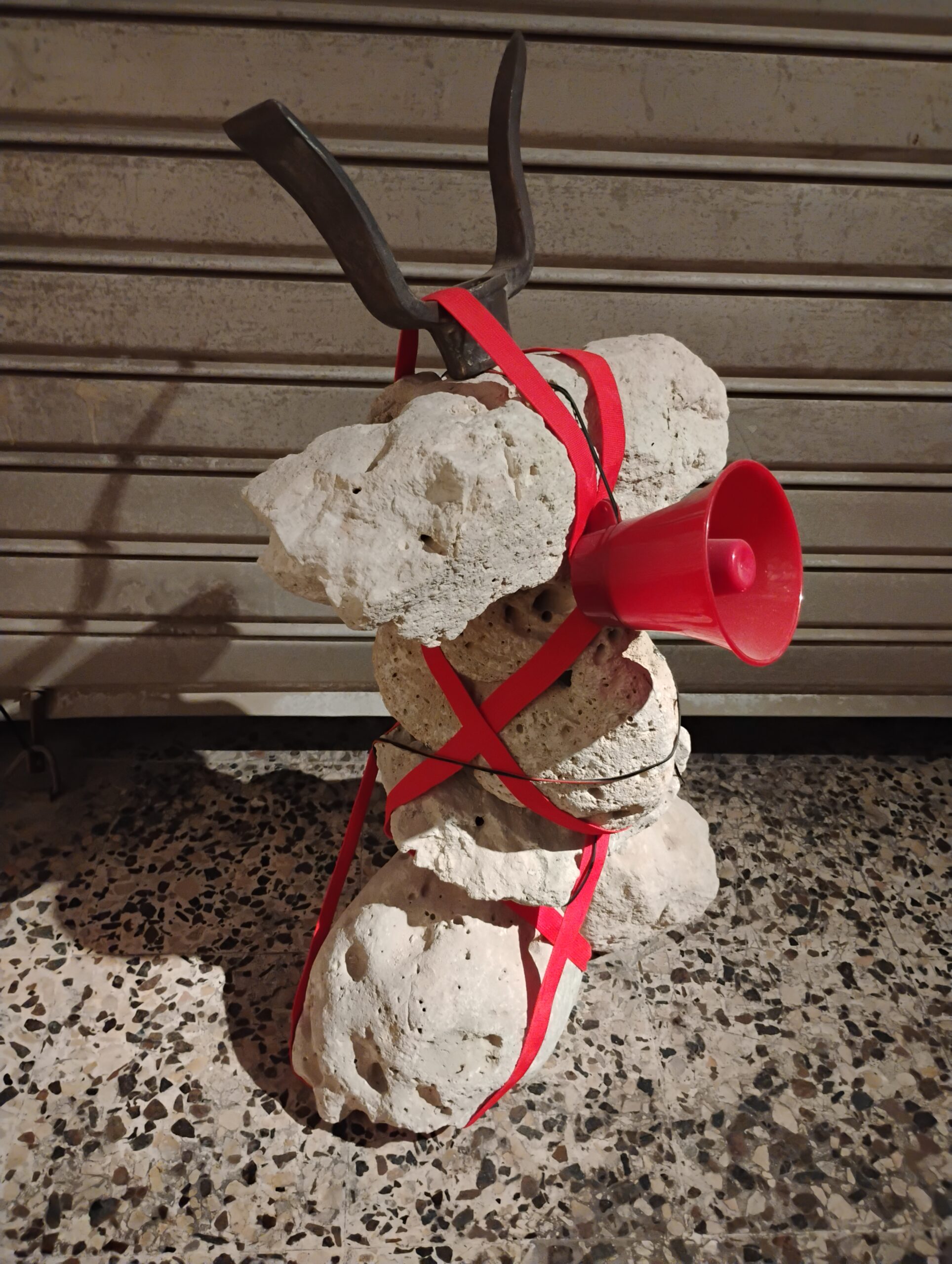
Registering this red megaphone alerts me to other Water Witnesses who incorporate this seemingly incongruous feature into their anatomy. Some are their mouths, their ears and even their feet. The association with amplified voices at protests and other forms of gatherings, immediately turns me back to the noisiest work in the exhibition, which looms over the community of Water Witnesses, loudly demanding attention and vying with the market’s architecture for space.
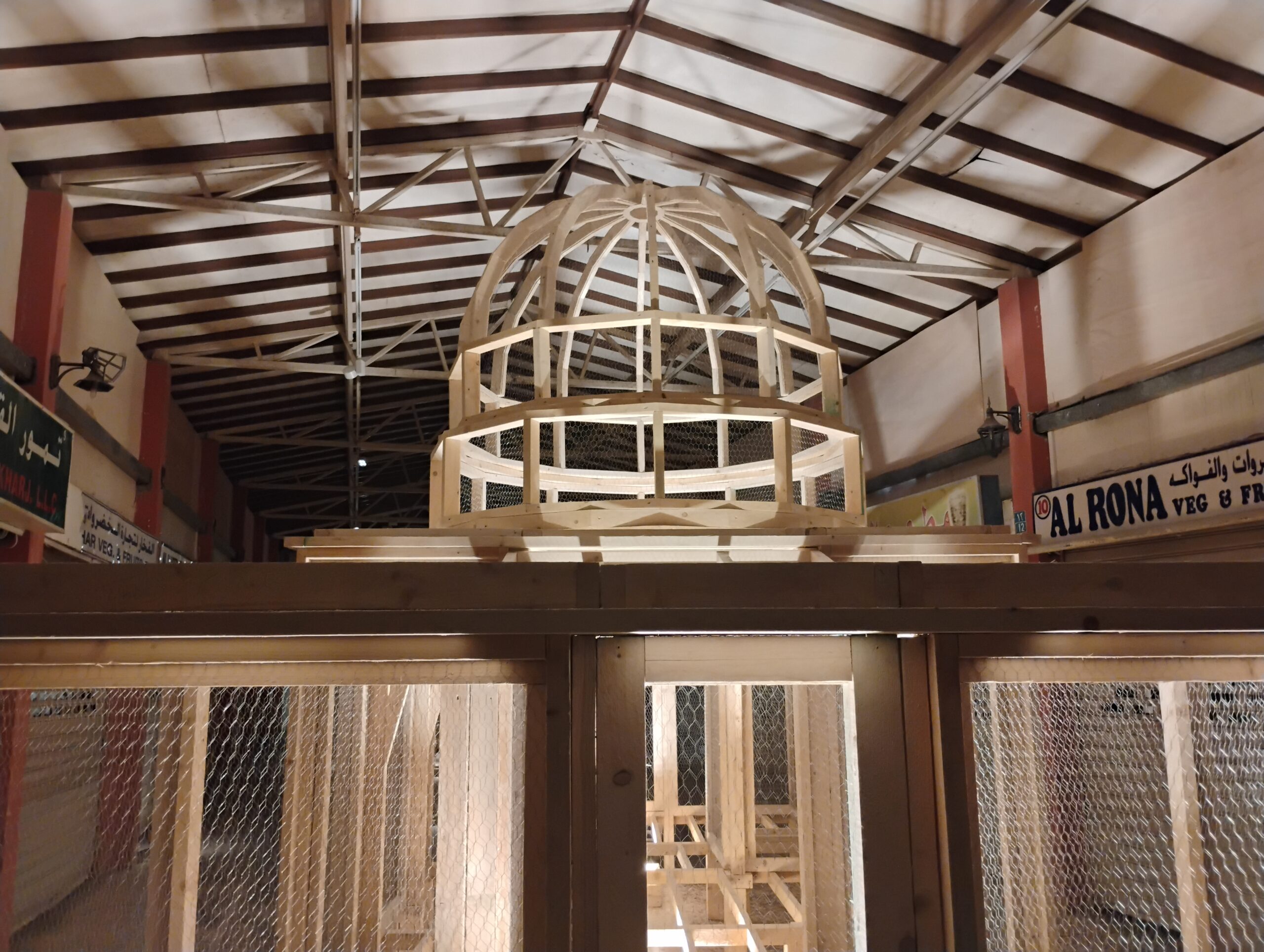
I standing gazing up at the impressive Capitol Coup (2024), a wire-frame chicken coop reproduction of the US Capitol building which, on the one hand puns on the violent insurrection of January 6, 2021, while on the other enacts a challenge to Israeli settlers who have increasingly attacked Palestinians and their means of livelihood in the West Bank, including Sakiya’s historic farm at Ein Quiniya. If settlers can desecrate mosques by turning them into chicken-coups, would they pause before destroying a structure made in the image of an iconic building of their big brother ally and their stubbornly ironclad support?
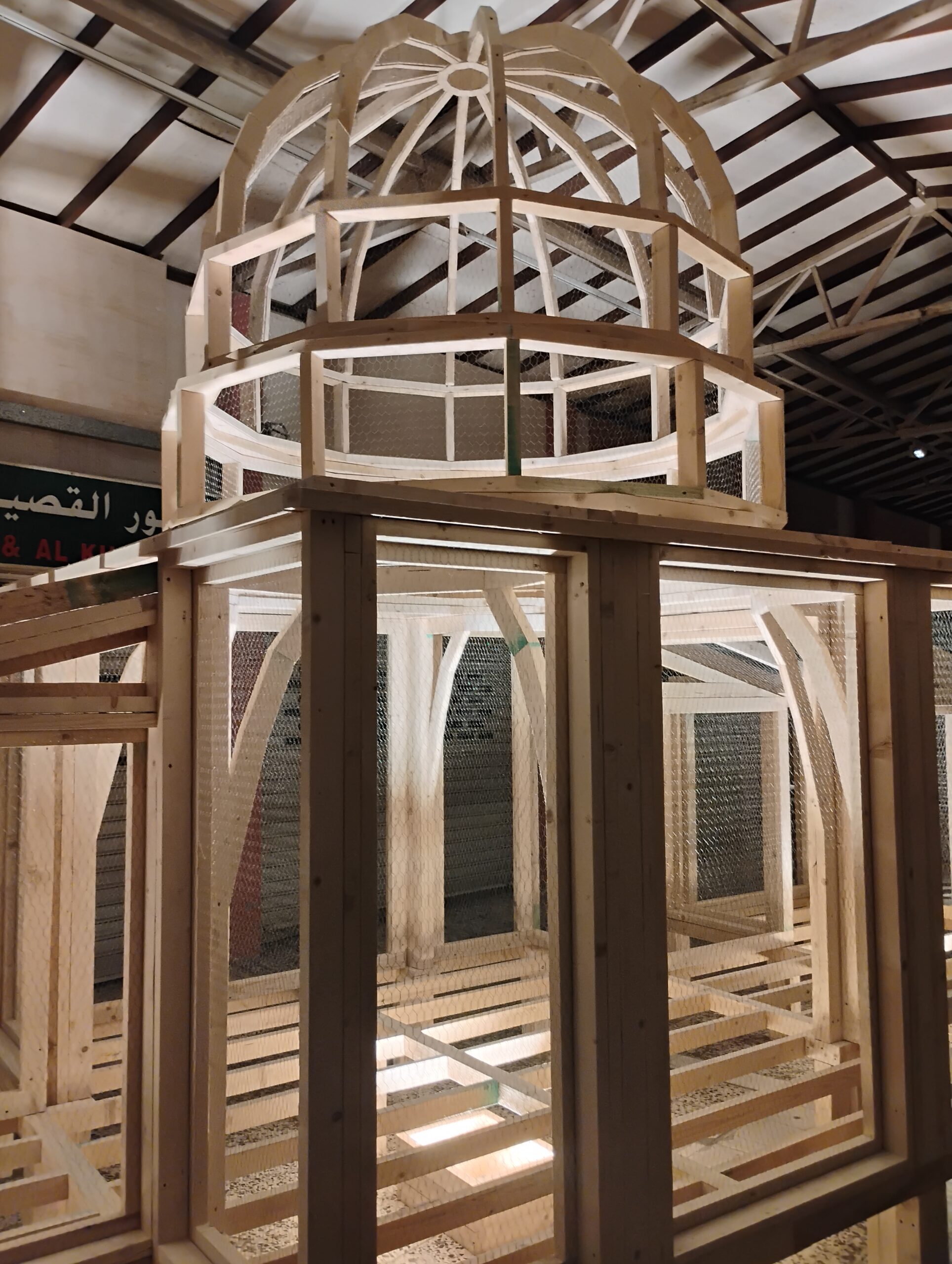
A partially unrealized component of the exhibition, which I only learned about from the poster, would have expanded this symbolism. Sinnokrot and Qawasmi named the exhibition Um al Einein after one of the Water Witnesses, which translated into English as ‘Mother of Springs/Eyes’ and was planned to stand on a plinth that would evoke the lantern of the original US Capitol dome, where stands a statue personifying Freedom. Instead, Um al Einein appears elsewhere in the exhibition, joining her brothers on a low plywood platform at the other end of the arcade.
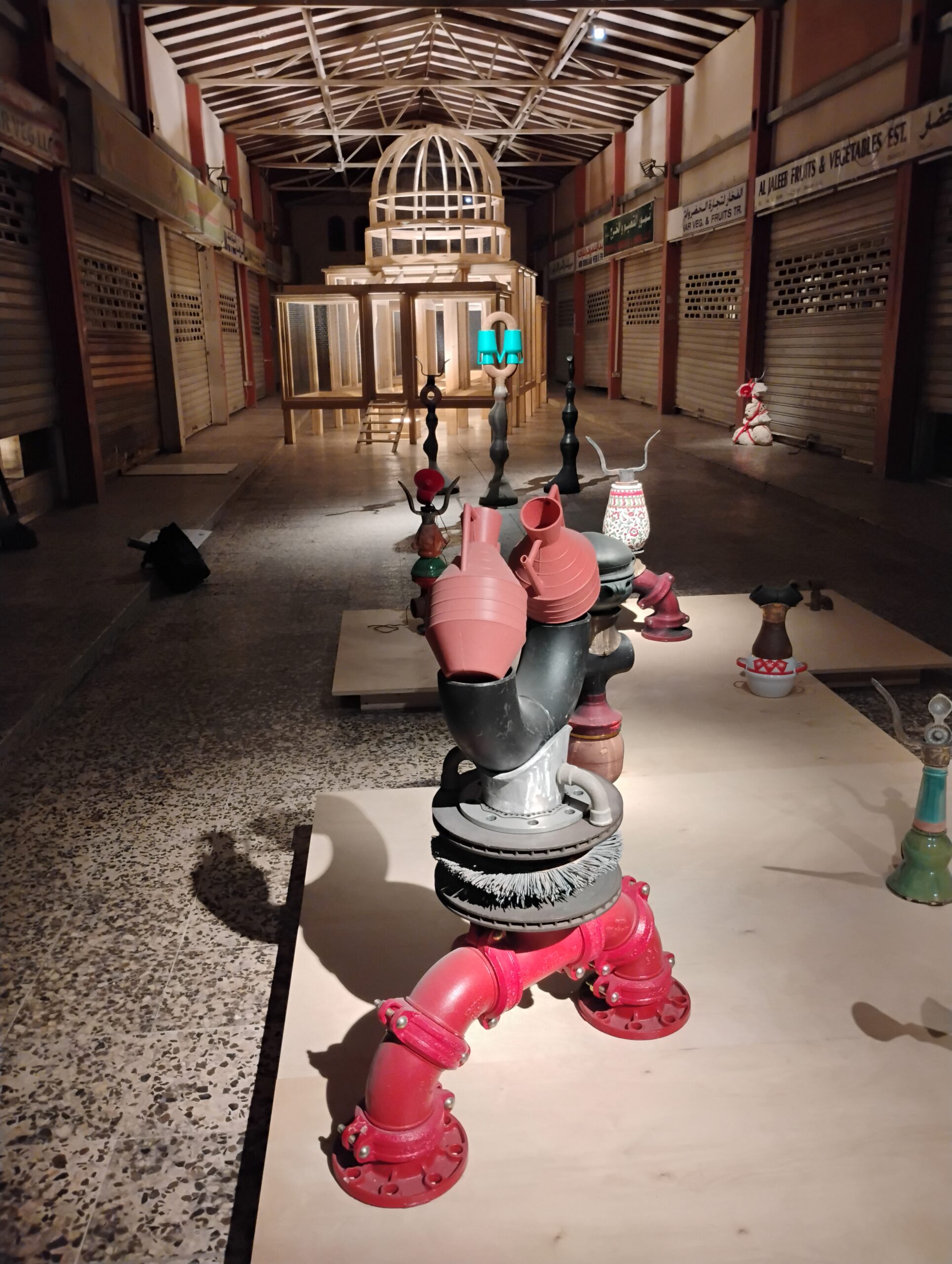
Circling back around to this modest plinth, mundanely titled Floor Plan (2024), the bombast of Capitol Coup and its simplistic political interpretations dissipate into boldly expansive and generative mythological, ecological and communal terrains that ground Sakyia’s work. Mirroring the footprint of Capital Coup, Sinnokrot and Qawasmi describe Floor Plan in their poster as:
“extending its [Capitol Coup’s] critique of centralized authority while offering a space for gathering, reflection, and assembly. Its minimal structure invites the viewer to imagine new vantage points, bother literal and conceptual, that challenge entrenched hierarchies.”
If Capitol Coup enacts practices of maintenance and care through concepts of ephemeral architecture in the face of its blunt pun evoking settler colonial violence and its monumentalizing ideologies, the plainness of Floor Plan places these practices and concepts quite literally against the land itself and the stories that sustain it. This grounding is part of a vital undercurrent in the exhibition that bridge systems and infrastructures of water and land management with ancient mythological and religious inheritance. While the Water Witnesses channel totemic forms of local deities that guard and steward the land and its people, in the poster, Sinnokrot and Qawasmi single out the figure of the Prophet Suleiman, not only for Floor Plan as an echo of his flying carpet, but the work Um al Falag as evoking his storied creation of the falaj system of water channels.
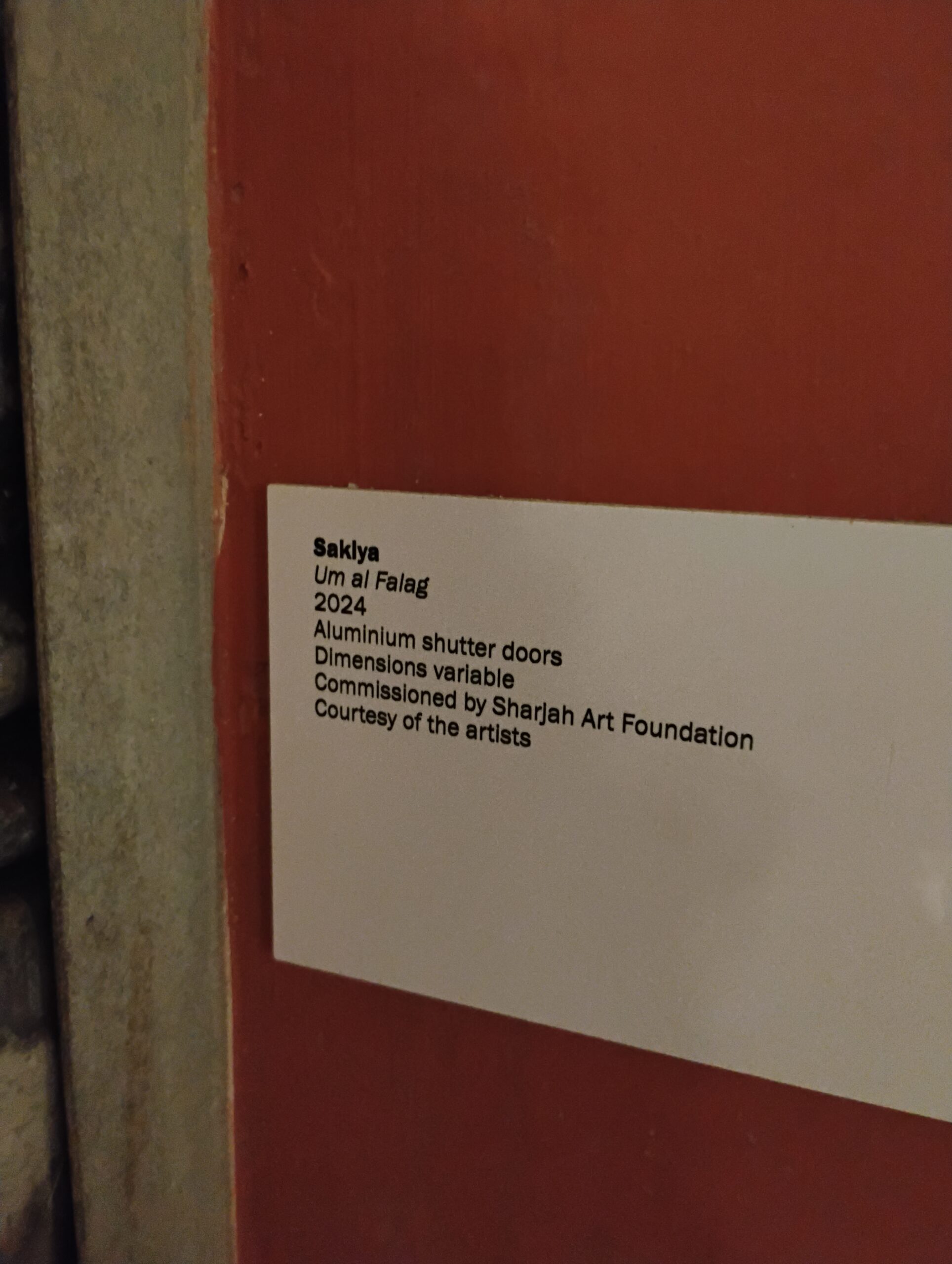
I return to the wall-text of Um al Falag, the only marker in the exhibition space that the closing and positioning of the aluminum shutter doors was even an artwork. Supplemented by their description in the poster, as with Capitol Coup Sinnokrot and Qawasmi juxtapose an overt political reference – to the shuttering of Palestinian businesses in protest during the First Intifada – with the opening and closing of the falaj water channels which the Prophet ordered “humans, jinns, animals, and birds” to dig, learning from the wisdom of rivers.
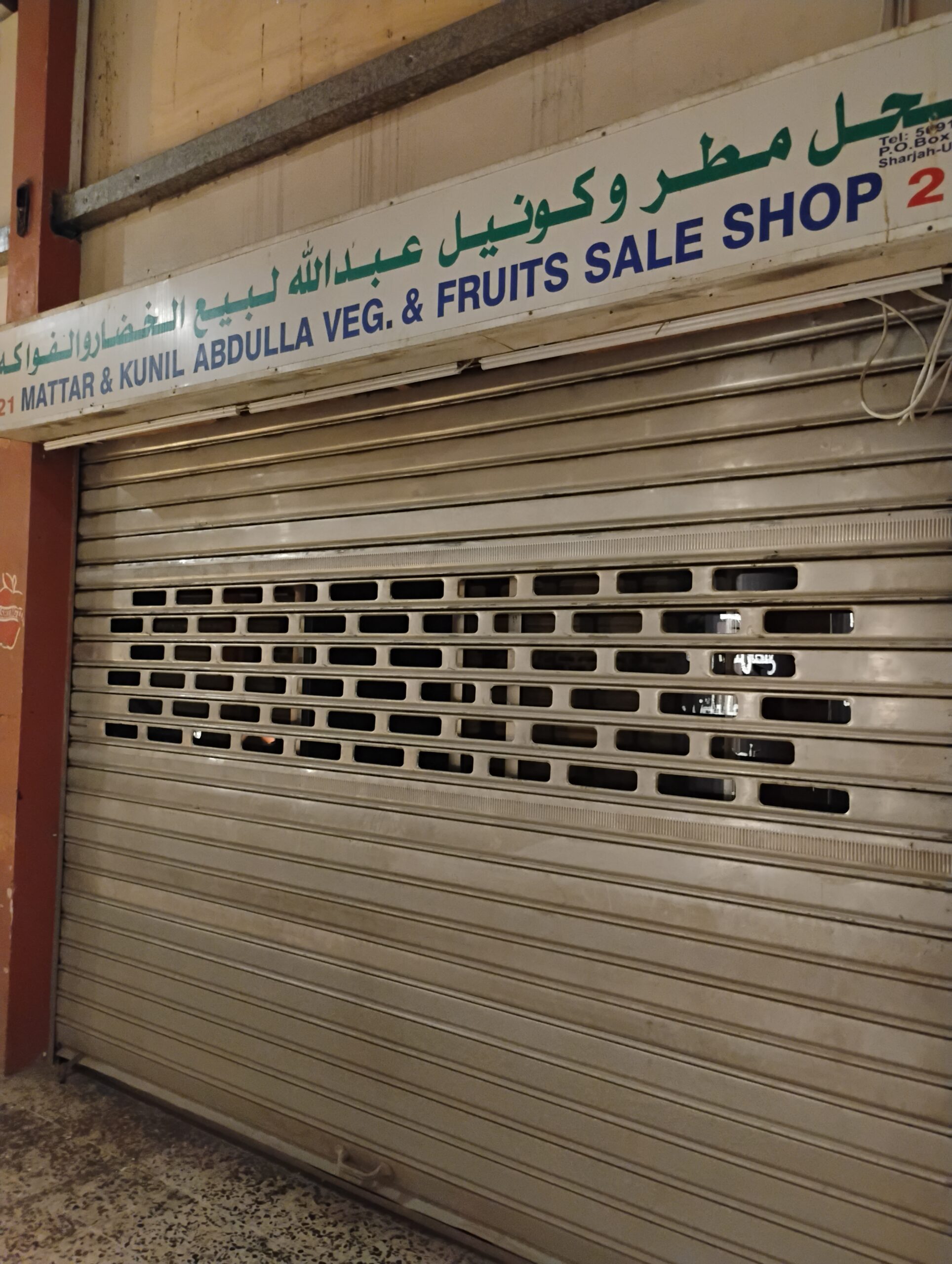
Moved by the unexpected agency of Um al Falag and a particularly loud squawk from a group of birds above me, I was reminded of the video and its soundtrack and thought that it would soon loop back to the beginning. So, I turn back to the entrance of the exhibition, and the words of poet Maya Abu al-Hayyat, embroidered in Arabic across two hanging banners in the work Sakiya Banners/Hanging Poems (2019).
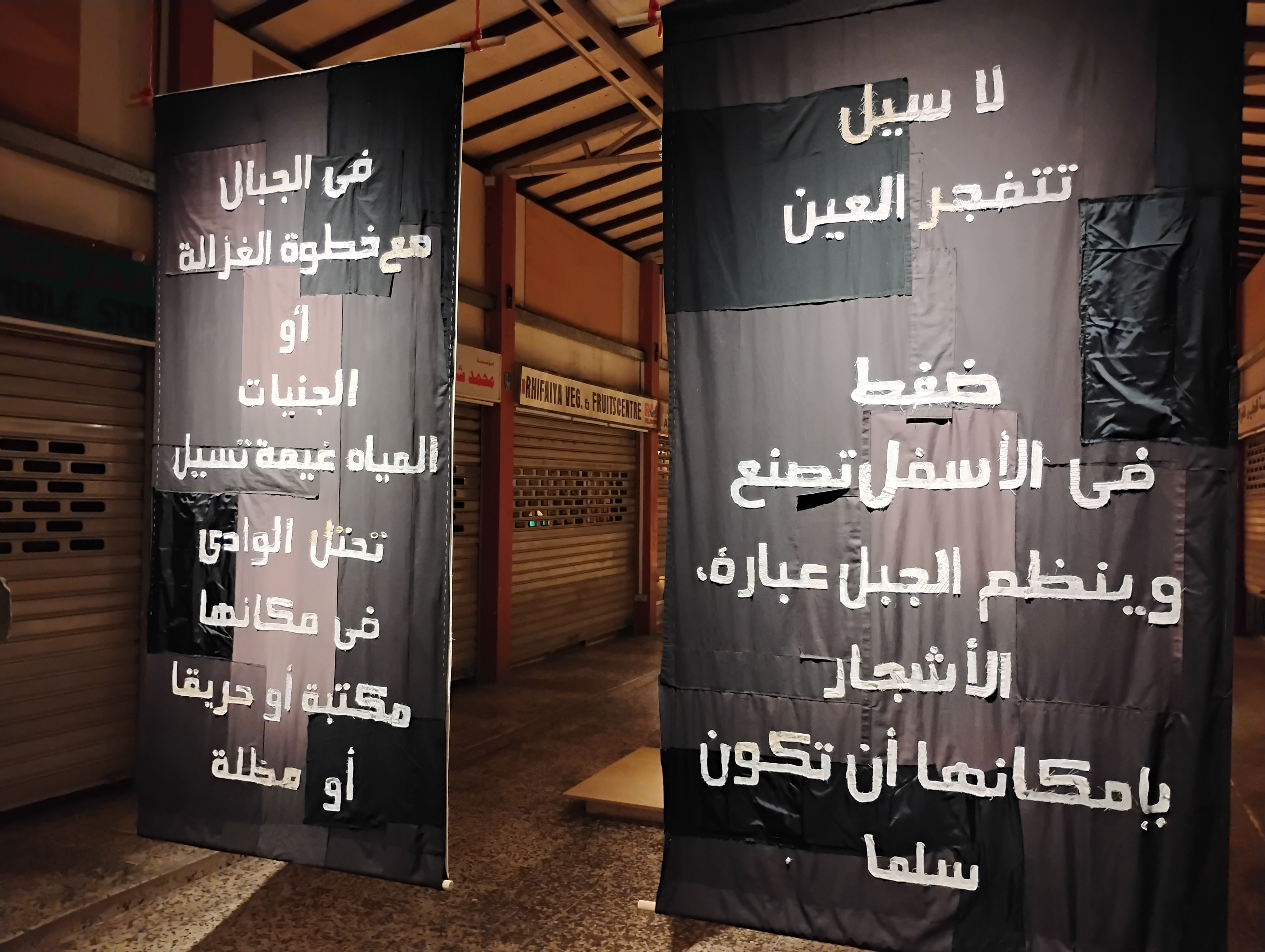
In the months before visiting Sharjah, I had been taking an Arabic class, and in honor of my patient teacher, Noor Murteza, I tried and failed to read the words before me, as I had the names and wares of the old market vendors. Thankfully in English translation was reproduced in the poster and it reads:
No torrents in the mountains.
The spring bursts forth with
the step of a gazelle
or the press of fairies.
Below, water forms a cloud that flows
and the mountain crafts a phrase
that claims the valley.
The trees remain in place
they could be a library or a fire,
a ladder or a shelter.
Musing on these words written to accompany the water of the sacred, living spring of Um al Einein at Sakyia, I turn back to the banners as I move between them into the main space of the exhibition.
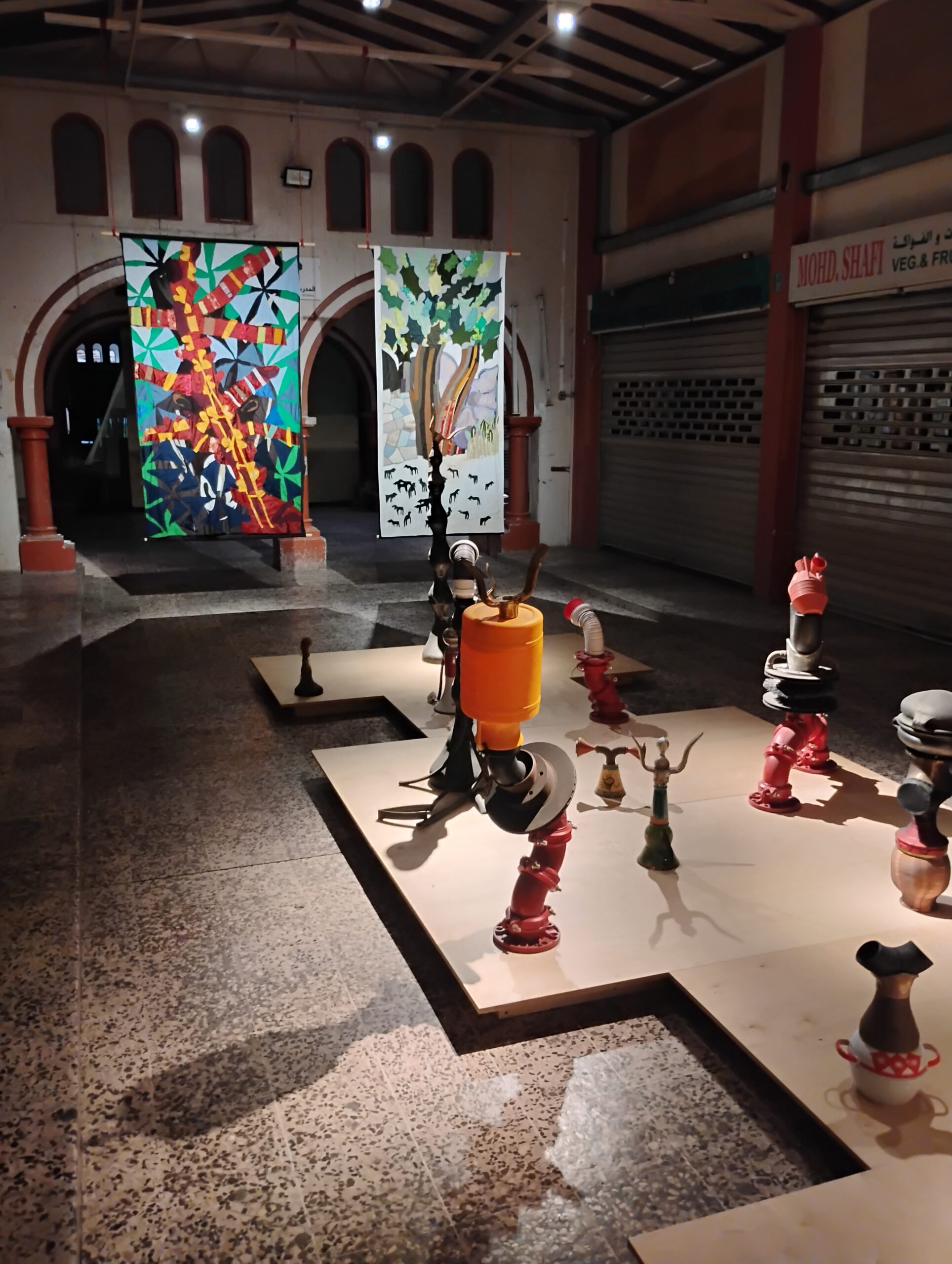
I see artist Michael Schramm’s depictions of trees and animals that he made with locals during a two-day festival to celebrate the inaugural exhibition of Sakiya in 2019, and the evocation of the trees remaining in place resonates with the whispering crowd of Water Witnesses and their shadows scattered before me, contrasting with the necessary impermanence of Capitol Coup and its noisy politics.
I drift back to the video – a work by Shuruq Harb called In the Presence of Absence (2022) after a collection of lyrical prose meditations by Mahmoud Darwish, in time for the loop to bring back the rooster’s crow and the donkey’s bray (did you hear them?). I pick up my phone and stop the recording. Pausing in appreciation of why I was even here in the first place. A year earlier at the Sharjah Art Foundation’s March Meeting under the title Tawashujat – the Arabic word for intertwining – I had witnessed a panel called ‘(Re)learning Indigeneity: Ecologies of Art, Sustainability and Resistance’, in which Sinnokrot and Qawasmi took part. They took a moment to play a section from Harb’s film (then unfinished) which depicted the shifting light on a massive boulder on the hill in Ein Quiniya.
Now the film includes sequences of hands moving smaller rocks, not unlike the one propping up the television before me. But then as now, it was the sound that stayed with me. The land, its chorus of people and more-than-human presences, seemed to whisper unasked and in a way that spoke to forms of collective care and narratives of renewal.
III
Abu al-Hayyat’s poem woven into the tapestry of Sakiya’s exhibition brought me back to the ‘black irises’ of Darwish’s ‘To the Reader’ and also sent me away to another Darwish poem: ‘Standing Before the Ruins of Al-Birweh’. This is a later poem, only published after the poet’s death which I only recently read in the anthology A Map of Absence: An Anthology of Palestinian Writings on the Nakba: Unlike the youthful ‘To the Reader’, this poem thrums with a menacing emotional quietness. The poet refuses his anger and himself (“I shut the door to my emotions to become my other”), adopting personas of the tourist and journalist, while opening out to the land and more-than-human existences: a stone sighing for a cloud, butterflies carrying a path to his old school, a gazelle breaking the glass of a window. The spring of Um al Einein bursting forth “with the step of the gazelle” in Abu al-Hayyat’s poem, reminding me of the opening lines of Darwish’s poem:
Like birds, I tread lightly on the earth’s skin
so as not to wake the dead
There is a whole section of the recent and stunning anthology Heaven Looks Like Us: Palestinian Poetry, edited by George Abraham and Noor Hindi, called ‘ the Whole Air the Path of the Gazelle’, where I found the Fady Joudah poem referenced earlier and which includes Naomi Shihab Nye’s dazzling poem ’19 Varieties of Gazelle’ – which not only gives the section its name, but also this line that stretches out this animal’s whispered significance: “There is no gazelle/in today’s headline.” The banners in the exhibition, like gazelles in a Palestinian poem, have a quiet function that counter the noisy political reduction of Palestinian life to suffering and oppression, by listening out for the land, and the whispering work of many hands for them to be made and used in rituals of gathering, for processions and to adorn shrines.
I remember this whispering work today as forced starvation in Gaza speaks through Darwish’s anger when writes that he has ‘shaken hands with banishment and hunger’. I am drawn back to the pages of The documenta 14 Reader’ and the folio “What color is hunger? What color paper?”. The third issue of the South as a State of Mind magazine, which became a publication of documenta 14 for four issues, was devoted to the topic of ‘language or hunger?’, including Natasha Ginwala’s moving essay ‘So Many Hungers’. The first essay after the editors’ introduction, called ‘Enfleshment of Memory’ by Neni Panourgiá, speaks as clearly today as when it was originally written ten years ago:
Hunger is, indeed, a man-made disaster (increasingly a woman-made one, too). Whether it is the result of environmental catastrophes or war—military or financial—matters little. As a result of the war in Syria, the seed bank of ICARDA (International Center for Agricultural Research in the Dry Areas) in Aleppo, fearing that it might lose its collection of seeds specially adapted to arid environments, recently requested replacements from the Svalbard Global Seed Vault in the Norwegian Arctic. This is the first time that Svalbard has agreed to release seeds—because the threat to ICARDA’s collection is not unsubstantiated. Seed banks in Afghanistan and Iraq have been devastated by the recent wars there. But what about financial wars? “You don’t eat much,” the young man said to his even younger guest, a girl not yet out of high school, as painfully thin as a rail. “There are some days when my father doesn’t even make two euros at his shop, so there are times that we go for two or three days without food at home and my stomach has shrunk; I can’t eat much.” Her response was as matter-of-fact as a butcher’s knife. Words spoken in Greece in the summer of 2015.
Now seeds from Gaza have been added to the seed vault (you can learn more about other Palestinian seeds there thanks to Jumana Manna’s film Wild Relatives) and the forced starvation has reached unprecedented levels. This is why we need the work of Sakiya more than ever, wherever we can find it, in whatever form. Because today, while we should never ask Palestinians to whisper, when they quietly show us the way they listen out for their land, we must be more than readers and join them as accomplices in a rooted pedagogy that binds us all.
[This post is part of the experimental radio show called A Curriculum of Imposters: Here & Now, There & Then, On & On that reflects on the creation, production & reception of the exhibition documenta 14 within ongoing learning contexts at a public land-grab university]